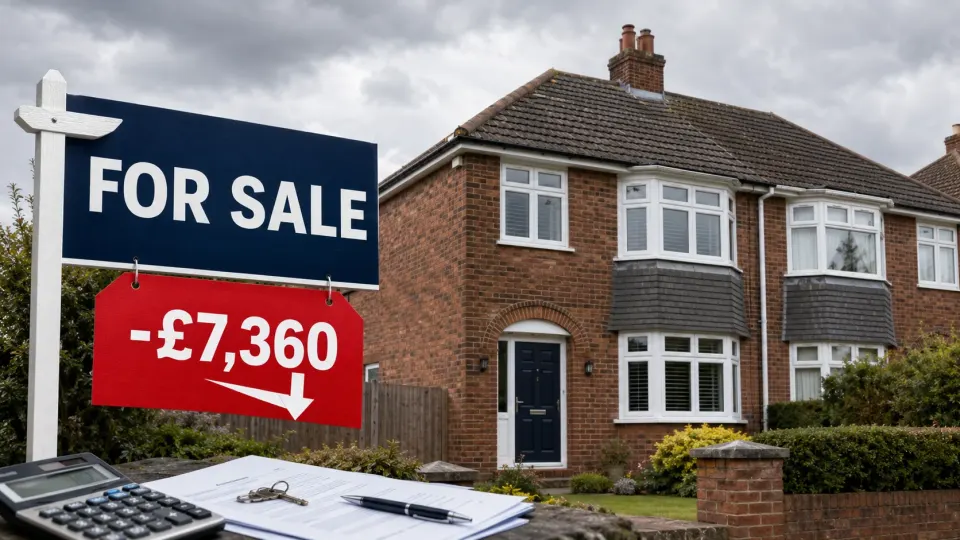
Britain’s housing market has received an unexpected software update.
For years, the system operated on one simple principle: whatever your house was worth yesterday, add another twenty grand and describe the kitchen as contemporary.
A railway line at the bottom of the garden? Excellent transport links.
A bedroom too small for a bed? Ideal home office.
A conservatory colder than a butcher’s freezer? Versatile additional living space.
Unfortunately, buyers have now looked at the prices, checked their wages and discovered that the numbers no longer belong to the same economy.
According to Rightmove’s latest House Price Index, the average asking price of a newly listed home dropped by 2% in August.
That is a reduction of £7,360 in a single month, taking the national average down to £364,999.
It is the largest August fall since 2018.
Apparently, even the British property market can eventually encounter gravity.
THE GREAT BRITISH PROPERTY DELUSION MEETS A CALCULATOR
To be clear, these are asking prices, not completed selling prices.
An asking price is the amount a seller would like somebody to pay.
A selling price is what eventually remains after a buyer, a mortgage lender, a surveyor and a suspicious relative have all taken turns pointing at the damp patch behind the wardrobe.
But asking prices matter because they reveal what sellers believe buyers might realistically afford.
And that belief appears to be undergoing what estate agents would describe as a substantial downward adjustment with excellent potential.
The average two-year fixed mortgage rate has climbed to around 5.09%, according to Rightmove, compared with 4.95% last month.
That difference may look small until it is applied to a mortgage large enough to purchase a three-bedroom house, at which point it becomes several cancelled holidays and a lifelong relationship with supermarket own-brand beans.
Buyers are not merely deciding whether they like the kitchen.
They are calculating whether buying the kitchen means they can still afford to eat in it.
SELLERS HAVE ACQUIRED COMPETITION
There are also more homes available for sale at this point of the year than at any time since 2014.
This presents sellers with a difficult new concept: choice.
When five similar properties are available on the same road, buyers no longer need to throw themselves through the front door waving a mortgage agreement before somebody else reaches the utility room.
They can compare prices.
They can ask questions.
They can even leave a viewing without immediately offering £15,000 above asking because the estate agent claims another buyer is “extremely interested”.
More homes on the market means sellers must compete on price, presentation and condition.
Adding a grey sofa, a bowl of decorative wooden balls and a framed sign saying Live, Laugh, Love may no longer be sufficient.
THE NORTH AND SOUTH ARE NOW USING DIFFERENT PROPERTY MARKETS
The national figure also disguises a growing regional divide.
Rightmove says asking prices in northern England are approximately 1.5% higher than a year ago, while London and southern England have been placing much greater downward pressure on the national average.
This is partly because northern prices generally remain closer to the amount an ordinary human can borrow without selling one of their kidneys.
Across parts of southern England, buyers are still being invited to spend half a million pounds on a modest semi-detached house because it has a train station somewhere within the same postcode.
The pandemic-era rush for space, years of cheap borrowing and a chronic shortage of housing helped push prices far beyond wage growth.
Mortgage rates then rose, household bills increased and buyers were handed the full cost of that optimism.
The result is not one national property market but several completely different ones wearing the same Rightmove logo.
ESTATE AGENTS PREPARE THE EMERGENCY VOCABULARY
Falling prices will require Britain’s estate agents to deploy their most powerful language.
“Reduced” will become new price.
“Unsold for six months” will become unexpectedly reavailable.
“Vendor beginning to panic” will become motivated seller.
And “nobody is paying £425,000 for this” will become priced to attract immediate interest.
Properties requiring complete renovation will continue to offer “an exciting opportunity to create your dream home”, because “the previous owner has removed everything except the supporting walls” apparently lacks warmth.
None of this means buyers suddenly hold all the power.
Good homes in desirable areas can still attract strong competition, and the cost of moving remains enormous once deposits, mortgage fees, surveys, solicitors and stamp duty have finished feeding.
It does mean sellers can no longer assume that listing a property automatically produces a queue of desperate buyers and a small bidding war by Tuesday afternoon.
ASKING PRICES ARE NOT COMPLETED HOUSE PRICES
This distinction is important.
Rightmove measures the initial asking prices of properties when they are newly listed. It does not measure the final amount paid when a sale completes.
Completed-price indices from the Land Registry and mortgage lenders cover a different part of the process and can move differently.
Asking-price data is useful because it provides an early indication of seller confidence and current market conditions.
But it does not mean every British home has suddenly lost exactly 2% of its value.
Some properties will fall further.
Some will remain unchanged.
A particularly desirable home will still be purchased within fourteen minutes by somebody whose parents have mysteriously found £120,000 behind the sofa.
The headline figure represents an average across a large and wildly uneven market.
BUYERS ARE INTERESTED — AT THE RIGHT PRICE
There is some better news for sellers.
Rightmove reports that buyer demand has recently increased, suggesting people still want to move but are becoming more selective about what they will pay.
That is an important difference.
Demand has not disappeared.
It has simply acquired a calculator.
A realistically priced property in good condition can still sell. An ambitiously priced property requiring a new roof, boiler and minor exorcism may remain online long enough to celebrate several birthdays.
Rightmove has reportedly reduced its forecast for asking-price growth in 2026 to somewhere between zero and minus 2%, reflecting weaker affordability and the growing number of homes competing for buyers. The wider figures were also reported by Reuters.
That is not necessarily the beginning of a dramatic housing crash.
It is a market being forced to acknowledge that people cannot indefinitely pay rising prices with wages that have failed to follow them.
REALITY HAS BOOKED A VIEWING
For sellers, the message is relatively simple.
Price the property according to today’s market, not according to what somebody down the road allegedly received during the cheap-mortgage frenzy.
For buyers, falling asking prices may create more room to negotiate, but higher mortgage costs can easily consume the saving.
And for estate agents, it may finally be time to accept that placing a wide-angle lens in the corner of a bathroom does not make it the size of a leisure centre.
Britain’s homes have not suddenly become worthless.
Buyers have simply become less willing—or less able—to fund the fantasy.
Reality has arrived for a viewing.
It has checked the roof, inspected the boiler and offered £25,000 below asking.
Sources
- Rightmove — August 2026 House Price Index
- Reuters — UK asking prices record their biggest August fall since 2018