You find the ticket. You compare the price. You decide it is just about affordable and begin the small online pilgrimage through names, dates, addresses, passwords and card details.
Then the price changes.
There is a booking fee. A digital fee. A service fee. A resort fee. A local tax. A transaction fee for the privilege of completing the transaction the company invited you to complete.
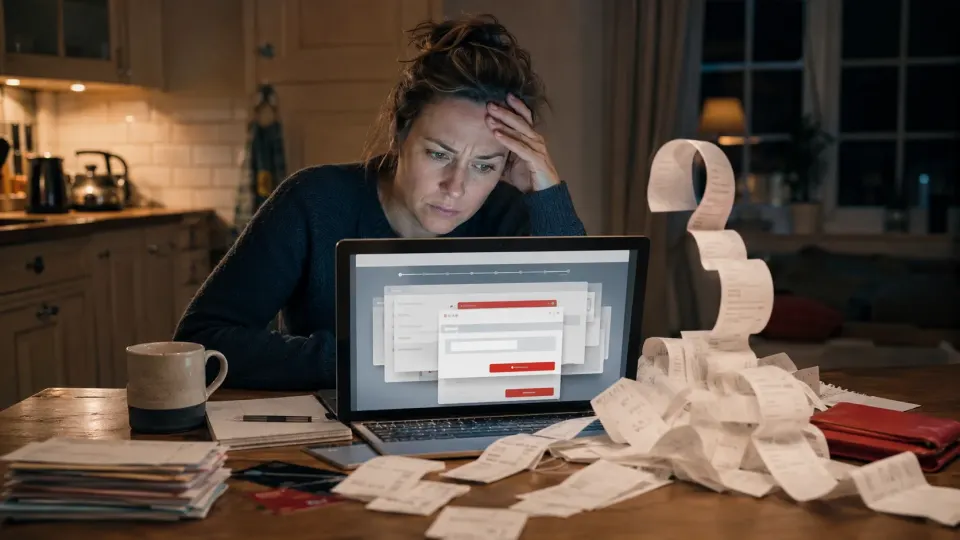
By the time the website reveals the real total, you have spent ten minutes, selected your dates, entered half your family history and developed an emotional attachment to a train leaving at 14:37.
This is called drip pricing. It is the commercial art of advertising one number and slowly introducing the number you will actually pay after you have invested enough time to resent starting again.
And according to official research, it may be persuading UK consumers to spend as much as £3.5 billion more online every year than they intended.
That is the upper end of a modelled range—not £3.5 billion counted in a giant vault beneath an online checkout—but it is still the equivalent of almost £9.6 million a day.
Apparently the most profitable part of modern shopping is the bit where the price develops additional limbs.
THREE CHECKOUTS ARE NOW UNDER THE MICROSCOPE
On 19 August, the Competition and Markets Authority opened formal investigations into Trainline, Virgin Atlantic and RED Driving School.
The questions are specific:
- Trainline: The CMA is investigating whether all mandatory charges were included in the prices initially displayed to people buying advance train and coach tickets. The regulator says it observed train transactions carrying fees from 59p to £2.79, plus a £1.50 coach-booking fee.
- Virgin Atlantic: The investigation concerns whether mandatory resort fees and local taxes were included upfront in prices for package holidays. The CMA says these charges vary and can add hundreds of pounds.
- RED Driving School: The regulator is examining the presentation of a mandatory booking fee and a “digital” fee totalling more than £7 per booking.
This is the legally important sentence: the CMA has not concluded that any of these companies broke the law. These are investigations, not verdicts, and all three businesses have the right to answer the regulator's concerns.
That distinction matters. So does the fact that all three had already received advisory letters reminding them of their obligations before the formal cases were opened.
A SMALL FEE BECOMES AN EXPENSIVE HABIT
A company can always point at £1.50 and ask what all the fuss is about.
The answer is repetition.
If a traveller encountered Trainline fees at the CMA's observed range once a week, the annual total would be £30.68 to £145.08. That is an illustration, not a claim that every booking attracts a fee or that every customer books weekly. It demonstrates why “only a couple of quid” stops being small when attached to a routine journey.
A £7 charge repeated across ten separate driving-lesson bookings becomes £70. A resort charge multiplied by rooms and nights can turn a holiday comparison into fiction.
But the deepest problem is not merely the final amount. It is that the false-looking cheaper price gets the first click.
A business showing the honest total upfront can appear more expensive than a competitor revealing compulsory charges later. The honest seller loses traffic for telling the truth. The customer loses the ability to compare. The misleading headline price wins before the real prices have even entered the room.
THIS IS NOT A THREE-COMPANY PROBLEM
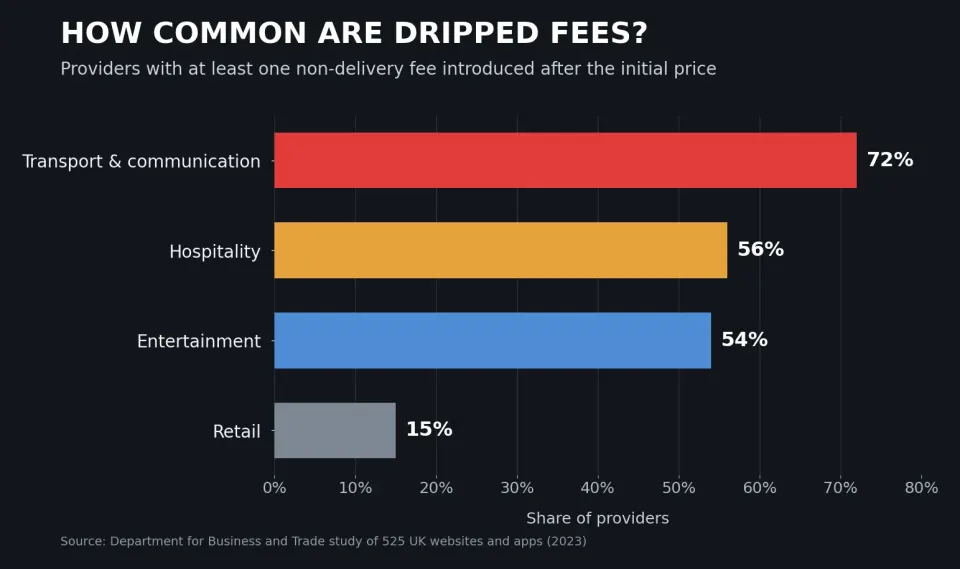
The government's large study of online drip pricing manually examined checkout journeys at 525 websites and apps across entertainment, hospitality, retail, and transport and communications.
Excluding delivery charges, it found at least one dripped fee at 46% of providers.
The sector results were:
- 72% of transport and communications providers
- 56% of hospitality providers
- 54% of entertainment providers
- 15% of retailers, excluding delivery charges
The study also found that 41% of providers used fees meeting more than one of its harm criteria: a compulsory fee, a charge worth more than 25% of the starting price, a pre-selected optional charge, a fee arriving after the checkout's halfway point, or at least three separate dripped fees.
Among the businesses reviewed, harmful fees were particularly common when buying event tickets, cinema tickets, gym memberships and flights.
This is not an unfortunate button placement on three websites. It is an entire pricing culture built around making the first number photogenic and the final number somebody else's problem.
THE CHECKOUT IS PLAYING YOU
The official research found the average checkout ran to ten pages, with dripped charges typically appearing just after the halfway point.
That timing is not harmless.
At the beginning, abandoning a purchase costs nothing. Six pages later, you have compared times, selected seats, created an account, entered passenger details and found the bank card that was apparently hiding in another dimension.
Economists call part of this the sunk-cost effect. Normal people call it: “For God's sake, I've come this far.”
The lower opening price becomes an anchor. Once customers discover the real price, many continue because going backwards means surrendering the time already spent and beginning another checkout without knowing whether that one has a trapdoor too.
The government-commissioned report says previous research found consumers can select an offer with a lower starting price and still complete the purchase after later fees make it more expensive than the alternatives.
In other words, drip pricing does not merely hide part of the bill. It interferes with the decision that produced the bill.
THE LAW IS SURPRISINGLY SIMPLE
Under the Digital Markets, Competition and Consumers Act, businesses inviting consumers to buy something must normally show the total price upfront, including unavoidable fees, taxes and charges.
The CMA's price-transparency guidance is not especially cryptic:
- If everyone must pay a booking charge, include it in the displayed total.
- If a delivery charge is compulsory and can be calculated, include it.
- If the exact total genuinely cannot yet be calculated, give equally prominent information allowing the customer to work it out.
- Genuinely optional extras can be displayed separately because the customer can refuse them.
The law does not ban companies from charging fees. It bans pretending an unavoidable part of the price is an exciting surprise unlocked during level seven of the checkout.
The CMA can now determine breaches directly rather than first taking a company through court. It can order compensation and impose a penalty of up to 10% of worldwide turnover, or £300,000 where that is greater.
For a large company, that is no longer the sort of fine found down the back of the corporate sofa.
THE REGULATOR HAS ALREADY USED ITS TEETH
In April, the CMA concluded its first cases under the strengthened regime. It found that AA Driving School and BSM Driving School had added a mandatory £3 booking fee later in their online process instead of including it upfront.
The result was a £4.2 million fine and refunds for more than 80,000 learner drivers, averaging roughly £9 each. The CMA described the enforcement as its first use of the new direct-redress power.
Since the stronger powers came into force, the regulator says its wider consumer work has secured more than £1.95 million in refunds and imposed fines approaching £6.2 million.
The new investigations therefore arrive with more than a sternly worded PDF behind them.
Trainline's shares fell nearly 17% during trading after the announcement, according to Reuters. Investors appear to understand transparent pricing immediately when the unexpected deduction comes from them.

WHAT THE COMPANIES SAY
Fairness requires their responses as well as the regulator's allegations.
Trainline said it had engaged proactively with the CMA for several months and was taking steps concerning the presentation of certain fees. It said it would continue working to ensure transparency.
Virgin Atlantic said it was reviewing the concerns and would cooperate with the investigation.
RED said it was disappointed to be named but would continue engaging with the CMA.
There is no statutory deadline for the investigations. Evidence will be gathered, the businesses can defend their practices, and the CMA will decide whether the law was infringed.
Until then, the honest formulation is not “three companies caught breaking the law.” It is “three companies formally investigated after previous warnings failed to settle the regulator's concerns.”
That is less dramatic. It is also true.
WHAT SHOPPERS CAN DO NOW
Consumers should not have to conduct a forensic audit every time they buy a train ticket, but until every checkout discovers honesty, a few habits help:
- Compare the final payable total, not the first price in search results.
- Take screenshots when a mandatory charge appears late.
- Challenge the company and ask why an unavoidable fee was not included upfront.
- Abandon the purchase if the final total no longer represents the best deal. The time already spent is gone whether you buy or not.
- For individual advice in England and Wales, contact the Citizens Advice consumer service. Scotland and Northern Ireland have their own services listed on the same government page.
- Tell the CMA about widespread consumer or market problems, although it does not resolve individual disputes.
Most importantly, stop accepting the idea that mandatory charges are somehow separate from the price.
If you cannot buy the £29.99 product for £29.99, then £29.99 was not the price. It was advertising fan fiction.
THE FIRST PRICE SHOULD BE THE REAL PRICE
Businesses know the power of the first number. That is why the cheapest possible figure is printed in large type while the unavoidable charge arrives later in a font apparently designed for ants studying contract law.
The industry's defence is often that the eventual total was displayed before payment. But disclosure at the last step does not repair a comparison distorted at the first one.
Transparent pricing does not require a revolution. It requires adding together the compulsory numbers before showing them to the customer—a calculation online businesses somehow perform flawlessly once the card details have been entered.
The first price should be the real price.
If the company intends to charge it, the company should have the courage to advertise it.
Anything else is not an extra. It is the price wearing a fake moustache.