Your energy bill is going up. Again.
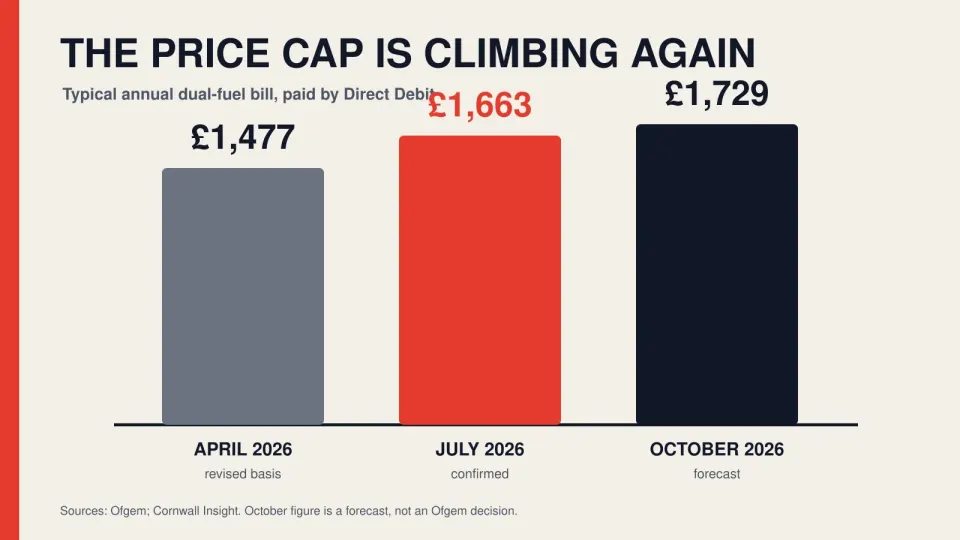
Ofgem has raised the price cap by 13% for July to September 2026. Before households have even reached the end of that quarter, Cornwall Insight is forecasting another 4% increase from October.
At the same time, domestic energy debt has reached a record £4.79 billion, while some of the world's largest energy groups have reported quarterly adjusted profits measured not in millions, but in billions.
Apparently, this is consumer protection.
THE NEXT RISE IS NOT OFFICIAL—YET
First, an important distinction: the October figure is a forecast, not a decision already made by Ofgem.
Cornwall Insight's final forecast puts the typical annualised dual-fuel bill at £1,729 from October, up from £1,663 on the same revised-consumption basis in July. Ofgem will announce the official cap, and wholesale markets can still move before then.
But this is not a wild guess from a bloke in a pub studying the gas meter. Cornwall Insight models the same market inputs used to calculate the cap. Its forecasts are watched precisely because they tend to show where the machinery is heading before Ofgem pulls the ceremonial lever.
THE £1,663 FIGURE NEEDS A WARNING LABEL
Energy-cap headlines have become even more confusing because Ofgem changed its Typical Domestic Consumption Values in July.
Using the revised benchmark—2,500kWh of electricity and 9,500kWh of gas—the illustrated annual bill moved from £1,477 to £1,663, a 13% increase. Using the previous, higher consumption benchmark, Ofgem's published comparison is £1,641 to £1,862.
Same capped unit rates. Different model household. Two perfectly official-looking numbers for the same quarter.
The price cap is not a maximum bill either. It limits unit rates and standing charges for customers on default tariffs. Use more energy and you pay more. A badly insulated home does not receive a charming apology from the spreadsheet.
WHY ARE PRICES RISING?
The immediate answer is wholesale energy.
Ofgem's July cap breakdown says the wholesale-cost allowance increased by 28% and now represents 45% of the cap, up from 40% in the previous quarter.
Ofgem says the Middle East conflict and increased risk around liquefied natural gas supplies were the main drivers. The gas wholesale allowance rose by 50%, while the electricity wholesale allowance increased by 9%. Because gas-fired generation still frequently sets the marginal price of electricity, expensive gas can drag power prices upwards too.
That is the market explanation. It is real. It is also the point at which households reasonably ask who benefits when the market becomes expensive.
THEN COME THE PROFITS
In the same broad period:
- Shell reported second-quarter adjusted earnings of **$9.8 billion**, income attributable to shareholders of $10.8 billion and a new $3 billion share-buyback programme.
- BP reported underlying replacement-cost profit of **$5.7 billion**.
- TotalEnergies reported second-quarter adjusted net income of **$6 billion**, alongside $9.8 billion in cash flow.
Those preferred adjusted profit measures total $21.5 billion for one quarter. They are not identical accounting measures and should not be treated as a perfect like-for-like league table. They are, however, all recognisable versions of the word profit, accompanied by dividends, buybacks and confident presentations to investors.
Households, meanwhile, are receiving their own quarterly presentation. It is called a direct debit review.
NO, THESE COMPANIES ARE NOT ALL DOING THE SAME THING
Here is the nuance the energy industry will quite correctly demand.
Shell, BP and TotalEnergies are integrated international groups. Much of their profit comes from producing oil and gas, LNG, refining, trading and operations outside the UK. Those figures are not simply profits made by selling capped household tariffs in Britain.
Ofgem regulates what domestic suppliers can charge on default tariffs; it does not cap the worldwide earnings of companies producing the commodities being sold into the market.
That distinction matters. But it does not make public anger irrational. It describes the problem.
The system passes higher wholesale costs through to households while allowing the companies best positioned on the production and trading side of the shock to collect enormous returns. The billpayer is told the increase is unavoidable. The shareholder is told performance is strong.
Both statements can be technically true. That is exactly why the system feels rigged.
THE PRICE CAP IS REALLY A COST-RECOVERY FORMULA
The phrase price cap sounds like a lid. In practice, it is closer to a regulated cost-recovery formula.
Ofgem's July breakdown allocates the typical Direct Debit cap roughly as follows:
- 45% wholesale energy and related contracts
- 25% networks
- 16% operating, debt and industry costs
- 6% policy costs
- 2.6% supplier earnings-before-interest-and-tax allowance
- 1% headroom
- 0.5% levelisation allowance
- 5% VAT
The formula is designed to stop suppliers charging whatever they fancy while ensuring a reasonably efficient supplier can recover its costs and remain viable. After the supplier collapses of 2021 and 2022, Ofgem is understandably reluctant to create another graveyard of failed energy retailers.
But affordability is not the formula's primary output. If the allowed costs rise, the cap rises. The regulator can check the arithmetic and still deliver a result millions of households cannot comfortably afford.
HOUSEHOLDS NOW OWE £4.79 BILLION
Ofgem's Consumer Vulnerability Strategy progress report says total domestic energy debt reached a historic high of £4.79 billion in the first quarter of 2026.
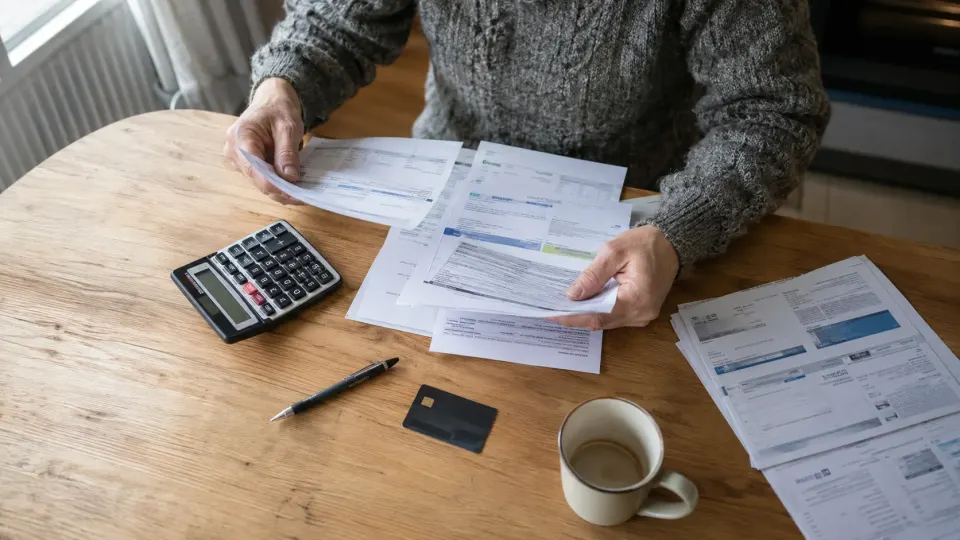
The regulator's underlying indicators show average debt among customers with a repayment arrangement rising to £828 for electricity and £679 for gas. More than 1.5 million electricity and gas accounts were repaying debt, while more than two million were in arrears without an arrangement.
This is not a handful of financially careless households forgetting to cancel a streaming subscription. It is a structural affordability crisis involving heat, hot water and light.
Every cap increase lands on people already carrying balances they could not clear under the previous cap.
THE CAP IS WORKING—JUST NOT FOR WHAT PEOPLE THINK
The price cap does provide protection. Without it, customers who never switch tariff—often older, poorer or more vulnerable customers—could face even higher default rates.
It also provides a transparent quarterly mechanism instead of allowing suppliers to alter standard tariffs at random.
But it does not cap the total bill, guarantee an affordable price or prevent global producers and traders making exceptional profits during a supply shock. Calling it a cap encourages people to believe it does all three.
Ofgem is operating the mechanism Parliament gave it. The problem is that the mechanism protects consumers from an even worse market while leaving them exposed to the market we already have.
That is a very low bar wearing a regulatory lanyard.
WHAT SHOULD HAPPEN NOW?
If ministers and regulators want the public to believe the system is more than an automated invoice generator, several things need to change:
- Introduce an automatic social tariff for households on low incomes and qualifying disability or vulnerability benefits.
- Create a serious debt-relief programme, with affordable repayment plans and write-downs where balances are plainly unrecoverable.
- Show supplier retail margins separately from upstream, generation and trading profits, so the public can see exactly where money is being made.
- Use targeted windfall taxation when exceptional production profits arise from geopolitical shocks rather than improved efficiency or investment.
- Accelerate insulation, renewable generation, storage and grid investment so British bills are less exposed to internationally traded gas.
- Stop presenting a model annual figure as though it were a guarantee when actual bills depend on usage, region and payment method.
None of that makes global gas cheap overnight. It does stop the entire response being reduced to: the formula says you owe us more.
APPARENTLY THE ONLY THING THAT ISN'T CAPPED IS THE INSULT
Energy companies will say their profits fund investment, pensions, dividends and the transition to cleaner power. Ofgem will say the cap reflects legitimate costs and protects customers from something worse. The Government will say global events are outside its control.
Each defence contains truth.
Yet the final picture remains obscene: household debt at a record £4.79 billion, bills up 13%, another rise forecast, and three global energy groups reporting $21.5 billion across their preferred quarterly profit measures.
The public is not confused because it cannot understand the market.
The public is furious because it understands the market perfectly well: when prices fall, relief arrives slowly; when prices rise, the bill arrives on time; and somewhere above the whole arrangement, another buyback programme receives a round of applause.