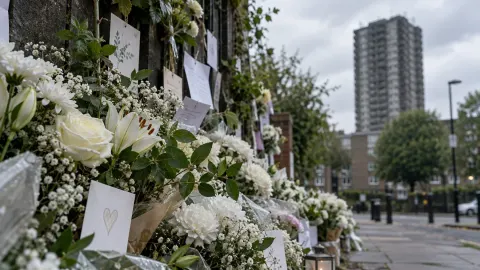
After his mum lost her home, treasured possessions and generations of family photographs, Andrew Reynolds delivered Britain’s shortest emergency briefing: “Sort it the hell out.”
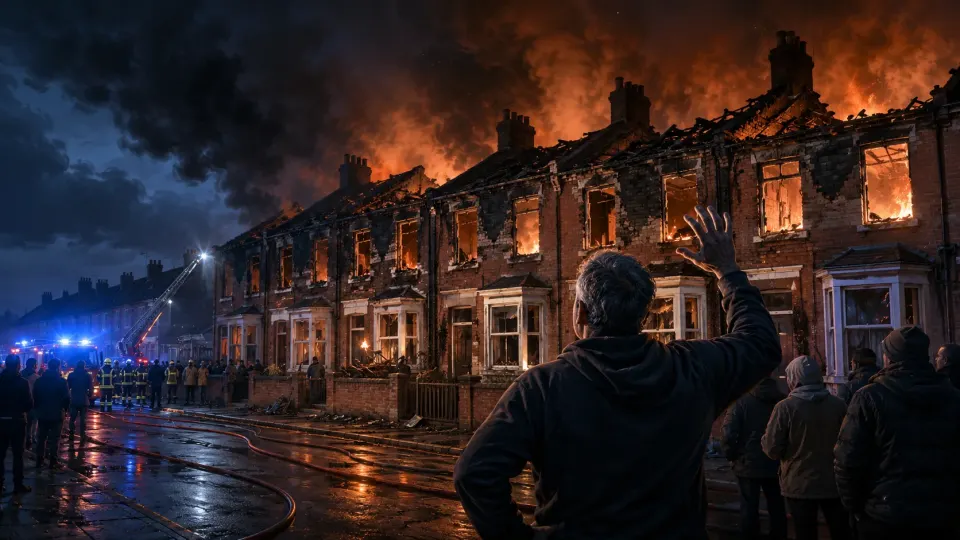
Six family homes on Gorleston Road in Birmingham have been devastated by a fire that tore through the properties with terrifying speed.
Families escaped, firefighters battled the flames and an entire community watched as homes full of photographs, possessions and irreplaceable memories disappeared behind a wall of smoke.
For Andrew Reynolds, this wasn’t simply another dramatic clip on the evening news.
It was his mum’s home.
The place where she had lived for 34 years.
And now, according to her son, there is effectively nothing left to save.
A LIFETIME GONE IN MINUTES
Reynolds said his mum had lost absolutely everything when the fire ripped through her property.
The building can eventually be repaired or replaced. Furniture can be bought again. Clothes, televisions and kettles all come with receipts, model numbers and insurance forms.
But the loft reportedly contained possessions belonging to Reynolds’ late grandmother, along with around a century’s worth of family photographs.
No replacement policy covers that.
You cannot order another box containing somebody’s childhood. Amazon does not provide next-day delivery on your grandmother’s memories. There is no customer-service number for getting the last hundred years back.
It is simply gone.
That is the part hidden behind phrases such as “significant property damage” and “a multi-agency response”.
Official language makes everything sound tidy.
Six homes were affected.
Residents were evacuated.
The situation was brought under control.
In ordinary English, several families watched their entire lives burn.
FIVE WORDS, ZERO POLITICAL POLISH
Speaking after the fire, Reynolds had a direct message for the Prime Minister:
Sort it the hell out.
No prepared statement.
No focus group.
No twelve-point national resilience framework printed on a glossy document that nobody will read.
Just five words from a man standing in front of what remained of his mum’s life.
And honestly, what else was he supposed to say?
“Could the government perhaps consider examining the possibility of initiating a consultation?”
Her house had just burned down.
There is a time for careful diplomatic language, and there is a time for somebody to stop polishing a press release and start fixing things.
This was very much the second one.
PUBLIC ONCE AGAIN DEPLOYED AS EMERGENCY GOVERNMENT
Emergency crews worked in brutal conditions as the fire spread through the row of houses. Reporting from the scene said around 50 residents were evacuated, while members of the community quickly began helping affected families.
A fundraiser was established to support people who had lost homes, possessions and the basic essentials needed to get through the following days.
It was another display of the British public’s remarkable ability to respond when disaster strikes.
Neighbours offer beds.
Strangers donate clothes.
Local businesses collect food.
Somebody creates an online fundraiser.
Meanwhile, official organisations promise that support is being “coordinated”, a reassuring word meaning several meetings have been booked and somebody is trying to locate the correct spreadsheet.
The community should be applauded for responding so quickly.
But ordinary people repeatedly having to become an emergency housing department, clothing service, fundraising team and welfare operation is not a national strategy.
It is a sign that people no longer expect help to arrive before they organise it themselves.
THIS WAS SOMEBODY’S HOME
It is easy for a story like this to become another collection of spectacular fire footage.
Flames leap through a roof. Smoke rolls across the sky. Emergency lights reflect from the road. The clip is watched, shared and replaced ten minutes later by something else.
But behind every destroyed window was somebody’s bedroom.
Behind every collapsed roof was a cupboard of family photographs.
Behind every blackened front door was a household that expected to wake up there the following morning.
These families did not lose “properties”.
They lost homes.
The cause of the blaze was being investigated, but whatever investigators ultimately establish, the consequences are already brutally clear.
Six households now face the exhausting process of finding somewhere to live, replacing basic belongings, dealing with insurers and rebuilding lives that were turned upside down in minutes.
THE OUTOUT VERDICT
Politicians are extremely good at finding longer ways to say very simple things.
They express concern.
They praise the emergency services.
They promise lessons will be learned.
They announce reviews, consultations and working groups.
Andrew Reynolds managed to save everybody a considerable amount of time.
His mum had lived in that house for 34 years. Her possessions, family photographs and treasured memories are gone.
She does not need another carefully worded statement.
She needs meaningful help.
The other families need meaningful help.
Fire services facing increasingly dangerous conditions need meaningful help.
Communities living beside dry land capable of carrying flames directly towards their homes need meaningful help.
Some stories require expert panels, complex analysis and thousands of words.
This one ultimately comes down to five:
Sort it the hell out.
This article is based on reporting from Sky News and wider coverage of the West Midlands fires by The Guardian.
Sources
- Birmingham Live — police investigation into the Highters Heath fire
- ITV News Central — homes damaged and destroyed across the West Midlands