Andy Burnham has placed one of Britain's most difficult household questions at the centre of his political programme: who pays when someone needs help washing, dressing and living safely? In his Labour conference speech in Liverpool on Tuesday 29 September, the prime minister promised a National Care Service offering free personal care for older people in the next parliament. He also proposed changing the state pension triple lock from April 2030 to help pay for it.
That is a consequential trade-off, though it is not an immediate change to either care bills or pension payments. The government's present commitment to the triple lock lasts through this parliament. The care pledge depends on Labour winning the next general election, legislation, detailed eligibility rules and a financing plan. The next election must take place by mid-2029 unless it is called sooner.
Labour's own account of the speech says the proposed service would provide free personal care for older people on NHS-like principles: everyone contributes and everyone is covered. Reuters reports Burnham said it would be free at the point of use and would not take care charges from people's basic state pension. Those words describe the ambition, but they do not yet define the full package a family could claim.
What would be free?
“Personal care” usually refers to direct help with everyday activities such as washing, dressing and eating. It is not automatically the same as making every residential care home place, accommodation cost, meal or domestic service free. Until ministers publish an eligibility definition and legislation, families should not assume that the proposed service removes every care bill.
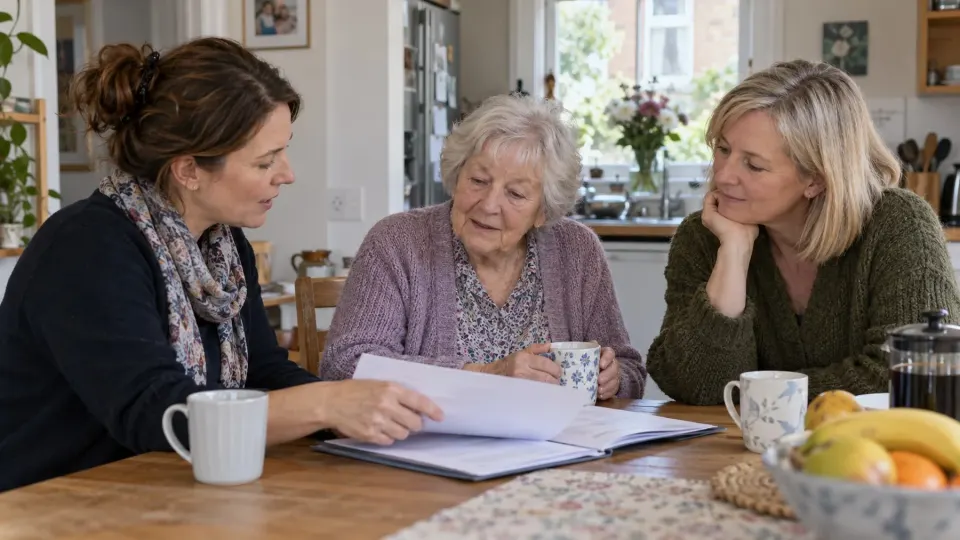
There are practical questions too. Who qualifies, at what age, and after which assessment? Will support at home and in care homes be treated alike? How will local councils, NHS services and private providers coordinate? What happens to someone who needs a long residential stay but relatively little personal care? A headline promise can fit on a conference stage; a fair entitlement must work at the kitchen table.
The distinction matters because the burden of care is often shared quietly between paid workers and relatives. A free service could reduce pressure on families and, if it helps people remain well at home, might also reduce avoidable hospital stays. Those are plausible benefits, not savings already demonstrated by this proposal. More care also requires enough trained workers, stable providers and consistent standards. A new national name will not staff an empty rota.

What happens to the triple lock?
The current triple lock raises the state pension each April by the highest of inflation, average earnings growth or 2.5%. Burnham said that, if Labour wins the next election, from April 2030 the pension would rise by at least inflation or 2.5%, while retaining its value relative to earnings over time. The annual earnings-growth guarantee would therefore change, although the proposed long-term earnings link still needs a precise mechanism.
That is more specific than simply saying the triple lock will be “scrapped”, and less specific than a complete replacement formula. In a year when wages rise faster than both inflation and 2.5%, the current rule can award an immediate larger increase. Burnham's outline does not promise that same annual result. In a high-inflation year, the inflation protection would still apply under his stated plan. Pensioners need the eventual formula, not only a reassuring slogan about sharing prosperity.
For a fuller explanation of how today's guarantee works, read OutOut's state pension triple-lock explainer. That earlier piece discussed the mechanism and fiscal pressure before this new government proposal. The policy announced on Tuesday is a separate development.
Burnham also said lower-income pensioners would not pay income tax during the current parliament, according to Reuters. That is a distinct undertaking. It should not be confused with a guarantee that no pensioner pays tax, nor with a published threshold or implementation schedule for the proposed care service.
Does the funding add up?
Labour says adjusting the pension rule will help fund care. “Help” is doing important work there. The party has not, in its summary of the speech, provided a full annual cost of the new entitlement, a quantified forecast of savings from the pension change, or a clear account of any remaining funding gap. Savings from a rule beginning in 2030 would also depend on what inflation and wages actually do. A forecast can put numbers on scenarios, but it cannot know the highest of three future rates in advance.
Timing creates another question. Labour says the care service would be established in the next parliament, while the pension adjustment would start in April 2030. Those dates may fit together, but there is no published timetable showing when services would begin, whether they would roll out in stages and how early spending would be financed. A manifesto promise after the next election is not the same as an enacted right today.
There is a defensible argument for asking a universal pension formula to give way to direct support for people with intense care needs. There is also a defensible concern that a weaker annual earnings guarantee could leave some future pensioners worse off than they would have been under existing policy. Both arguments deserve figures. Without them, voters are being invited to endorse a swap before seeing the receipt.
The wider speech
Burnham used the same conference address to discuss water companies, Britain’s relationship with the EU and electoral reform. Labour says it will remove the ban on public ownership of water companies and establish a national commission on electoral reform. Reuters reports that he also wants a longer-term consensus on EU ties. Those pledges underline the scale of the political agenda, but they should not be mistaken for measures that have already taken effect.
For the care announcement, the next useful documents are a costed policy paper, eligibility criteria, a workforce plan and the replacement pension formula. Voters should also be able to see independent scrutiny of the assumptions: how many people would receive care, how much support each would receive and how the bill changes as the population ages.
The OutOut verdict
Britain has spent years treating adult social care as the problem that can wait until after the next election. Burnham has at least named a significant entitlement and admitted that paying for it entails a choice. That is a more honest starting point than pretending care appears when families need it and disappears from the Treasury ledger.
The roast is reserved for the familiar conference trick of presenting a very large promise alongside a very small invoice. Free personal care could matter enormously to older people and their families. Changing the triple lock could also matter enormously. Put the price, the eligibility rules and the pension formula on the same page. Until then, this is a serious proposal, not a delivered service.
Sources
- Labour Party: six announcements from the 29 September conference speech (29 September 2026).
- Reuters: Burnham on social care and other conference pledges (29 September 2026).
- Reuters: proposed triple-lock adjustment from 2030 (29 September 2026).