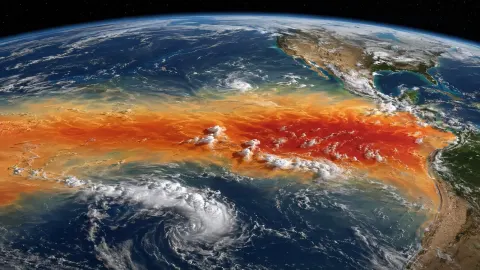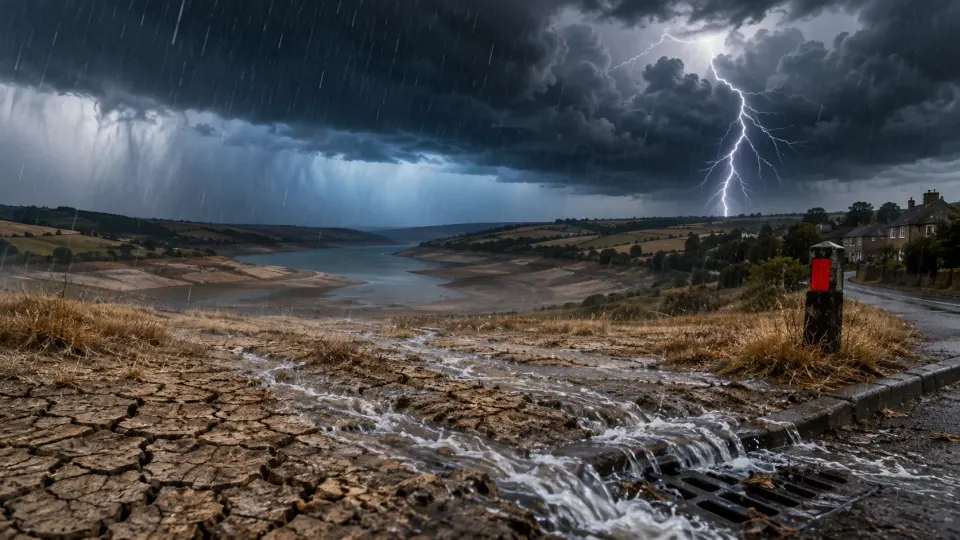
After months of relentless heat, brown grass and official requests not to fill a swimming pool for the dog, Britain begins praying for rain.
The rain eventually arrives.
Unfortunately, it brings lightning, hail, flooded roads and approximately one month’s water in the time required to collect a takeaway.
This creates an obvious question.
If enough rain has fallen to flood the high street, overwhelm the drains and turn Dave’s conservatory into an indoor water feature, how can the country possibly still be in drought?
The answer is that rain falling from the sky and water reaching the places where we store it are not the same thing.
A thunderstorm can dump an enormous amount of water on one small area while doing almost nothing for reservoirs, aquifers and rivers elsewhere.
Britain can therefore experience flooding and drought at exactly the same time, because our weather has apparently decided that choosing one national emergency would be insufficient.
WHY DO THUNDERSTORMS FOLLOW HOT WEATHER?
Thunderstorms require three main ingredients:
* Warm, moist air near the ground
* Colder air higher in the atmosphere
* Something that forces the warm air upwards
After several hot and humid days, the ground has absorbed large amounts of energy from the sun.
That heat warms the air immediately above it.
Warm air is less dense than cold air, so it begins to rise. As it climbs, it expands and cools, causing water vapour to condense into tiny droplets.
Given enough heat, moisture and instability, the rising air forms a towering cumulonimbus cloud.
These are the enormous anvil-shaped clouds that announce the atmosphere has stopped being decorative and started preparing an attack.
The Met Office explains that the most severe UK thunderstorms commonly develop in summer after hot, humid and sunny weather.
Incoming cooler air can make the atmosphere even more unstable, forcing the warm air upwards faster and helping the storm cloud grow.
Inside the cloud, powerful updraughts carry droplets and ice particles thousands of metres into the atmosphere.
Water freezes, pieces of ice collide and electrical charges begin separating inside the cloud.
When the difference in charge becomes large enough, electricity violently discharges through the atmosphere.
That is lightning.
Thunder is the resulting shockwave created when the lightning rapidly heats and expands the surrounding air.
In summary, several days of lovely weather have quietly been charging an enormous atmospheric cattle prod above your house.
WHY CAN THE RAIN BE SO INTENSE?
Ordinary rain is usually associated with larger weather systems that can cover broad areas for many hours.
Thunderstorms behave differently.
They are powered by convection—the rapid movement of warm air upwards and cooler air downwards.
A mature storm can contain huge quantities of water while affecting a relatively narrow area.
This is why one town can receive a biblical downpour while a village five miles away watches somebody continue watering hanging baskets.
Thunderstorm rainfall can also be exceptionally intense.
Rather than releasing water gradually across a full day, the cloud may unload it within minutes.
The drains, rivers and soil must suddenly process an amount of water they were designed to receive much more slowly.
They cannot.
The water therefore collects on roads, flows through gardens and begins exploring the lower floors of nearby buildings.
WHY DOES DRY GROUND MAKE FLOODING WORSE?
You might assume extremely dry soil would absorb rain enthusiastically.
After all, it needs the water.
Unfortunately, soil is not a thirsty kitchen sponge waiting politely beneath the cloud.
After prolonged heat and drought, some ground can become dry, hardened and compacted.
When intense rain lands faster than the soil can absorb it, the water remains on the surface and begins flowing downhill.
The Environment Agency warns that hardened ground can increase localised flood risk because heavy rainfall cannot drain away or soak in quickly enough.
Urban areas create an additional problem.
Tarmac, concrete, roofs and paving are largely impermeable. Water cannot soak through them, so it is funnelled directly towards gutters and drains.
If the drainage network receives more water than it can carry, the excess has nowhere useful to go.
It then becomes surface flooding.
This produces the apparently ridiculous situation in which water is rushing past somebody’s front door while the reservoir supplying their taps remains half empty.
WHY DOESN’T ONE HUGE STORM END A DROUGHT?
A drought is not simply the absence of rain yesterday.
It develops when an area experiences a shortage of water over an extended period.
The Met Office identifies several different forms of drought:
* Meteorological drought: rainfall remains below the normal level
* Agricultural drought: soil becomes too dry to support farming properly
* Ecological drought: water shortages damage wildlife and habitats
* Hydrological drought: rivers, reservoirs and groundwater supplies become depleted
A thunderstorm may briefly improve the first two.
It can wet the topsoil, revive a lawn and give crops some immediate relief.
But deeper recovery takes much longer.
Reservoirs need sustained inflows.
Rivers need reliable rainfall across their entire catchment areas.
Groundwater must slowly filter through soil and rock before reaching underground aquifers.
That process can take weeks or months.
A lawn can turn green after several wet days and create the impression that everything has returned to normal.
Meanwhile, the water table below it may still be exceptionally low.
Grass is therefore not a qualified hydrologist, despite being the indicator most people can see from their kitchen window.
HOW MUCH RAIN IS ACTUALLY NEEDED?
There is no single amount that ends every drought.
Recovery depends on:
* How long the dry period lasted
* How depleted rivers, reservoirs and aquifers have become
* Where the rain falls
* How heavily it falls
* The type of soil and rock beneath the area
* How much water homes, farms and businesses continue using
Short, violent storms are generally less useful than widespread, sustained rainfall.
Steady rain gives water more time to soak into the soil, reach rivers and begin replenishing underground supplies.
Winter rain can be especially important because lower temperatures reduce evaporation and plants use less water.
The Environment Agency says a drought is only over when river, groundwater and reservoir levels have returned to normal for the time of year.
That may require weeks or even months of regular rainfall.
In a previous recovery period, officials noted that flooding and drought could exist simultaneously while depleted water stores were still recovering. Government drought guidance confirms that one wet spell does not automatically repair the effects of prolonged dry weather.
One thunderstorm is therefore less like refilling the bath and more like throwing a bucket of water at the bathroom door.
Some may enter.
Most will cause a mess elsewhere.
DOES THUNDERSTORM RAIN HELP AT ALL?
Yes.
Even a short storm can:
* Reduce temperatures and slow evaporation
* Provide temporary relief for crops and gardens
* Increase some river flows
* Reduce immediate demand for household water
* Begin softening dry soil before further rainfall
* Lower wildfire risk in places receiving enough rain
The problem is scale and duration.
If rain falls over the correct catchment areas and is followed by more sustained wet weather, it can form the beginning of drought recovery.
If it falls intensely on one town for twenty minutes before disappearing into the drainage system, its contribution may be limited.
Very heavy rain can also wash soil, pollutants and debris into rivers, causing additional environmental problems.
Water is useful.
Water arriving everywhere at once with no appointment is less useful.
CAN CLIMATE CHANGE MEAN MORE DROUGHTS AND HEAVIER RAIN?
UK climate projections point towards hotter, drier summers on average, particularly in southern England.
At the same time, warmer air can hold more moisture, increasing the potential for heavier downpours when storms do develop.
This does not mean every thunderstorm or drought is individually caused by climate change.
Weather events result from numerous interacting conditions, and thunderstorm development remains difficult to predict precisely.
However, the Met Office says future summers may contain more dry days alongside heavier bursts of rainfall between them.
That combination creates an awkward problem.
Long dry periods reduce water supplies and harden the ground.
When rain finally arrives, more of it may fall rapidly, increasing flood risk without providing the slow recharge reservoirs and aquifers require.
Essentially, Britain may receive less of the useful rain and more of the rain that enters the house horizontally.
WHAT SHOULD YOU DO DURING A THUNDERSTORM?
If thunderstorms are forecast:
* Check current Met Office weather warnings
* Stay inside when thunder and lightning are nearby
* Avoid open water, exposed high ground and isolated trees
* Unplug vulnerable electrical equipment if it is safe to do so
* Never drive or walk through floodwater
* Check official flood warnings for England
If you can hear thunder, the storm is close enough to present a lightning risk.
The delay between seeing lightning and hearing thunder can provide a rough estimate of distance. Count the seconds and divide by five for miles, or by three for kilometres.
But if the calculation reveals the storm is nearby, the correct response is to go indoors—not remain outside congratulating yourself on the arithmetic.
THE SHORT ANSWER
Thunderstorms form when hot, moist air rises rapidly into colder air and creates enormous convective clouds.
They can produce extremely heavy rain over small areas.
After a drought, hardened ground and urban surfaces may be unable to absorb that water quickly, causing rapid runoff and flash flooding.
But ending a drought requires sustained rainfall capable of replenishing soil, rivers, reservoirs and groundwater across a much wider area.
That takes time.
So yes, your road can be underwater while the country remains officially short of water.
It sounds contradictory.
It is actually just the difference between water falling somewhere inconvenient and water being stored somewhere useful.
Britain asked for rain.
The atmosphere delivered it all to one postcode.