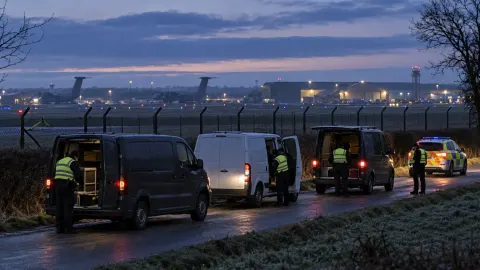
The UK–France “one in, one out” Channel migration pilot has stopped taking new cases. The Home Office confirmed that position on Wednesday 30 September as France and Britain discussed winding down the scheme, which was due to expire on Thursday. Returns already in the pipeline may still go ahead, and both governments say cooperation against dangerous small-boat crossings will continue.
Those distinctions matter. “No longer processing new cases” does not mean every existing case vanished overnight, or that the whole border relationship has ended. But it does mean the central pilot mechanism that both countries presented as a way to discourage irregular arrivals is closing to new applicants. The next test is what replaces it.
The arrangement allowed Britain to return some people who had arrived by small boat to France while admitting an equivalent number of people through a legal route, subject to eligibility. It was designed to make the boat journey less attractive while preserving a route for applicants with connections to Britain. In practice, it required two governments, two legal systems and a constant exchange of case decisions to operate together.
What the governments have said
A French interior ministry source told Reuters that Paris did not want to extend the pilot and that the sides were discussing the terms of withdrawal. The Home Office said it was no longer processing new cases under the pilot, would continue working with France to tackle crossings and expected further returns to France in the coming weeks. It also said it had established a new task force.
The French ministry did not give Reuters a detailed explanation for its decision. In earlier parliamentary remarks, French interior minister Laurent Nunez argued for a wider European approach and said France should not be expected to carry sole responsibility for an EU external border affected by movement elsewhere in Europe. That is France's policy position, not proof that any single administrative problem caused the pilot to end.
Associated Press reported the agreement had been scrapped, quoting the same Home Office description that it would take no new cases. The operationally precise reading is therefore that the pilot is winding down: the intake has closed, while some removals connected to existing cases can still happen. Britain has not, in the sources reviewed here, published a fully detailed successor agreement.

Did it work?
The government says Channel arrivals were more than 40% lower by late September than over the same period in 2025, and described the summer total as its lowest in six years. That is a real change in the recorded flow. It is not, on its own, proof that this particular pilot caused the fall. Weather, enforcement, departures elsewhere, smuggling networks and broader migration patterns can all affect crossings.
Reuters reported that Nunez told French lawmakers in June that 951 people had been returned under the scheme and 935 had entered Britain through its legal side. Those were figures at that point, not a final account of the pilot. Associated Press has reported later approximate totals of around 1,500 returns and slightly fewer admissions. The sources use different reporting dates and levels of precision, so they should not be merged into a single neat scorecard.
Success also cannot be measured only by a headline balance. Policymakers need to know how long a case took, how many proposed removals failed legal review, whether people attempted the crossing again, and whether the legal route changed behaviour. None of those questions is answered by the familiar television graphic of two arrows crossing the Channel.
There is a human measure as well. Small-boat journeys remain dangerous even if annual totals fall. People seeking protection have individual claims that must be assessed according to law. Smuggling gangs exploit desperation and gaps in safe routes. A workable deterrent has to operate fairly enough to survive legal challenge and quickly enough to affect decisions before someone climbs into a boat.
What changes for Britain now?
The Home Office says it will still return people to France under cases already in progress and will continue joint work with French authorities. It has not announced that every form of return to France is impossible after the pilot closes. Equally, a new task force is not the same as a replacement bilateral returns agreement. Its powers, resources and measurable goals need to be published before ministers can claim it fills the gap.
The wider political debate will be loud because the scheme was used as a visible symbol of control. Opponents will call the closure failure; supporters may point to lower crossings. Both claims need evidence about causation and outcomes. The most useful immediate questions are how many cases remain open, whether France will continue accepting those returns, and what arrangement will govern future arrivals.
OutOut has previously examined how British cars risk exclusion from European incentives. Migration and manufacturing are very different issues, but each depends on negotiated rules with European partners that cannot be replaced by a domestic slogan. The UK can set its aims; an agreement still needs the other side to sign up.
The OutOut verdict
The pilot was sold as a practical way to change incentives around a dangerous crossing. Now it has stopped taking new cases before the governments have shown the public a detailed replacement. That is a substantial policy setback, even while arrivals are reported to be down.
The roast is for any politician who treats a lower annual crossing figure as a complete answer to a missing returns mechanism, or treats the pilot's closure as proof that no cooperation remains. The honest account is less tidy: existing cases continue, new intake has ended, and the next agreement has yet to be made clear. People crossing the Channel and the communities receiving them deserve policy that can be audited after the press conference ends.
Sources
- Reuters: France and Britain discuss ending the returns pilot (30 September 2026).
- Associated Press: UK confirms pilot is no longer processing new cases (30 September 2026).