Housing announcements are excellent at producing enormous numbers.
£10 billion.
70,000 homes.
£39 billion over ten years.
All very impressive.
Unfortunately, most people don't live inside a Treasury spreadsheet. They want to know whether any of those homes will be near them, how much the rent will actually cost and whether joining a council waiting list today means somebody might eventually hand them some keys before their children retire.
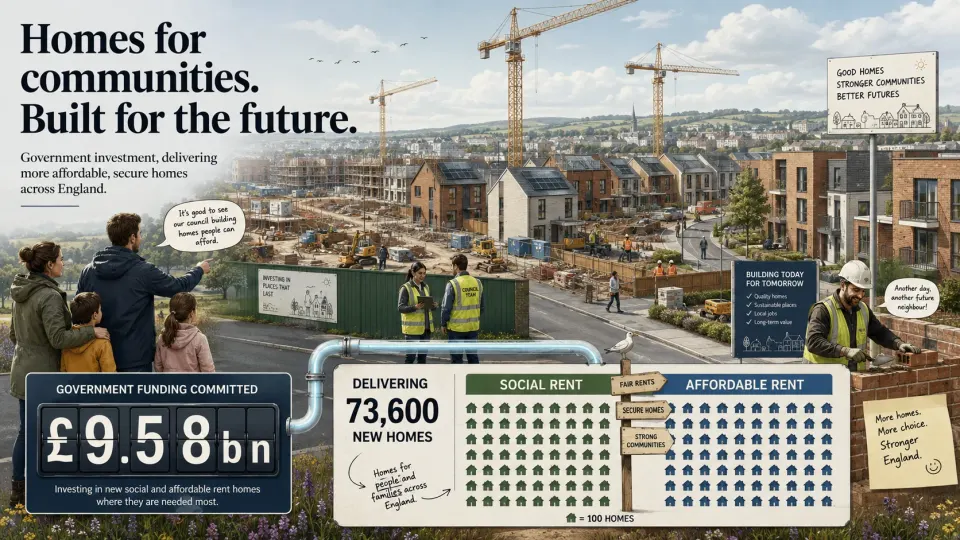
The government has now announced the first major allocations from its £39bn Social and Affordable Homes Programme, committing £9.58bn to 33 strategic partners outside London to support the delivery of 73,600 new homes over the next ten years. Councils, housing associations and other providers are receiving long-term funding commitments, and nearly two-thirds of homes delivered through these partnerships are expected to be for Social Rent.
That last bit matters enormously.
Because Social Rent and Affordable Rent are not the same thing.
And in British housing policy, the word affordable has been asked to perform more heavy lifting than a bloke moving a sofa up three flights of stairs.
SO WHAT HAS ACTUALLY BEEN ANNOUNCED?
The first thing to clear up is that the government has not bought 73,600 finished houses for £9.58bn.
This is grant funding designed to support development. It goes towards the capital cost of building homes, with councils, housing associations and other providers combining it with their own borrowing, land, planning agreements and other funding sources.
The money is being awarded to 33 Strategic Partners, giving them longer-term certainty about how much government support they can expect. The logic is that a council or housing association can plan a development programme considerably more confidently if it knows funding will still exist after somebody changes the colour of the Treasury PowerPoint presentation.
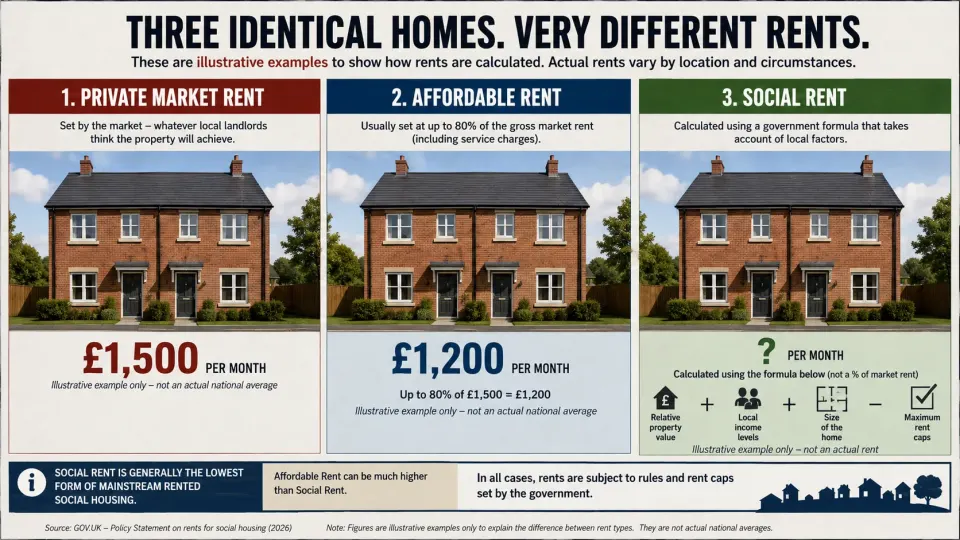
The programme itself runs from 2026 to 2036.
So when you read “70,000 new homes”, do not expect the nation's bricklayers to finish them before Christmas.
These are homes intended to be delivered across a decade. More than £16bn of the programme's funding outside London remains to be allocated, while the Greater London Authority intends to offer at least £6bn through the programme separately.
There is therefore considerably more housing funding still to come.
The genuinely significant part of this particular announcement is the emphasis on Social Rent.
WHAT EXACTLY IS SOCIAL RENT?
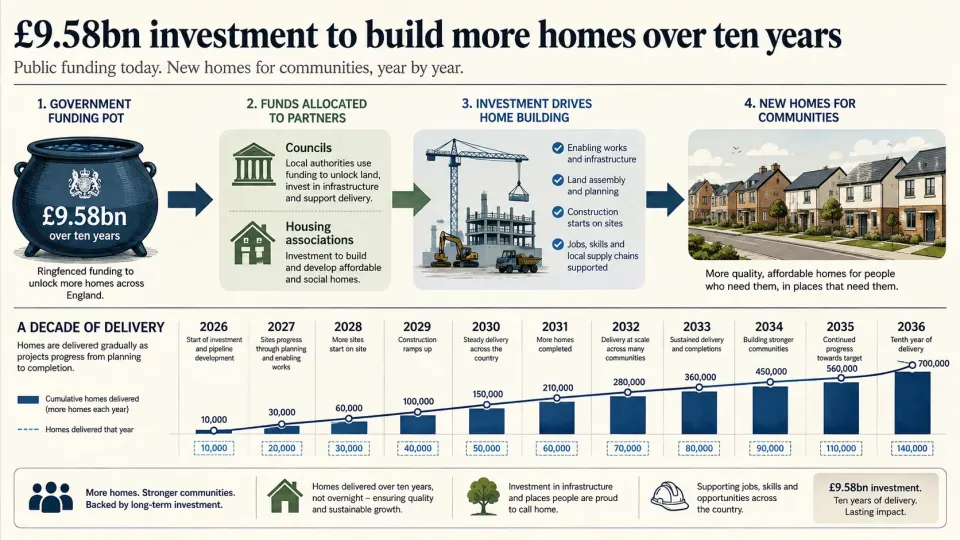
Social Rent is generally the cheapest mainstream form of rented social housing.
The rent isn't simply calculated by asking what a private landlord down the road is charging and knocking a few quid off.
Instead, England uses a government formula taking account of factors including the relative value of the property, local income levels and the size of the home. There are also maximum rent caps, and registered landlords have limited flexibility around the formula.
That's important because it means Social Rent is deliberately detached, to a significant degree, from the increasingly exciting adventure that is the private rental market.
If a two-bedroom private flat in an expensive area suddenly reaches £1,700 a month because apparently walls and a boiler are now luxury goods, the Social Rent calculation does not automatically follow it all the way up.
That makes Social Rent particularly valuable to households on low incomes and people who would otherwise struggle to sustain private-market rents.
The government's programme has a target for at least 60% of homes to be Social Rent, and officials say nearly two-thirds of the 73,600 homes in this first group of strategic partnerships are expected to fall into that category.
AND WHAT IS “AFFORDABLE RENT”?
This is where normal English and housing-policy English briefly stop speaking to each other.
Affordable Rent can be considerably more expensive than Social Rent.
Under the rules, the initial Affordable Rent for a new tenant can generally be set at up to 80% of gross market rent, including applicable service charges. Government policy explicitly acknowledges that Affordable Rents are typically higher than Social Rents.
So imagine a comparable private home rents for £1,500 a month.
Eighty per cent would be:
£1,200.
That's cheaper.
Whether somebody earning £24,000 a year considers £1,200 a month affordable is a philosophical discussion housing policy has largely decided not to attend.
Social Rent uses its formula instead and will generally come out lower.
This distinction is one reason the announcement's emphasis on Social Rent matters much more than simply saying “73,600 affordable homes.”
Those two words can conceal dramatically different rents.
WHY DOES THE COUNTRY NEED THEM SO BADLY?
Because demand is enormous.
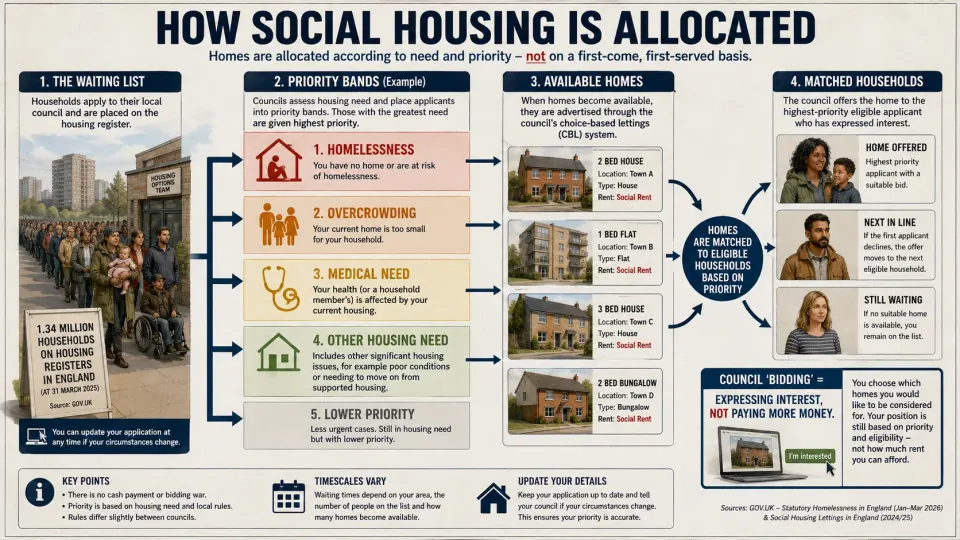
At 31 March 2025, there were 1.34 million households on local-authority housing registers in England, the highest figure since 2014. During 2024/25, about 263,000 households received a new social letting.
Meanwhile, the latest homelessness statistics show 135,580 households living in temporary accommodation at the end of March 2026.
Among them were 177,530 children.
That number is worth stopping at.
Almost 178,000 children were living without a settled permanent home.
Hotels.
Hostels.
Temporary flats.
Accommodation that may be miles from schools, family networks and jobs.
So when government press releases talk about increasing Social Rent, underneath all the billions and strategic partnerships is a much simpler problem:
There aren't enough secure low-cost homes for the number of people who need them.
And 73,600 additional homes help without remotely making that problem disappear.
DOES 73,600 HOMES MEAN 73,600 PEOPLE COME OFF THE WAITING LIST?
No.
For several reasons.
First, these aren't all Social Rent homes.
Second, they will arrive over many years.
Third, housing demand doesn't freeze while they're being built. New households will become homeless, relationships will break down, families will grow, rents will increase and other people will join registers.
Fourth, this isn't the country's only source of new social housing. Other homes will be delivered through London funding, planning agreements such as Section 106, later rounds of the £39bn programme, council borrowing and housing-association development.
And existing social homes continually become available when tenants move or circumstances change.
So comparing 1.34 million households waiting directly with 73,600 new homes and concluding everyone waits 182 years would be wonderfully dramatic but mathematically useless.
Housing is a flow, not one enormous queue outside a newly built estate.
WHO ACTUALLY GETS A SOCIAL RENT HOME?
This is perhaps the most useful bit if you're reading all this wondering whether you're eligible.
You normally apply through your local council.
There isn't one single national queue.
Every council operates its own allocation scheme within national legislation, usually using a banding or points system based on housing need. Applicants with greater need generally receive greater priority.
Examples given by GOV.UK include people who are homeless, living in overcrowded accommodation or whose medical condition is being made worse by their current home.
Councils can also apply qualification rules, including local-connection requirements in some circumstances, although there are statutory protections and exceptions for particular groups.
You can normally apply from age 18, with some councils accepting younger applicants.
And this is the slightly brutal sentence on the government's own guidance:
Joining the waiting list does not guarantee you'll get a property.
That's because in many areas the number of applicants vastly exceeds the number of homes becoming available.
WHAT DOES “BIDDING” FOR A COUNCIL HOUSE MEAN?
This regularly confuses people too.
Many councils operate something called choice-based lettings.
Available homes are advertised and eligible people on the housing register can express an interest in one.
This is called bidding.
No money changes hands.
You are not standing outside a two-bedroom terrace shouting £950 at an auctioneer while another family waves a numbered paddle.
Your position is still determined by the council's allocation rules, including need and priority.
The system simply lets applicants indicate which suitable available properties they would like to be considered for.
WHERE IS THE FIRST £10BN GOING?
The first strategic-partnership allocations cover housing associations, councils and providers around England outside London.
The government has highlighted major expected spending in established mayoral areas, including:
Greater Manchester: £529m supporting around 4,400 homes
North East: £445m supporting around 3,400
West Yorkshire: £441m supporting around 4,000
West Midlands: £409m supporting around 3,200
Liverpool City Region: £380m supporting around 3,100
South Yorkshire: £249m supporting around 2,200.
That does not account for the entire £9.58bn because the programme involves numerous strategic partners beyond those mayoral allocations.
Four newer mayoral strategic authorities — Cambridgeshire and Peterborough, East Midlands, West of England, and York and North Yorkshire — are also being given a role in setting future strategic direction for the programme in their areas.
London operates separately through the Greater London Authority, which intends to offer at least £6bn from the wider programme.
WHEN WILL PEOPLE ACTUALLY MOVE IN?
This is the question government announcements can never answer with one satisfying date.
Some projects will already be well advanced.
Others will still require land deals.
Planning permission.
Procurement.
Contractors.
Infrastructure.
Financing.
And Britain's deeply cherished national pastime of arguing for three years about whether a field should contain houses.
The strategic-partnership programme runs for a decade, so deliveries will be staggered rather than arriving as one giant house-shaped parcel.
That's also why the government is spending an additional £46m over three years on council housebuilding skills and capacity, including early development support and specialist recruitment. There is little value giving councils billions of pounds for construction if they lack enough planners, surveyors and project managers to actually turn the money into buildings.
WILL THIS SOLVE THE HOUSING CRISIS?
No.
And, to its credit, the announcement doesn't realistically claim that 73,600 homes alone will.
The scale of the problem is too large.
There are more than a million households on housing registers, record numbers living in temporary accommodation and huge affordability pressures in the private-rental market.
For context, England completed just around 2,000 council homes annually during the five years leading up to 2025, compared with council housebuilding averaging roughly 103,000 homes a year at its late-1970s peak, according to figures cited in current reporting.
Returning anywhere close to those historic levels would require far more than this first funding round.
But that doesn't make 73,600 homes meaningless.
The important shift is that government funding is once again explicitly making Social Rent and council housebuilding a major priority, with long-term funding extending beyond a single spending-review cycle.
Housing providers have spent years arguing that certainty matters almost as much as the headline amount because developments can take years to assemble.
Ten-year funding gives organisations a better chance of planning ten-year building programmes.
SO WILL YOU EVER GET ONE?
If you're already on a housing register, the honest answer is:
Maybe — but this announcement can't tell you.
Your chances depend heavily on where you live, your household circumstances, your priority band, what type and size of property you need and how many suitable homes become available locally.
Someone in severe housing need requiring a one-bedroom accessible flat faces a completely different queue from a family needing a four-bedroom house.
The best practical step remains decidedly less glamorous than a £39bn government announcement:
Check your council's housing-allocation policy and make sure your application accurately reflects your current circumstances.
If something significant changes — homelessness, overcrowding, disability, medical needs, domestic abuse or another material housing issue — tell the council rather than assuming your existing application magically updates itself.
Because the £10bn announcement is national.
The keys are allocated locally.
THE BOTTOM LINE
Here's the version without the government vocabulary.
Nearly £9.6bn has now been committed to 33 organisations to help deliver 73,600 social and affordable homes outside London over the next decade.
A large majority of the emphasis is on Social Rent, where rents are based on a government formula rather than simply tracking private-market prices.
That is meaningfully different from Affordable Rent, which can generally reach 80% of market rent.
The homes will not appear immediately.
Being on a waiting list does not guarantee you'll receive one.
And 73,600 homes cannot erase a waiting-list problem measured in seven figures.
But for households currently spending years waiting for a secure home, the most important number might not actually be £10bn.
It is 60% plus.
Because increasing the proportion built for genuine Social Rent means more of the houses eventually coming out of the programme should be affordable to the people who need them most.
And in British housing policy, making “affordable” actually mean affordable would be quite the innovation.