Humanity has spent centuries developing faster athletes, better training methods and increasingly expensive footwear.
Vilnius has taken a different approach.
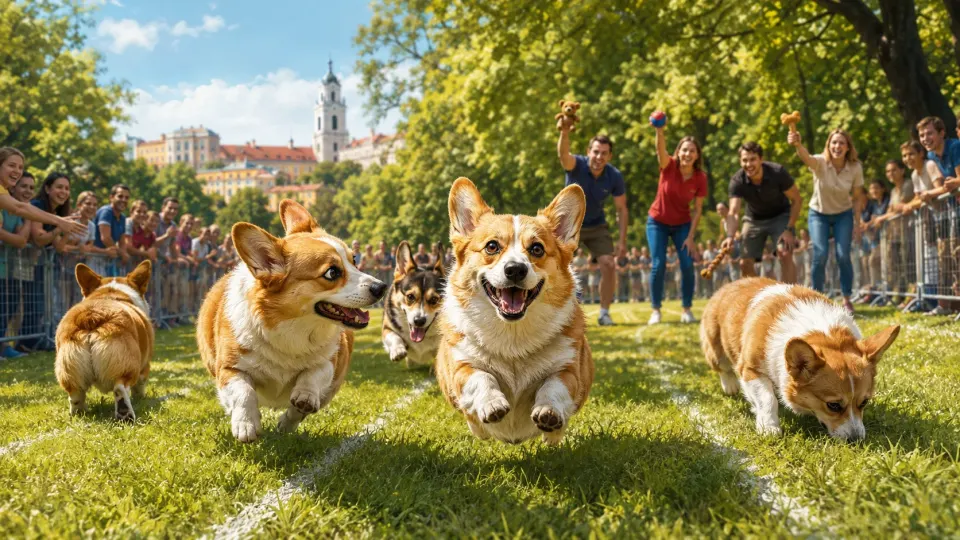
It gathered 150 dogs shaped like furry doorstops and asked them to sprint across a park while their owners waved toys, treats and what appeared to be the occasional household cleaning implement.
The result was the fifth Corgi Race Vilnius—an international sporting event in which turning around, stopping for a chat and investigating an interesting patch of grass were all treated as perfectly reasonable race strategies.
This was elite sport, just much closer to the ground.
SHORT LEGS, INTERNATIONAL AMBITION
Around 150 corgis from nine countries arrived at Vingis Park in Lithuania’s capital for the event on Saturday 15 August.
Competitors travelled from Lithuania, Latvia, Poland, Estonia, Germany, Ukraine, the Czech Republic, the United States and Britain.
According to the Associated Press, the event began with just 40 local corgis and has since developed into an international gathering involving thousands of spectators.
Organisers now describe Vilnius as the European capital of corgis.
This is a bold claim, but difficult to challenge when the city has 150 of them assembled in one park and several appear prepared to bark at anyone requesting supporting evidence.
THE SPORTING FORMAT, APPARENTLY
Corgi Race Vilnius was not merely about running in a vaguely forward direction.
The programme included:
* A 25-metre main race
* Individual sprint challenges
* A loudest-bark competition
* A “smartest nose” treat-finding contest
* Agility challenges
* A run-and-return event
* A costume parade featuring 38 dogs
Ninety-four corgis entered the main racing competition, progressing through qualifying heats, semifinals and a grand final.
Some displayed genuine speed and focus.
Others froze at the start, played with their opponents or turned around and headed back towards their owners.
Reuters reported that owners attempted to encourage their athletes with toys, treats and even a broom.
Nothing in the official history of the Olympic Games adequately prepares you for a corgi being pursued with household cleaning equipment.
AMERICA TAKES THE SHORT-LEGGED CROWN
The main 25-metre final was won by American entrant GG, short for Gustave the Girl Dog.
Fellow American Mr Corgington finished second, while Lithuania’s two-time former champion Moka claimed third place.
GG had already won a major corgi race at Emerald Downs in Washington state, making this less of a surprise victory and more of an international canine takeover.
The Americans had crossed an ocean, entered Lithuania’s biggest corgi race and taken the top two positions.
Vilnius had welcomed the world.
The world had responded by sending two extremely competitive sausages with ears.
MR CORGINGTON FINDS HIS VOICE
Finishing second in the main race was not enough for Mr Corgington.
He recovered from defeat, cleared his throat and won the loudest-bark competition with a performance measured by Reuters at 111 decibels.
That is roughly comparable to a loud nightclub, a chainsaw or somebody discovering the price of food inside an airport.
The “smartest nose” competition was shared by Latvian corgis Tora and Rusty, who successfully located hidden treats.
This was described as a test of intelligence, although finding food remains one of the few examinations most dogs would willingly retake several times.
BRITAIN SENDS ITS SENIOR BARKING DELEGATION
Britain’s first competitor was Duke, a 12-year-old Pembroke Welsh corgi from Sedbergh in Cumbria.
Duke sensibly avoided the main race because of his age but entered the barking competition after what his owner described as a lifetime of training.
He did not win, but reaching international competition after 12 years of shouting at delivery drivers remains an achievement worthy of recognition.
Britain may have invented the breed, but the United States had the speed and Lithuania had the numbers.
We were effectively Italy turning up to a pizza competition and discovering that Chicago had brought a deeper tray.
KNIGHTS, DINOSAURS AND DOGGY SPORTSWEAR
The costume parade featured 38 corgis dressed in outfits including a dinosaur, dresses and miniature sporting equipment.
Amigo won both the judges’ decision and the public vote with an elaborate knight-themed costume.
The event organisers clearly understand that if a normal corgi attracts attention, a corgi dressed as medieval nobility can control an entire city centre.
Around half of this year’s competitors were attending for the first time, while six veteran dogs have appeared at every edition.
The event’s official website says last year’s gathering reached thousands of spectators and attracted international coverage across dozens of countries.
THE OUTOUT VERDICT
There were serious competitors.
There were international rivalries.
There were qualifying rounds, semifinals, judges, trophies and allegations of excessive sniffing.
Most importantly, there were 150 corgis attempting organised sport despite possessing legs apparently designed for navigating beneath coffee tables.
GG returned to America as champion.
Mr Corgington left with silver and the loudest bark.
Amigo became a knight.
Several other competitors simply enjoyed the grass.
Every one of them understood the assignment in their own special way—even the ones who ran backwards.