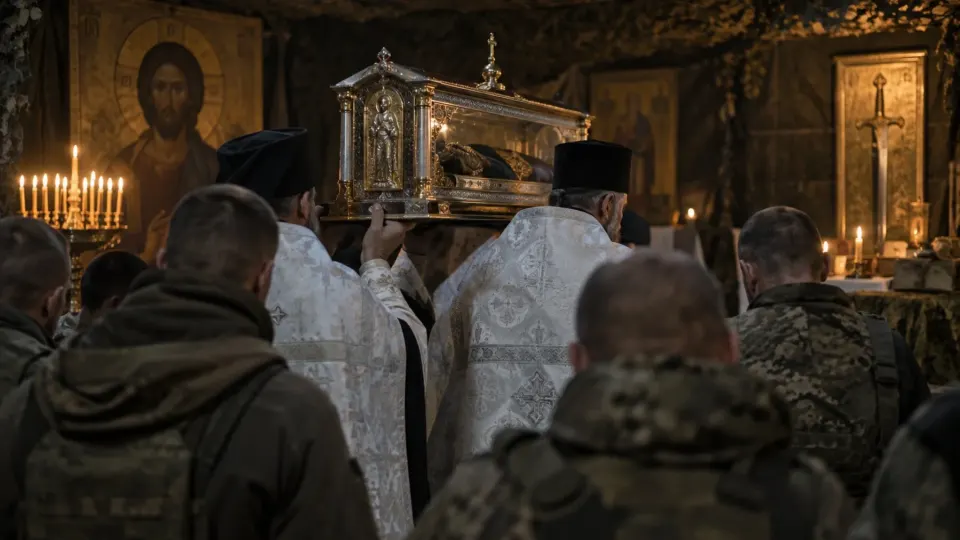
The Russian Orthodox Church has sent a bone fragment attributed to the right hand of medieval warrior prince Dmitry Donskoy to troops in occupied Ukraine, because ordinary military logistics apparently lacked enough fourteenth-century symbolism.
Reuters reported on Thursday 10 September that the relic was presented in Donetsk and is expected to travel across roughly 1,000 kilometres of the front. Church officials described the tour as spiritual support for Russian forces.
Donskoy, a prince of Moscow who died in 1389, is celebrated in Russia for victory over a Mongol-led army at the Battle of Kulikovo in 1380. The Russian Orthodox Church canonised him in 1988. A fragment said to come from his remains was discovered in the Kremlin’s Cathedral of the Archangel, according to the church.
Why this prince?
Donskoy occupies a useful place in Russian national mythology: a military leader associated with resistance, unity and Moscow’s rise. Invoking him connects the current war to a much older story of sacred territory and heroic defence.
That comparison is political, not merely devotional. Russia invaded Ukraine and claimed the annexation of Donetsk and three other Ukrainian regions in 2022. Ukraine and most countries reject those claims. Calling the present campaign a continuation of medieval defence reverses who crossed whose internationally recognised border.
President Vladimir Putin inspected the relic in August, Reuters reported. Its subsequent journey to the front ahead of Russian elections gives critics further reason to describe the display as state-aligned propaganda.

Faith, morale and power
Relics have long been used in Christian traditions as physical connections to saints and sacred history. For believers, veneration is not a claim that bone possesses comic-book powers; it is a focus for prayer, memory and example.
The controversy comes from placing a relic inside a modern military and political campaign. The Russian Orthodox Church under Patriarch Kirill has strongly supported the invasion. Religious language has been used to bless soldiers, frame sacrifice and present the war as a civilisational struggle.
Some Orthodox Christians, including clergy and believers in Ukraine, reject that fusion of church and Kremlin policy. Ukraine’s religious landscape is complex, and communities have faced pressure, legal disputes and division since the invasion.
The display also raises questions about verification and stewardship. Reuters described the object as a fragment identified by church authorities. Independent scientific proof of identity was not presented in the report. That does not settle questions of faith, but news coverage should distinguish attribution from laboratory certainty.
What the tour is meant to achieve
Military morale depends on leadership, training, supply, rotation, communication and belief in a cause. Ceremonies and symbols can strengthen group identity, especially during a long and costly conflict.
The relic tour is therefore best understood as strategic storytelling. It tells soldiers that they belong to a line of defenders blessed by history and church. It tells domestic audiences that the war is sacred and inevitable rather than a policy chosen by present-day leaders.
That is why apparently eccentric symbolism deserves serious attention. Propaganda is not effective only when it looks modern. Old objects can carry enormous emotional authority, and the spectacle can distract from battlefield losses or political accountability.
For more verified coverage of the war, visit OutOut’s World section. When the factual sentence already sounds like a rejected sketch, Just Daft handles the paperwork.
The OutOut verdict
Russia has combined a medieval hand, a modern invasion and an election calendar into the least subtle travelling exhibition in Europe.
Believers can treat a relic with sincere reverence while journalists still examine how institutions use it. The bone does not explain the war, legitimise annexation or answer for government decisions. It does reveal the story the Kremlin and church want troops to hear: history is on their side, literally carried in a box. History, as usual, has not signed the release form.