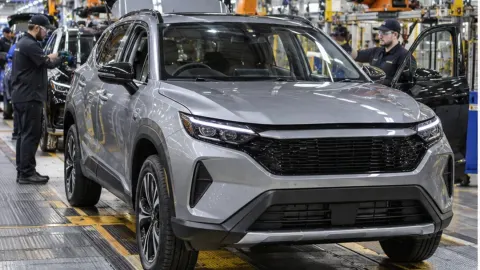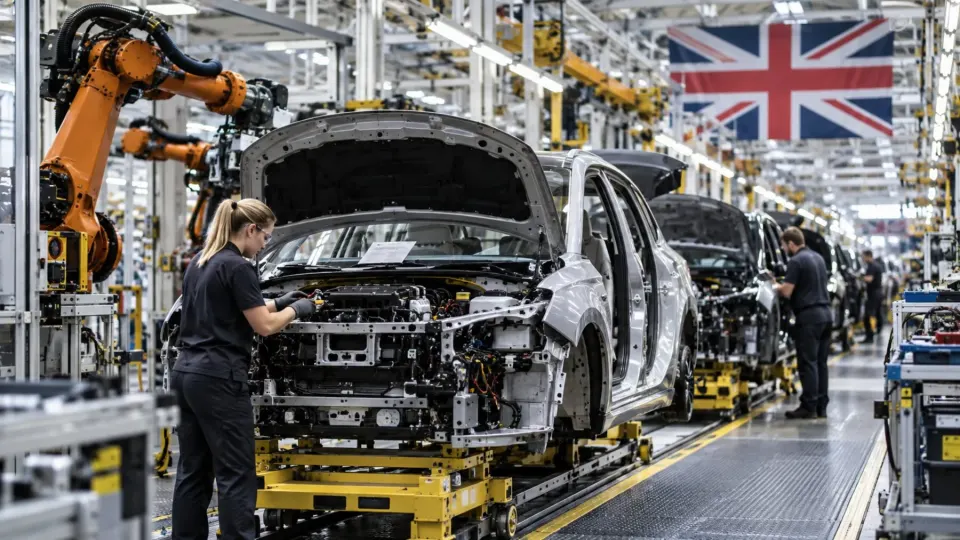
British-built cars could be excluded from future European Union incentives, carbon advantages and public-sector contracts under draft “Made in Europe” rules, the UK motor industry has warned.
The Society of Motor Manufacturers and Traders said on Tuesday 22 September that the current proposal would place factories in Britain at a competitive disadvantage in their largest export market. The rules form part of debate around the EU’s Industrial Accelerator Act, intended to strengthen European production and reduce dependence on China.
The proposal is not final law, and the SMMT is an industry lobby making the case for its members. But the underlying trade relationship is real: cross-Channel automotive trade is worth about €80 billion a year, and production lines on both sides still share components, suppliers and customers.
Brexit moved the border. It did not teach a gearbox to recognise it.
What the draft rules could do
According to Reuters and the SMMT, British vehicles would not qualify for incentives reserved for products meeting the proposed European-content rules. The potential exclusions include support for greener company fleets and “CO2 super credits”, which can make qualifying low-emission vehicles more valuable to manufacturers meeting regulatory targets.
UK-built cars could also be excluded from procurement by public bodies in EU member states. That matters because governments, councils and public services buy large fleets. Losing eligibility does not mean every British export immediately disappears, but it can make an otherwise competitive model more expensive or impossible to choose under a tender.
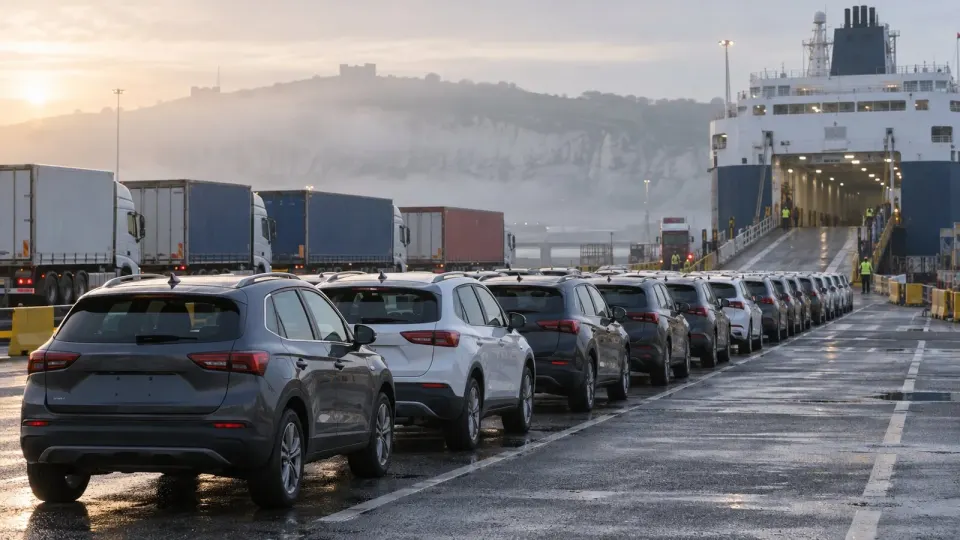
Details will decide the scale of the effect: how “European” content is calculated, whether the rule applies to assembly or components, which incentives each member state adopts, and whether Britain negotiates equivalent treatment. None of those questions should be replaced by a headline announcing that all UK cars have been banned. They have not.
Why both sides are tied together
The EU is Britain’s largest export market for passenger cars, while Britain is the largest export market for EU passenger cars, the SMMT said. The UK is also the EU’s largest customer for automotive components.
A modern car may contain an engine or battery assembled in one country, electronics from another, specialist steel from a third and software written somewhere else entirely. Supply chains were designed around efficiency and shared standards, not a referendum map. Rules that treat a finished vehicle as wholly foreign can ignore how much European material and labour is already inside it.
Mike Hawes, the SMMT chief executive, called excluding Britain an “own goal” that would reduce scale, weaken competitiveness and limit consumer choice. That is a lobbying phrase, but the reciprocal risk is credible. If UK factories sell fewer cars into Europe, they may also buy fewer EU-made parts. If Britain retaliates or redirects procurement, European manufacturers can lose access to one of their biggest customers.
The strategic argument behind Brussels
The EU is not pursuing local-content rules merely to annoy Sunderland. European leaders are trying to protect industrial capacity, accelerate the switch to cleaner vehicles and compete with Chinese manufacturers supported by enormous scale and state policy. Public subsidies create a reasonable question: should European taxpayers’ money build production and jobs inside the bloc?
Britain asks for special treatment because its industry remains deeply integrated with Europe despite leaving the political union. That case is stronger where UK rules, standards and supply chains remain aligned. It becomes harder whenever Westminster celebrates divergence as an achievement and then requests the economics of membership at the loading bay.
The answer need not be all or nothing. A negotiated content arrangement could recognise UK and EU components, with common standards, traceability and reciprocal market access. The existing trade agreement already contains automotive rules of origin; any new incentive system should be designed alongside them rather than creating a second maze.
Jobs, prices and investment
For workers, the concern is future investment. Carmakers allocate new models years in advance. A factory facing weaker access to its main market may lose the next production line before it loses today’s shift. Britain has recently welcomed new commitments including Nissan’s investment in Sunderland, but durable confidence depends on predictable export rules.
Consumers could face less choice or higher prices if manufacturers cannot access incentives on equal terms. EU buyers may lose British-made models; British buyers may pay indirectly if production volumes fall and fixed costs are spread across fewer vehicles.
Ministers should therefore treat the warning as a negotiation, not an opportunity for vintage outrage. The task is to secure mutual recognition or an association arrangement before the final text hardens. Slogans will not qualify a car for a procurement contract.
For more household and business reporting, visit OutOut’s Money section.
The OutOut verdict
“Made in Europe” sounds simple until somebody opens the bonnet. Then Europe discovers a French component, a German sensor, British assembly and several thousand tiny objects whose passports have gone missing.
The EU is entitled to use public money to build strategic industry. Britain is entitled to argue that excluding a closely linked neighbour harms both markets. The intelligent outcome is a reciprocal rule that rewards genuinely regional production without pretending the Channel is an industrial force field.
Five years of political theatre can be performed without moving a single axle. The factories, however, need an answer.