Five British men aged between 23 and 25 have been released on strict police bail after being arrested near RAF Fairford in Gloucestershire. Counter Terrorism Policing says all five remain under investigation, but no one has been charged and the authorities have not declared that a terrorist plot or foreign-state operation has been proved.
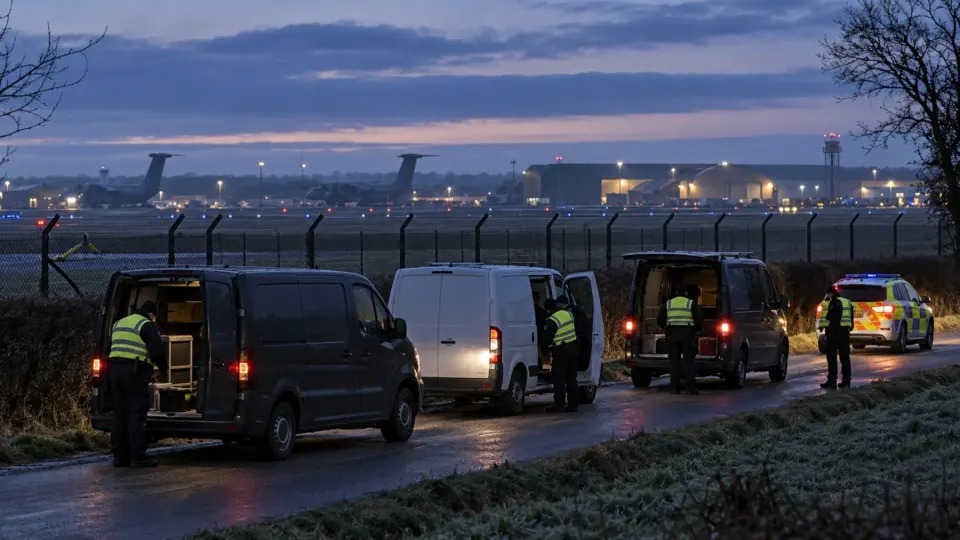
The incident began shortly after 12.45am on Sunday 27 September, when Gloucestershire Police received a report about three vehicles travelling towards the airbase near Whelford. Armed officers responded and arrested five men on suspicion of offences under the Explosives Act. They were later also arrested on suspicion of preparing an act of terrorism under Section 5 of the Terrorism Act 2006.
Those are arrest grounds, not findings of guilt. An arrest allows police to investigate a reasonable suspicion; it does not establish that an offence occurred. The distinction is especially important when a military base, terrorism legislation and speculation about hostile states all appear in the same news cycle. The nouns arrive wearing sirens, while the evidence still has to walk through the door.
What police have confirmed
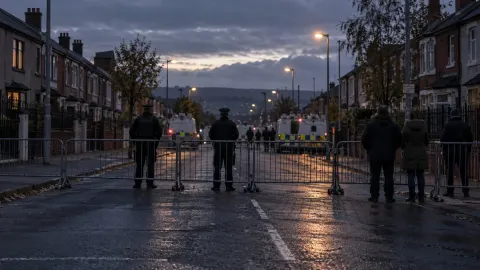
Counter Terrorism Policing said specialists, military assets and forensic experts carried out extensive examinations of the three vehicles. A large cordon disrupted nearby residents while investigators worked. By Monday afternoon, Assistant Commissioner Laurence Taylor said the men would be released on bail subject to stringent restrictions on their movements and contact with other people.
Taylor said the investigation was continuing across multiple lines of inquiry. Asked about the wider geopolitical context, he said police were keeping an open mind and had adjusted protective-security advice and posture to the threat. That wording does not confirm which state, group or motive—if any—is under examination.
The Associated Press reported that police found no viable explosive device. Reuters reported that investigators were considering whether a foreign state could be involved while also examining other possibilities, and that the inquiry was not launched from an intelligence tip. Those details narrow the responsible description: this is a serious investigation arising from suspicious activity, not a solved attack plan.
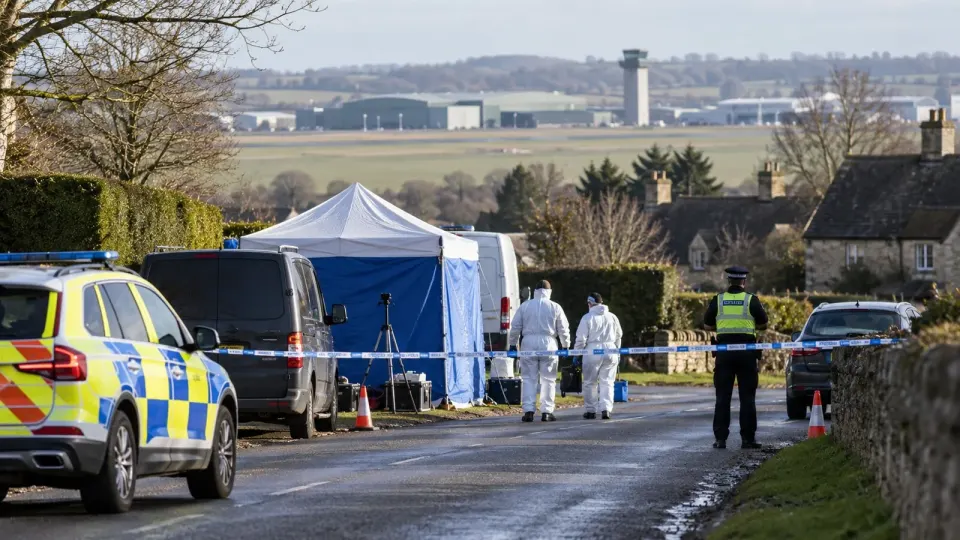
RAF Fairford is used by the United States Air Force and has hosted American bombers and other strategic aircraft. Its importance explains why suspicious vehicles approaching in the early hours would produce a substantial armed and forensic response. It does not prove that the occupants intended to attack the base. Location is a reason to investigate urgently, not a substitute for the result.
Why the bail decision matters
Releasing suspects on police bail does not mean the case has been dropped. Conditions can protect an investigation while officers analyse devices, vehicle contents, communications, financial records or contacts. Equally, bail is not a quiet conviction. The suspects retain the presumption of innocence unless and until a court determines otherwise.
The next meaningful developments would be charges, a formal statement that no further action will be taken, a renewed arrest, or a clearer police account of what evidence was recovered. Until then, descriptions such as “terror cell”, “bomb plot” or “state-backed attack” would go beyond the public evidence.
Iran's embassy in London denied any involvement after media speculation linked Tehran to the incident. That denial can be reported, but the existence of a denial does not demonstrate that police accused Iran in the first place. Investigators have publicly said they are keeping an open mind. Russia-linked activity and Islamist extremism have reportedly not been ruled out either, which is another way of saying the inquiry has not publicly selected a conclusion.
This caution does not require minimising the risk. Military bases are obvious targets for surveillance, disruption and hostile activity. The UK has also warned repeatedly about state threats and terrorism. A competent response therefore involves fast arrests where grounds exist, specialist examination, protection for the site and disciplined public information. It should not involve social media promoting the most dramatic theory because it contains the most flag emojis.
The information gap
Police have not published a suspected method, named a target within the base, identified an ideology or described material allegedly found in the vehicles. They have not announced charges. Reporting must preserve those absences instead of filling them with inference.
The public also deserves further information when it can be released without damaging the investigation. Residents were displaced and roads were restricted. A clear closing account—whether it leads to prosecution or not—would help explain why such a major response was necessary and counter the rumours that rush into silence.
The case resembles another recent story in which the responsible approach was to distinguish an arrest from a proven offence. OutOut's report on the Manchester Jewish-community investigation set out what was confirmed and what remained unknown. The same discipline applies here, regardless of how strategically important the location looks in a photograph.
The OutOut verdict
Police were right to treat suspicious movement near a strategic airbase seriously. They are also right to say the men remain under investigation rather than presenting speculation as a completed case.
The rest of us should manage the same restraint. Five arrests, three vehicles, a major forensic operation and strict bail are confirmed. A viable bomb, a proven plot, a named foreign sponsor and guilt are not. “We do not yet know” may be less clickable than an imaginary spy thriller, but it has the considerable advantage of being true.
Sources
- Counter Terrorism Policing, 28 September 2026: afternoon update on the RAF Fairford investigation
- Counter Terrorism Policing, 28 September 2026: incident and arrest details
- Reuters, 28 September 2026: five men questioned and lines of inquiry
- Associated Press, 28 September 2026: suspects bailed and no viable explosives found