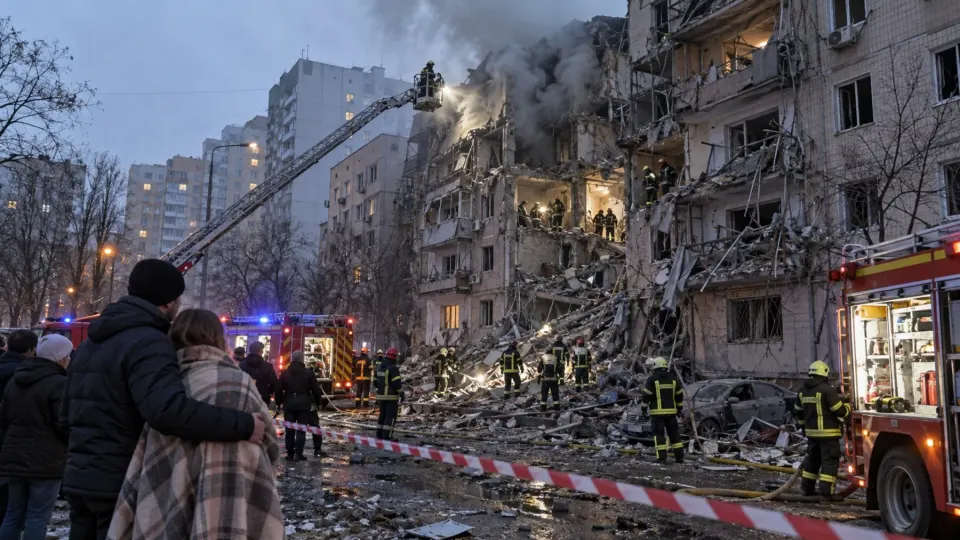
Russian drone attacks across Ukraine killed at least seven people and injured more than 80, according to Ukrainian authorities cited by the Associated Press on Monday 28 September. Homes, offices, petrol stations and a building connected to Ukraine's National Academy of Sciences were among the sites reported damaged.
Russia's Defence Ministry said it struck Ukrainian military facilities. That claim does not account for every civilian casualty or prove that each damaged civilian building was deliberately selected. Ukraine's description of the toll and Russia's account of its intended targets can be reported together without pretending they are the same question.
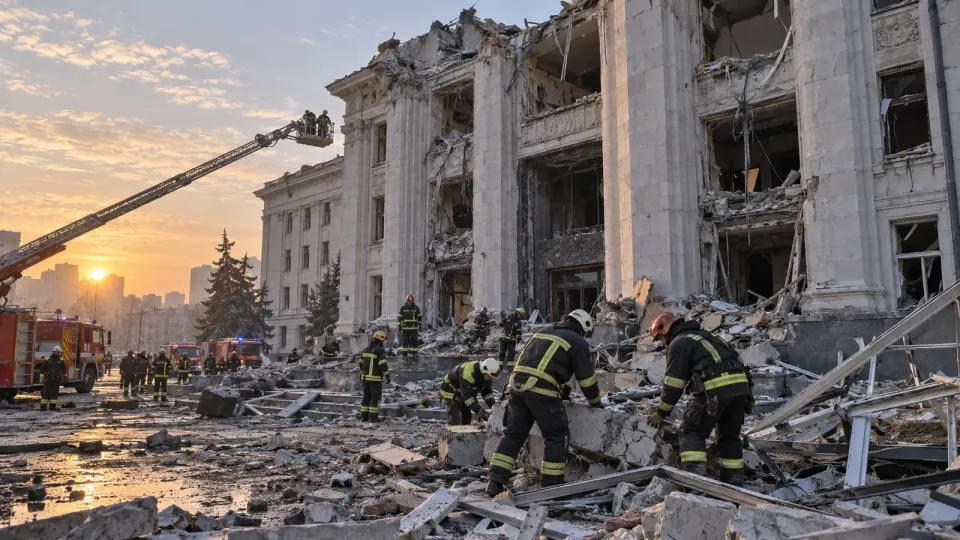
Emergency services worked through damaged apartment blocks and public buildings after the overnight barrage. The confirmed numbers may change as rescuers search sites and hospitals update casualties. War reporting should state the source and time of a toll rather than allowing a preliminary figure to harden into an eternal fact.
What is known about the attacks
The AP reported strikes in Kyiv and elsewhere in Ukraine, with fires and structural damage across civilian areas. Ukrainian officials said drones hit apartment buildings and offices. The National Academy of Sciences said one of its buildings in the capital was damaged. Images from the aftermath showed rescue workers among shattered windows and debris.
Long-range drones are used in large numbers partly because air defences cannot intercept every incoming weapon. Debris from a destroyed drone can also cause casualties, and investigators need time to determine the precise weapon and impact in each location. None of those complications reduces the legal obligation to distinguish military objectives from civilians and take feasible precautions.
The attacks came amid continuing Ukrainian strikes against targets in Russia and occupied territory. Ukraine says those operations are intended to degrade Russia's military capacity and energy revenues. Russian authorities have also reported civilian casualties from Ukrainian drones. Civilian protection applies on both sides; recognising that principle does not create a false equivalence about who launched the full-scale invasion in February 2022.
The expanding civilian burden
Recent United Nations reporting provides the wider frame. UN officials told the Security Council on 23 September that more civilians were killed or injured in Ukraine during the first eight months of 2026 than during all of 2025. Long-range missiles and drones have become a leading source of casualties far from the front line, while short-range drones make daily movement dangerous in frontline communities.
That pattern matters more than the novelty of any individual drone model. The technology allows repeated attacks at distance and scale. Air-raid alerts interrupt sleep, education and work even when weapons are intercepted. Repair crews restore power or windows knowing another wave may arrive. Trauma is not confined to the crater.
The UN has documented a sharp increase in civilian harm during 2026 and repeatedly called for an immediate ceasefire and compliance with international humanitarian law. Its monitoring also warns that publicly available information from occupied territory is limited, meaning the true toll may be higher than verified totals.
Civilian objects do not lose protection merely because they exist in a country at war. If a military objective is located within or near a city, attackers must still assess proportionality and precautions. Determining whether a particular strike violated the law requires evidence about the target, weapon, expected harm and decisions made. News reports can identify the consequences without pretending to complete a war-crimes investigation overnight.
Why target claims require caution
Both governments use strategic communication. Russia routinely says large barrages hit military or military-industrial sites; Ukraine publishes evidence of civilian damage and sometimes limited information about its own military losses. Independent journalists, open-source investigators and international monitors help test claims, but access can be restricted and evidence takes time.
The presence of a damaged civilian building is verified evidence of harm. It is not, by itself, proof of intent. Conversely, a statement that the intended target was military does not erase foreseeable civilian effects or establish compliance with the law. Responsible reporting holds those ideas simultaneously, however inconvenient they are for slogans.
Britain has a direct policy interest because it supplies Ukraine with military, financial and humanitarian support. The war also shapes European security, energy markets and defence spending. Recent OutOut coverage explained how Ukrainian battlefield data is being shared with British AI firms. Today's destruction is a reminder that drone technology is not an abstract innovation category. Its performance is measured around homes as well as laboratories.
Readers should also be wary of viral clips detached from place and date. Footage of explosions is frequently reposted from earlier attacks or other countries. A dramatic video may show a genuine event while carrying a false caption. The safer route is to rely on geolocated material, named agencies and multiple independent reports.
The OutOut verdict
Another overnight barrage can become a row of numbers that the morning scroll consumes between weather and sport. Seven dead and more than 80 injured must not be flattened into a scoreline.
Russia says it targeted military facilities. The visible result included ruined civilian rooms, disrupted lives and rescue workers climbing through debris. The strategic arguments will continue; the immediate truth is simpler. People who were not fighting have again paid for a war launched from above their homes.