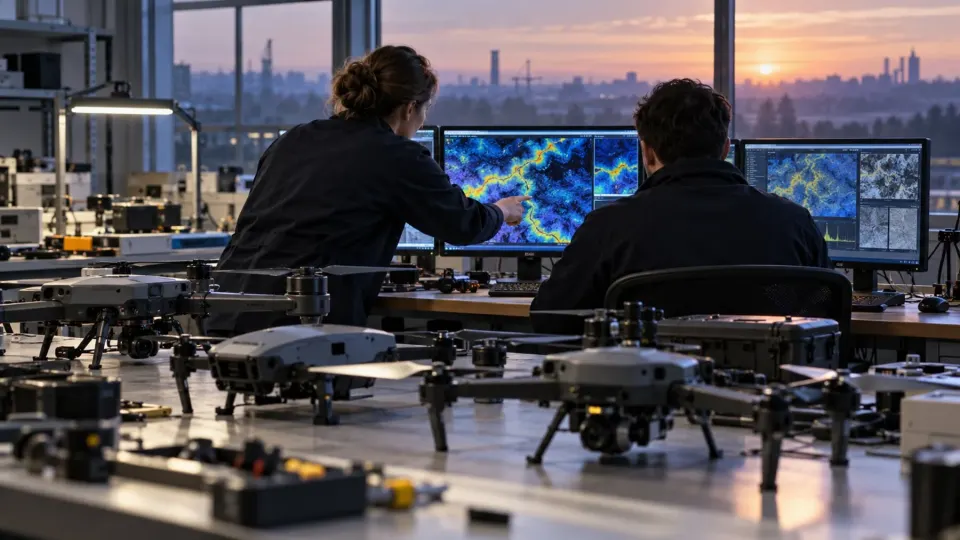
The British government announced on Friday 25 September that up to 12 UK companies could gain access to a Ukrainian battlefield data set to develop artificial-intelligence models for drone swarms. The Ministry of Defence says the material includes imagery and video collected by uncrewed aircraft, with information from more than six million detections of objects including vehicles, air-defence systems, people and other drones.
This is a fresh, concrete step in a partnership with Ukraine, not a claim that a fleet of fully autonomous weapons has been deployed. The MOD is inviting company proposals and says the first participants will be selected within weeks. Access and model development are the announced actions; the eventual capability, performance and safeguards still have to be shown.
The figure of six million needs translating. It counts detections recorded in a data set, not six million verified attacks, unique targets or independently checked examples. The footage was gathered in a real war through daylight and thermal sensors. That makes it potentially valuable for engineers trying to teach systems to recognise objects under difficult conditions. It also means a model may learn from incomplete labels, unusual battlefield conditions or mistakes unless the data and testing are handled carefully.
What the companies have been invited to build
The government says the first competition under its UK–Ukraine AI partnership will look for tools that can recognise and track relevant objects, share information between platforms, adapt routes and coordinate missions when communications or satellite navigation are unreliable. Drone swarms might deliver supplies, support surveillance or help target military capabilities. The stated ambition is to enable a small number of service personnel to oversee many systems.
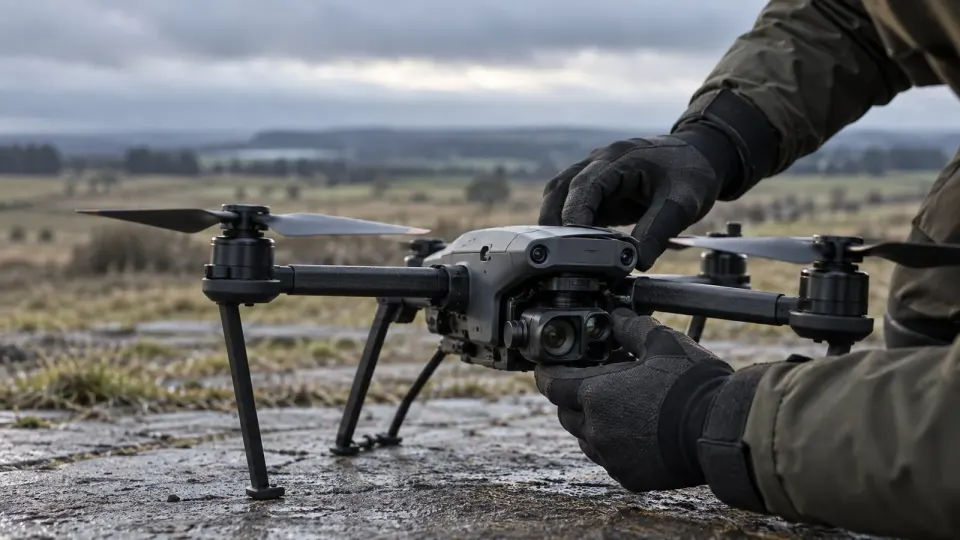
The MOD identifies four technical areas: autonomous target recognition, distributed decision-making, adaptive mission execution and collaborative sensing. Those are descriptions of research and proposals, not proof that any particular product works in combat. The ministry also says drones could operate in the air, on land or at sea. An image of a quadcopter alone cannot capture the entire programme.
Reuters reported the announcement on Friday, confirming the UK is being offered access to Ukraine's Avengers AI Labs data. The UK government describes itself as the first international partner to receive that access, following an agreement between the British and Ukrainian leaders. The level of access for individual firms, conditions on onward use and the precise testing arrangements were not fully set out in the public announcement.
That matters because the data is more than a software ingredient. Footage from an active war can contain sensitive information about tactics, equipment and people. A good contract would need clear rules on who can see it, where it is stored, how training outputs are checked and what must be deleted or restricted later. Those are questions raised by the nature of the project; they are not allegations that any selected firm has mishandled Ukrainian data.
The accuracy trap in a dangerous setting
An object detector that is impressive on archived footage may still fail when the weather changes, the camera is shaken, a target is partly hidden or an adversary deliberately tries to deceive it. Thermal imagery can remove some problems and create others. Training on an enormous volume of examples helps only if evaluation catches the cases where the model is confidently wrong.
There is a distinction between identifying a shape on a screen and deciding what a commander is legally and ethically permitted to do about it. A system might correctly identify a vehicle yet still lack the context to distinguish civilian and military use. It might pass a laboratory test but behave differently when several drones share conflicting information and a radio link drops out. The harder the conditions, the less useful a simple accuracy percentage becomes.
The MOD says such systems would make decisions with appropriate human involvement. That phrase deserves a working definition. Does a person approve every use of force, approve a bounded mission beforehand or only have the ability to intervene if communication survives? Who receives warnings when the model is unsure? What logs would allow investigators to reconstruct a mistake? The announcement does not answer these operational questions in public, so it should not be presented as proof that human control is solved.
Nor does this programme itself announce an unrestricted licence to attack targets. Research into recognition, logistics and coordination can be useful without automatically becoming an autonomous strike capability. Equally, the possible military uses are explicit in the government's own release. Pretending this is merely a clever delivery app would be a disservice to the people who may live under its decisions.
Why the UK and Ukraine want to move quickly
Ukraine has accumulated a huge volume of real operational sensor material while defending itself against Russia's invasion. British firms may be able to test ideas against conditions that traditional exercises cannot easily reproduce. The government wants technology made in Britain that can serve both Ukrainian and UK defence needs, while strengthening domestic industrial capability.
There is a practical case for improving systems that keep operating when satellite navigation is jammed, send supplies without exposing soldiers or identify incoming drones sooner. There is also commercial value to those selected firms. The public should therefore be able to see, at least in broad terms, what the competition costs, how firms are chosen, what success looks like and how military necessity is balanced against safety. Secrecy around specific tactics does not require vagueness about the principles of oversight.
Earlier this week the UK and US announced a separate AI defence partnership. OutOut covered its promises and accountability questions. Friday's Ukrainian data announcement gives one part of Britain's wider AI-defence push a more tangible shape: actual sensor material, a competition and a short list of companies. It does not make those two programmes identical.
For now, watch the selection of the firms, the definition of evaluation tests and whether officials specify the role of people in decisions involving lethal force. Those milestones will tell us more than the size of the training set. A model can learn patterns from six million detections; it cannot, by itself, settle responsibility for a wrong decision.
The OutOut verdict
The government's pitch has the rhythm of a technology launch: real data, fast selection and a domestic industry prize. The useful test is less glamorous. Can the resulting systems tell the truth about what they see, say when they are uncertain and leave a human accountable for decisions that matter?
Ukraine's experience should help engineers build better tools. It should also sharpen the questions. A battlefield is an unforgiving place to discover that a model's confidence score was merely good marketing in numerical form.