Nine technologies intended to shorten the wait for a dementia diagnosis are going into NHS trials, with up to £80 million backing the wider programme. UK Research and Innovation (UKRI) announced the selection on Friday 2 October, according to Reuters. The candidates include shorter brain scans, blood tests, a remote cognitive assessment and tools to track changes in memory and thinking. That is a promising research and service announcement, not an offer of an instant new test at every GP surgery this morning.
The goal is consequential. UKRI wants 92% of people referred for a dementia assessment to receive a diagnosis within 18 weeks by 2029, compared with roughly 60% now, according to its figures reported by Reuters. Some people wait more than a year. For them, a diagnosis can determine the kind of support a family seeks, whether symptoms point to dementia or another condition, and how to make practical plans while the person affected can take part fully. Faster is valuable only if the answer is accurate and accompanied by care.
What is actually being funded?
The £80 million is a ceiling for a research challenge, not a cheque already spent on nine nationwide services. UKRI says the technologies will be tested in real NHS settings. Projects that demonstrate a benefit may receive further support, while those that fail should not be pushed across the health service simply because their prototype made a good presentation. That trial-and-selection approach is sensible: the NHS needs results for patients, staff and budgets, not another glossy machine waiting in a corridor.
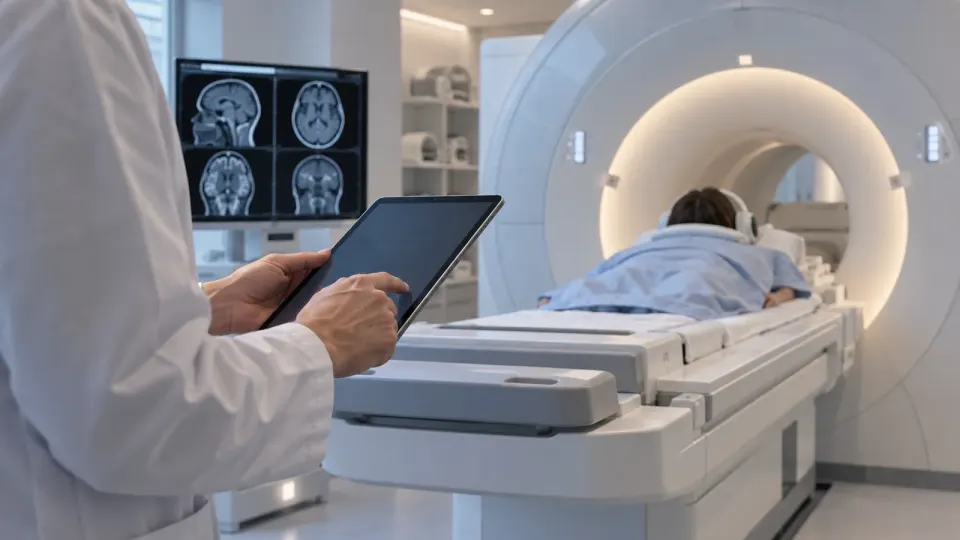
Reuters reports that one project aims to cut a brain MRI scan to about seven minutes from approximately 20. Another uses a remote 15-minute cognitive test. Blood testing and artificial intelligence tools are also in the mix. These examples sit at different points in the pathway. A quick scan could free capacity; a remote assessment could reduce travel or help triage; an algorithm might help clinicians understand how an illness is progressing. None alone proves that a person has a particular dementia, and no single technology resolves every backlog.
UKRI's existing Dementia Challenge funding brief makes the ambition clear: develop, validate and implement tools that help meet the 2029 waiting-time target. The brief predates today's chosen projects. That history matters because Friday's announcement is a step in an existing programme, not the invention of a new goal overnight. Its claim should be judged by how many people reach a reliable diagnosis sooner once the trials are evaluated.
A test is only one part of diagnosis
Memory problems do not all have the same cause. A clinician may need a history, examination, cognitive assessment, medication review, blood work and imaging to distinguish dementia from other explanations and to understand what support is appropriate. A test with a high headline accuracy in one research group can perform differently across ages, ethnic backgrounds, other illnesses and the everyday mix seen by NHS clinics. Trial design must show whether these technologies help the patients who actually turn up, including those who find digital tools difficult to use.
Speed can also shift a bottleneck. If a remote test identifies more people who need specialist assessment, but the number of clinicians interpreting scans and speaking with families stays fixed, the queue may simply move. If scans become shorter, radiology capacity still depends on appointments, equipment uptime and staff. The meaningful measure is referral to a communicated diagnosis and care plan, not the time taken to run one impressive piece of software.
The potential gain reaches beyond scheduling. Earlier identification may let people and their families discuss work, driving, money, home support and future wishes while there is time to do so calmly. It may also help suitable patients join research or receive treatment where available. But earlier testing can cause distress if it arrives without counselling, follow-up or support. A positive screening result is not the same as a confirmed clinical diagnosis, and an algorithm must never become a convenient excuse to leave a person alone with a number on a screen.
What does the 92% target mean?
It concerns people who have been referred for dementia assessment and whether they receive a diagnosis within 18 weeks. It is not a claim that 92% of everyone living with dementia will be found by 2029. The two questions are related but distinct: one measures the speed of a defined pathway; the other concerns how many people with the condition are recognised at all. A service could improve one measure while leaving gaps in access or follow-up.
The starting figure and method should remain visible as the programme proceeds. Reuters says about 60% meet the 18-week window now. UKRI used a lower baseline when it first described the challenge in 2025. Different measurement periods and definitions may explain the gap; Friday's announcement does not, on its own, establish a like-for-like improvement. Publish the same denominator, time period and case mix each year, and patients will be able to tell whether the promise is moving.
There is also a wider cost question. Alzheimer's Society estimates that dementia imposed £42 billion of costs on the UK in 2024 when health care, social care, unpaid care and wider losses are counted. That figure is not a projected saving from these trials. It does show why families and ministers should care about services after diagnosis as well as the diagnostic timetable. A faster answer followed by an overstretched care system is useful, but incomplete. OutOut's analysis of the proposed National Care Service explores the separate and still unresolved question of who pays for support.
The OutOut verdict
The prize here is not a seven-minute scan as a party trick. It is fewer months of uncertainty for people whose lives cannot pause while the NHS queue inches forward. Testing several ideas and withdrawing support from the ones that do not work is a better use of money than announcing that every new gadget is the future of healthcare.
The roast goes to the temptation to call a trial a transformation before a single national result exists. By 2029, the public should be able to see faster diagnosis, reliable accuracy across different patients, proper clinical conversations and support afterwards. Until then, the £80 million is an opportunity to prove a better pathway, not proof that the pathway has already been fixed.
Sources
- Reuters: UK commits up to £80 million to accelerate dementia diagnosis, published 1 October 2026 at 23:04 UTC / 2 October UK time.
- UKRI: NHS fit for the future dementia challenge funding brief, accessed 2 October 2026.
- Alzheimer's Society: UK dementia cost estimates, accessed 2 October 2026.