The first detailed official account of the June rail collision near Elstow, Bedfordshire, has arrived. It describes two separate failures in the minutes before one passenger train hit the back of another: an unexpected emergency stop after a warning sounded at a green signal, then a second train passing a red signal while accelerating. The Rail Accident Investigation Branch (RAIB) published its interim report on Thursday 1 October. It is an account of evidence so far, not a final finding of cause or blame.
The collision happened at about 5.13pm on Friday 19 June 2026, roughly four kilometres south of Bedford. East Midlands Railway's 16:40 Corby to London St Pancras service struck the rear of its stationary 15:50 Nottingham to St Pancras service. The driver of the moving train died. RAIB has identified 257 people aboard the two trains, at least 160 injured, and 102 taken to hospital. Both trains derailed. Those are the human stakes behind what otherwise risks becoming a discussion of signal codes and equipment tolerances.
The stop that put a train on the line
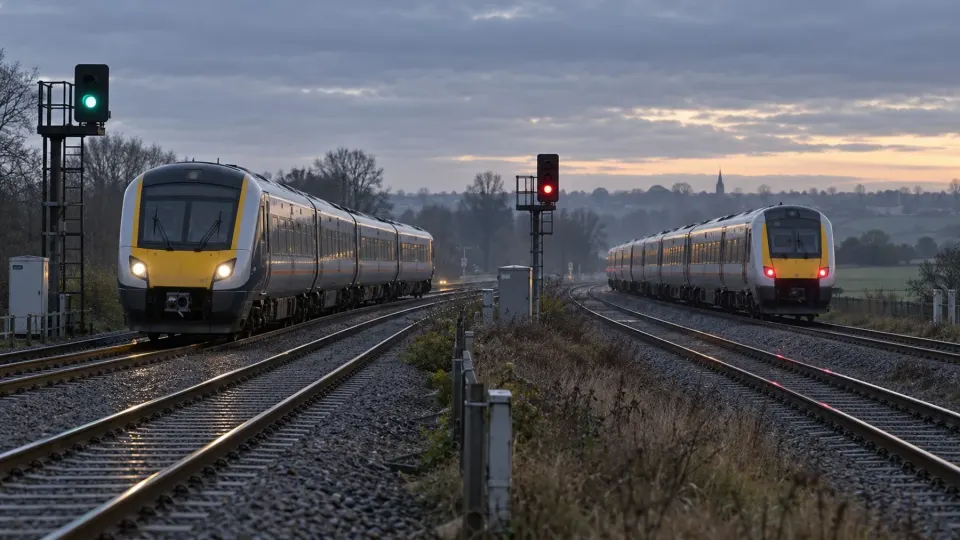
The Nottingham train, known in the report as 1B67, was travelling at about 123mph when its automatic warning system, or AWS, sounded a warning near signal WH154. Forward-facing camera footage showed that signal displaying green. On the evidence available, it should have produced an all-clear indication instead. The driver did not acknowledge the warning within the required 2.7 seconds, triggering an automatic emergency brake application. The train stopped beyond the signal at 5.11pm.
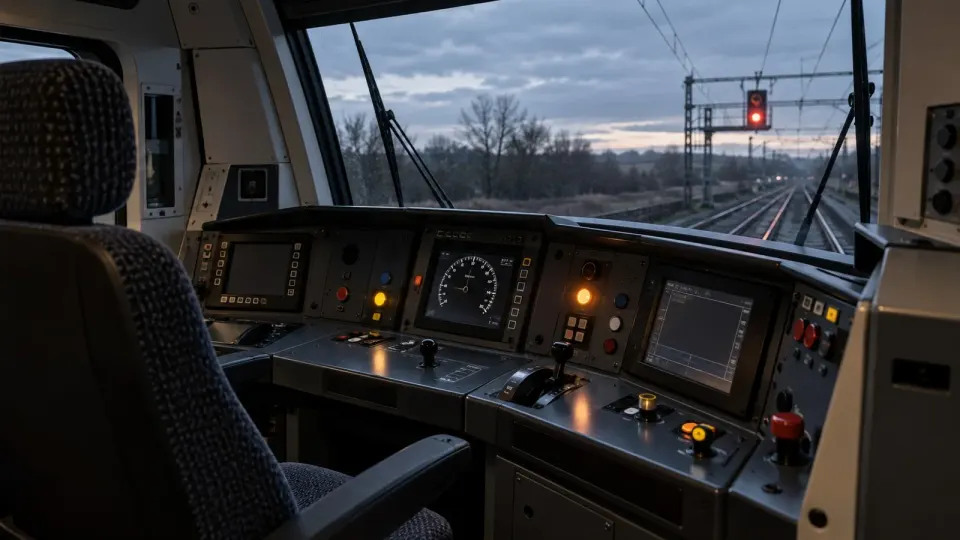
RAIB says a yellow warning button then flashed in the cab and a loud alarm sounded. Witness evidence indicates that neither the driver nor the driver-instructor recognised that sound as an AWS warning. The driver reported what they understood to be a fault to the signaller by radio. These observations explain why investigators are examining the system, its controls and training. They do not settle why the first warning occurred or assign individual responsibility.
With 1B67 stationary on the track, the preceding signal WH154 displayed red to protect it. The Corby train, 1H46, had left Bedford on a different line and then crossed onto the same fast line. It had correctly received and promptly acknowledged an earlier warning at a yellow signal. At 5.12pm it also received and acknowledged a warning associated with WH154, which camera footage shows was red. Its recorded speed nevertheless rose from about 49mph to a maximum of 76mph as it passed the signal.
The first recorded full-service brake application came about 10 seconds before impact, around 260 metres from the stopped train. An emergency brake followed roughly two seconds later. The speed had fallen to about 50mph when the trains collided at 5.13pm. RAIB says its investigation still needs to establish why 1H46 passed the red signal. Any confident explanation of the driver's thinking would go beyond the evidence it has published.
What the safety equipment did, and did not do
AWS sounds an alert as a train approaches a signal that is not green. A driver must acknowledge it; otherwise emergency braking follows. Acknowledgement is not permission to continue through a red signal. It is a prompt to observe and respond to the signal itself. The train protection and warning system, TPWS, can apply brakes at some red signals or on some approaches, but it is not fitted everywhere and is not intended to cover every possible speed and situation.
RAIB says WH154 had no TPWS track equipment and no signal-passed-at-danger alarm for the signaller. The report explains that a legal exception applied to a signal where a red-signal overrun could lead to a rear-end collision with a train travelling in the same direction. Network Rail had assessed the signal as low risk in October 2025, below the threshold for a more detailed assessment that might prompt extra protection. Those are important questions for policy and engineering, not proof that an individual broke a rule. The final report will examine the risk assessment and controls.
There is another technical clue. On 9 July, a different train received an AWS warning at WH154 while the signal showed green. That driver acknowledged the alert and reported it. Investigators found the track electromagnet sat 16 millimetres below railhead level, outside a required tolerance of plus or minus 12 millimetres. RAIB is still examining its interface with the train involved in June; it has found no evidence that the electromagnet was not energised. A measured discrepancy is not, by itself, a complete causal explanation of a fatal collision.
Why the interim label matters
RAIB draws on train data recorders, camera footage, signalling records, radio calls and witness evidence. Some footage stopped before impact, and the report says the different recording systems required time synchronisation. Small timing inaccuracies remain possible. More importantly, an interim report lays out what has been observed while the investigation continues. RAIB explicitly says its job is to improve safety, not determine criminal or civil liability.
Investigators will examine why the first train stopped, why the second passed the red signal, the behaviour of warning and braking systems, signal visibility, crashworthiness and the emergency response. That wider work matters because a railway is designed as several layers of defence. If a first layer misleads, another should protect people. A serious investigation asks how the layers interacted, including the awkward exceptions that can look innocuous on paper until a rare sequence occurs in real life.
For readers following transport resilience, OutOut's report on the recent UK air-traffic failure looks at a different system with the same public expectation: faults should be contained before passengers bear the cost. The rail evidence is much graver, and no comparison should erase the death and injuries here.
The OutOut verdict
The report is striking because it gives the public a sequence precise enough to scrutinise while refusing to pretend that sequence is the whole answer. The worst headline would reduce a complex collision to one button, one driver or one oddly placed magnet. The better question is how an unexpected warning, a stopped train, a red signal and the available automatic protections combined without preventing impact.
Rail passengers deserve an explanation that survives engineering scrutiny, and the family of the driver who died deserves more than instant blame assembled from a partial report. RAIB's final findings and any safety recommendations must be judged against the evidence, especially the risk model that treated this signal as low risk. A system can be compliant with its current rules and still need to change when reality exposes a gap.
Sources
- Rail Accident Investigation Branch interim report IR1/2026, published 1 October 2026; incident on 19 June 2026.
- RAIB report landing page, published 1 October 2026.