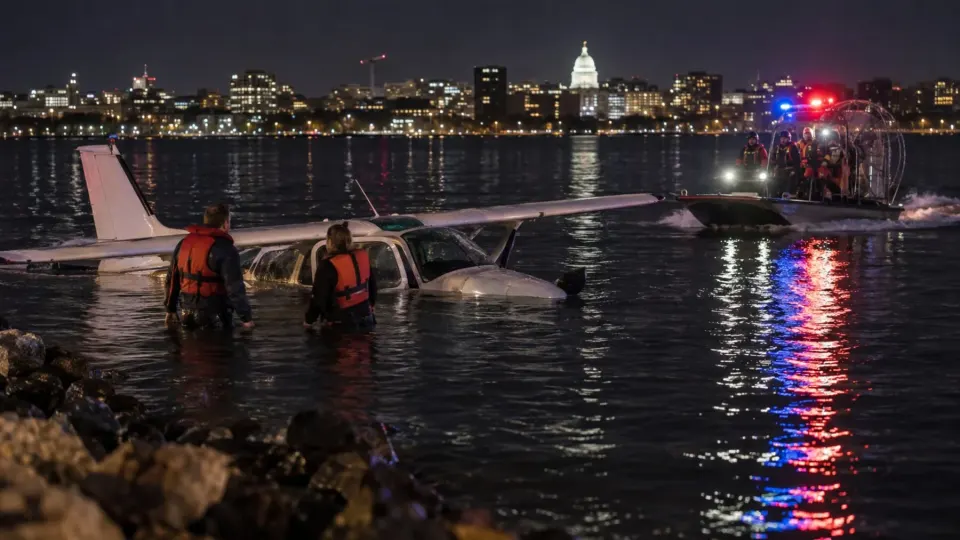
US congressman Tom Tiffany and pilot Leonard Boltz survived an emergency landing in a Wisconsin lake on Saturday night, escaped the aircraft as it began to sink and swam towards shore.
Tiffany, a Republican running for governor of Wisconsin, described the experience to reporters on Sunday 13 September. He said the pilot warned that the plane was going down and told him to tighten his seat belt. Roughly ten seconds later, they hit Lake Wausau.
The account is extraordinary without improvement from the internet. Two people were in a small aircraft. The aircraft entered a lake at night. Both got out, remained with it until it began sinking and then entered the water.
The sequence of the rescue
The Marathon County Sheriff’s Office said the emergency landing happened shortly before 9pm on Saturday. Boltz called emergency services after they escaped. Firefighters reached them using an airboat shortly after 9pm.
Tiffany said the pair initially stayed on top of the aircraft. When it began to sink, they decided to swim roughly 100 to 150 feet until the water became shallow enough to stand. Emergency crews then brought them to safety.

The 68-year-old congressman suffered a cut above his right eye that required 12 stitches. Boltz, described by Tiffany as a retired Air Force pilot, received four stitches for cuts. No other passengers were reported.
The cause of the emergency had not been established in the initial report. It would be irresponsible to turn a survivor’s account into an engineering conclusion. Investigators will examine the aircraft, maintenance and flight information before saying why it could not continue safely.
A no-wake buoy was placed near the partly submerged plane and boaters were asked to avoid the area until recovery. That mundane detail matters: wakes can move wreckage, create hazards and complicate evidence preservation.
What the pilot got right
Water landings are rare and dangerous. Survival depends on variables including aircraft type, speed, angle, visibility, restraint use and how quickly occupants can exit. In Tiffany’s account, the pilot provided a short, actionable warning rather than a lecture: tighten the belt.
After impact, staying with an aircraft can make survivors easier to locate, but a sinking cabin changes the calculation. Their decision to swim was made in the conditions they could see. It should not become generic instruction for every emergency; official guidance and a pilot’s commands take priority because no two scenes are identical.
The episode also demonstrates why “minor injuries” can describe a major event. Twelve stitches may be medically limited compared with what could have happened, but the emotional effect appeared later. Tiffany wiped away tears and laughed while recounting the crash, saying the gravity of it was only beginning to land.
He said the incident would not affect his campaign. That is politically relevant, but it should not crowd out the work of the pilot, dispatchers and fire crews. The story is shareable because a public figure survived; the rescue would be equally skilful if nobody aboard had a campaign website.
Readers should resist circulating dramatic footage falsely attached to the incident. The first verified reporting used official statements and Tiffany’s direct account. A generic night-rescue clip from another lake does not become evidence because someone adds his name in capital letters.
See more verified breaking stories in OutOut’s World section.
The OutOut verdict
This is the rare political story improved by removing politics. A pilot kept control long enough to put a small aircraft onto water. Two people escaped a sinking cabin. Fire crews crossed a dark lake and brought them home.
Tiffany says he will continue campaigning. Fair enough. After tightening a belt, hitting a lake and swimming towards shore at night, a day of town halls may feel like the relaxing option.