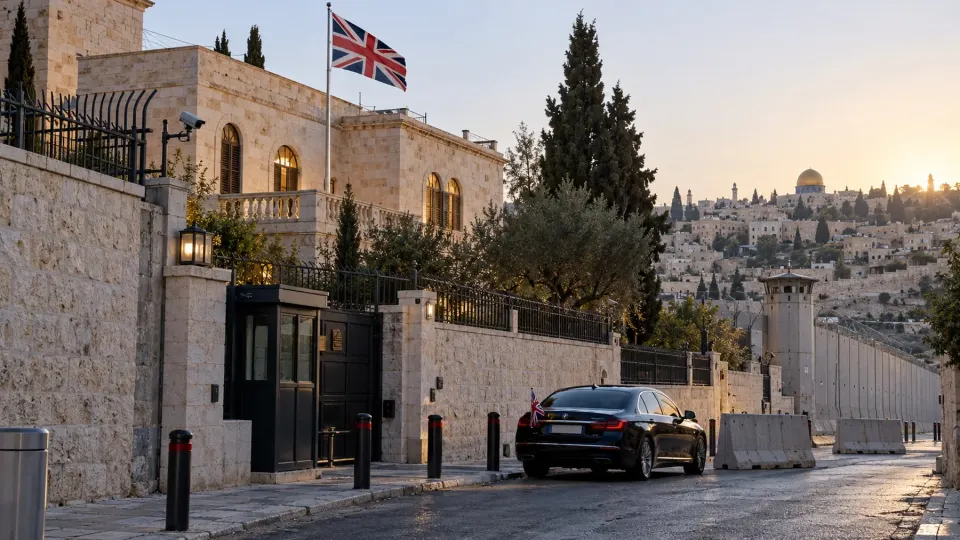
Britain is trying to prevent Israel from closing its consulate in East Jerusalem, a diplomatic mission that has served as the UK’s principal channel to Palestinians for decades. The threatened shutdown is retaliation in a policy dispute, but its practical consequences would fall on diplomacy, consular work and a population already living inside an unresolved conflict.
Reuters reported on Monday 5 October that National Security Adviser Jonathan Powell made an undisclosed visit to Israel the previous week to seek a solution. Israel ordered Britain on 8 September to close the consulate within 30 days and remove its diplomats from Jerusalem after the UK announced a ban on goods produced in Israeli settlements in the occupied West Bank.
The deadline is Thursday 8 October. Talks were continuing, Reuters said, but Powell’s visit had not secured an agreement. The British government says the sanctions respond to settlement expansion and settler violence, which it regards as undermining prospects for a two-state solution. Israel’s government rejects that position and has accused Britain of interfering in its politics.
The argument is therefore both immediate and much older than the latest order. It concerns who may represent whom in Jerusalem, whether settlement trade should receive ordinary market access, and how a government demonstrates displeasure without dismantling the channels needed to manage the consequences.
What the consulate actually does
The British consulate in Sheikh Jarrah represents UK interests in East Jerusalem, the West Bank and Gaza and supports relations with the Palestinian Authority and Palestinian communities. It also carries out consular and diplomatic functions that cannot be replicated by a strongly worded post from Whitehall.
Closing the mission would reduce Britain’s independent presence and its ability to engage directly with Palestinian officials and civil society. It would also send a political signal about East Jerusalem, whose status remains one of the central disputes in the Israeli-Palestinian conflict.
Britain does not recognise Israeli sovereignty over East Jerusalem. The UK supports a negotiated two-state settlement and regards Israeli settlements in occupied territory as illegal under international law. Israel disputes many international characterisations of the territory and says Jerusalem is its undivided capital.
Those positions cannot be made compatible by changing the locks on a consulate. Closure would instead convert a disagreement over trade and settlements into a dispute over diplomatic presence.
Why Israel ordered the closure
Britain announced that goods made in Israeli settlements in the occupied West Bank would be banned. France and Canada joined the sanctions, but Reuters reported that Israel had not taken equivalent action against them.
Israeli Foreign Minister Gideon Saar condemned the British policy and accused the Labour government of moral distortion and interference ahead of Israel’s election. That is Israel’s political case, not an independently established description of British intent.
The UK says settlement growth and increasing violence by some settlers are eroding the possibility of a viable Palestinian state. Banning settlement goods is designed to distinguish trade with Israel inside its internationally recognised borders from economic activity in occupied territory. Critics will ask whether the measure changes conduct or mostly advertises disapproval. Supporters will argue that allowing ordinary commerce while condemning settlements is policy by contradiction.
The consulate order raises a second proportionality question. Diplomatic missions exist partly so hostile governments can communicate when relations deteriorate. Removing one may feel decisive, but it also removes staff who understand local institutions, provide services and carry messages that cannot safely wait for relations to become friendly again.
OutOut has previously examined how sanctions can collide with institutions and payment systems. The mechanism differs here, but the lesson is similar: political measures have operational consequences beyond the headline target.
The sovereignty problem underneath
East Jerusalem was captured by Israel in the 1967 Middle East war and later annexed in a move not recognised by most of the international community. Palestinians seek it as the capital of a future state. Israel’s government claims the entire city as its capital.
That status explains why a consular building becomes more than office space. Keeping a separate British mission in East Jerusalem reflects the UK’s refusal to treat the territory’s final status as settled. Requiring it to close would weaken that practical distinction even if British policy remained unchanged on paper.
The dispute also arrives during immense regional strain. War, displacement, hostage diplomacy, settlement expansion and repeated violence have reduced political trust. In that environment, direct representation is most valuable precisely when it is least comfortable.
None of this makes British policy immune from scrutiny. Ministers should publish the legal basis, product definitions and enforcement arrangements for the settlement-goods ban. Consumers and businesses need to know how origin will be verified, while Parliament needs evidence about whether sanctions are achieving their stated purpose.
Israel, meanwhile, should explain why Britain’s consulate must pay for a decision made in London and why equivalent steps have not been taken against the other governments involved. Selective retaliation invites the conclusion that the mission’s particular political meaning—not only the trade measure—is the point.
What happens by Thursday
Negotiations could produce a delay, compromise or reversal. Britain could also face a forced closure and then decide how to preserve services and Palestinian engagement through other diplomatic arrangements. Reports that London might consider retaliatory expulsions have added pressure, but any such action should be confirmed officially before being treated as policy.
The next useful facts are an Israeli decision on the deadline, a formal UK response and practical guidance about consular services. Until those arrive, anonymous briefings should not be promoted into completed diplomacy.
The OutOut verdict
Closing a consulate because a government dislikes a sanctions policy is diplomacy performed with the fire exit blocked. It creates a dramatic gesture while reducing the machinery available to resolve the dispute.
Britain must defend its legal position clearly and demonstrate that its settlement-goods ban is enforceable rather than decorative. Israel can challenge that measure through diplomacy and law. Evicting diplomats who work with Palestinians looks less like an answer to the policy than an attempt to erase the distinction the policy is built upon.
The region has no shortage of megaphones. It needs officials who can still enter rooms, listen and carry an accurate message home. A consulate is not a peace agreement, but removing one is an oddly efficient way to ensure everybody understands one another less.
Sources
* Reuters, 5 October 2026: UK adviser sought to keep East Jerusalem consulate open