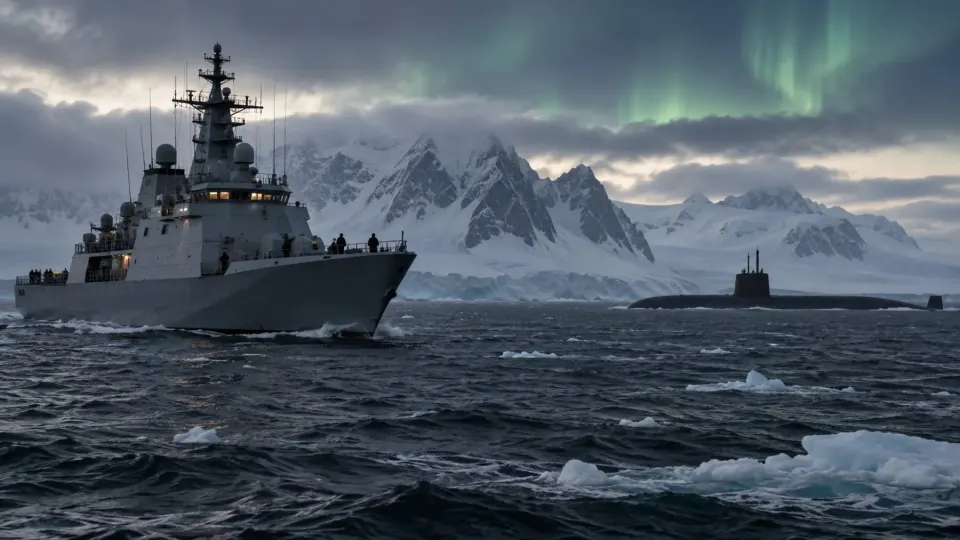
Britain, Norway and the United States disrupted a Russian military exercise near critical undersea cables in the Arctic, according to two Western officials who spoke to Reuters.
The officials said Russian deep-sea units associated with the military’s GUGI directorate were attempting to practise deploying technology that could damage cables near Svalbard. Allied forces tracked and confronted the operation before the exercise was completed. No cable was damaged.
Reuters published the exclusive account on Thursday 10 September. Russia did not respond to the agency’s detailed request for comment. The claims have not been independently demonstrated through publicly released evidence, so the responsible formulation is “officials say”, not “Russia definitely tried to cut the internet”.
Why Svalbard matters
Two fibre-optic cables, each roughly 1,400 kilometres long, link the Norwegian archipelago of Svalbard with the mainland. They carry ordinary communications and data from SvalSat, a major satellite ground station used by commercial, scientific and government customers including NASA.
The cables cross deep and difficult waters, reaching depths of about 2,700 metres. Repairing damage in that environment is not like replacing the lead behind the television. Ships, specialist equipment, suitable weather and knowledge of the fault location are required.
That vulnerability gives subsea infrastructure strategic importance. Cables carry the overwhelming majority of international digital traffic, while pipelines and power connections share the seabed. A failure can have civilian, commercial and military consequences without producing the visible destruction associated with a conventional attack.

What the allies reportedly did
The Reuters account describes a joint operation involving surveillance and military assets from Britain, Norway and the US. Norway’s defence minister confirmed that the allies had conducted covert activity in the High North, although public statements did not provide every operational detail.
The purpose appears to have been deterrence as well as interruption: show that the activity had been detected, prevent the exercise being completed and avoid escalation into physical damage.
Operations of this kind sit in an uncomfortable grey zone. States can map infrastructure and exercise in international waters; sabotage is illegal and potentially escalatory. Proving intent before damage occurs is difficult, especially when governments cannot reveal the intelligence methods behind their assessment.
Russia has repeatedly denied Western allegations that it conducts sabotage campaigns or plans conflict with NATO. That denial should be recorded alongside the Western claims.
A wider pattern of concern
European governments have increased patrols after a series of damaged cables and pipelines in the Baltic and North seas. Not every incident is hostile: anchors, fishing gear, weather and accidents regularly damage subsea infrastructure. Attribution requires physical evidence, tracking data and sometimes a criminal investigation.
The number of ships drifting or behaving unusually near infrastructure can indicate risk, but it cannot by itself prove a state-directed plot. The same caution applies to dramatic maps shared online after an outage. Correlation is a reason to investigate, not a verdict.
Resilience is therefore as important as interception. More diverse routes, faster repair capacity, better monitoring and cooperation with private cable operators reduce the leverage any adversary might gain.
For continuing international coverage, see OutOut’s World section. Our Technology reporting follows the infrastructure beneath apparently weightless digital services.
The OutOut verdict
The cloud is, once again, wet cables at the bottom of the sea wearing a marketing department.
The Reuters report is serious and plausible, but its most important claims rest on unnamed officials and classified activity. Treat the operation as a reported allied assessment, not settled courtroom fact. The policy lesson does not depend on theatrical certainty: Europe’s cables are vulnerable, repair takes time and quiet investment in redundancy is considerably cheaper than discovering the problem after the screen goes black.