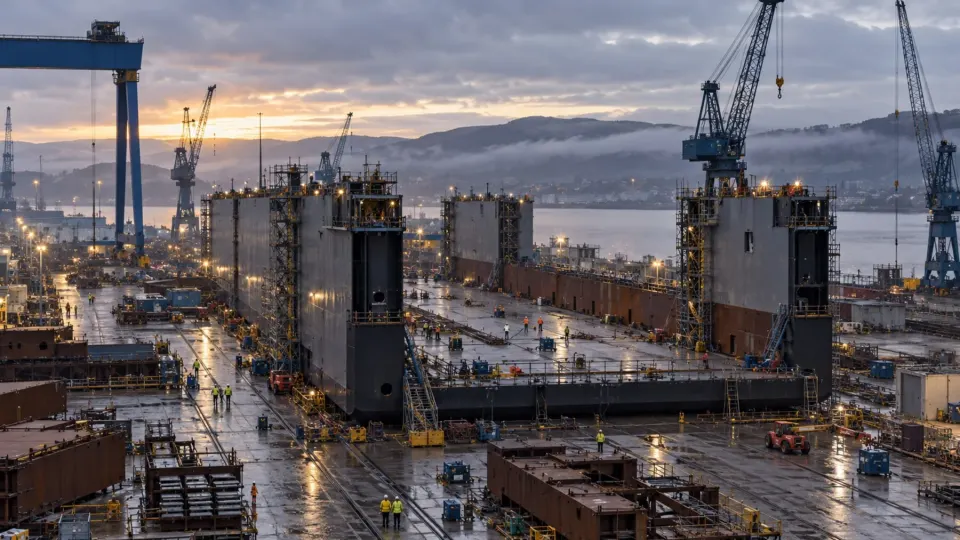
The government announced on Monday 28 September that three new floating docks for the Royal Navy's submarine service and a replacement marine research vessel will be built in Britain. Ministers describe the package as part of a “new age of industrialisation” and say the projects are worth billions of pounds. That is a serious procurement commitment, but it is not yet a photograph of four finished vessels, a named set of winning yards or a final bill.
The three docks, grouped under Programme Euston, are intended for HM Naval Base Clyde. They will allow inspections, repairs and upgrades to Britain's current and future nuclear-submarine fleet. A floating dock is not a warship: it is a vast movable maintenance platform that can be submerged, receive a vessel and then lift it clear of the water. Without suitable dock capacity, even the most expensive submarine eventually becomes an extremely sophisticated object waiting for somewhere to be serviced.
The separate research ship will replace the ageing RV Cefas Endeavour and is expected to become operational in the early 2030s. It will monitor fish stocks, pollution and the seabed, using automation, robotics and artificial intelligence, according to the government. The contract will be restricted to UK shipyards under a national-security exemption in procurement law.
What has actually been promised
The Clyde dock competition will be UK-only because ministers regard submarine support as a sovereign capability. The announcement does not identify the winning builder, the individual contract value, construction start date or completion schedule. “Multi-billion pound projects” describes the combined scale, not a blank cheque already deposited in a yard's account.
That distinction matters for jobs. A long pipeline allows yards to recruit apprentices, retain welders and engineers, invest in machinery and give suppliers confidence to expand. An announcement without timely contracts can instead become a glossy holding pattern. Workers will judge the policy by paid hours and durable skills, not the number of times ministers say “industrial strategy” beside a hard hat.

The government also plans to give the National Shipbuilding Office oversight of future civil ship procurement. That could reduce the stop-start pattern in which departments order ships separately, yards face gaps between projects and the public sector relearns the same lessons at considerable expense. It could also add another coordinating body unless authority, budgets and accountability are clear. The promised Shipbuilding and Maritime Technology Action Plan later this year should show which version is intended.
Why floating docks are strategic infrastructure
Britain's nuclear deterrent and attack submarines depend on specialist maintenance facilities. The Clyde base is central to that system, so dock capacity is not a decorative regional project. It is part of whether submarines can remain safe, available and upgradeable over decades. The national-security argument for retaining design, fabrication and maintenance knowledge in the UK is therefore stronger than a generic campaign to place every public order domestically.
There are still trade-offs. Restricting competition may strengthen sovereign capacity and reduce exposure to overseas disruption, but taxpayers need assurance that price and performance remain disciplined. A British-only contest is not permission for cost growth to become patriotic. Programme Euston will require transparent milestones, credible contingency and parliamentary scrutiny without publishing operational details that genuinely need protection.
The research vessel poses a different test. Its value will lie in reliable evidence about seas and fisheries, not merely in the launch ceremony. Cefas data informs decisions about stock management, pollution and marine conditions. Building the replacement in Britain may sustain industrial capability, while operating it successfully will require scientists, crews, maintenance budgets and usable data systems for years after delivery.
The supply-chain opportunity
Large ship projects pull spending through steel fabrication, electrical systems, pumps, sensors, software, specialist coatings and professional services. Not every pound remains beside the slipway. That can spread work across the country, but only if procurement rules give smaller suppliers a realistic route into contracts and prime contractors do not swallow the policy whole.
Skills are the longer prize. Shipbuilding cannot summon experienced welders, naval architects or systems engineers on the morning a contract is signed. Predictable orders allow colleges and employers to train people before a shortage becomes an emergency. The government should publish apprenticeship numbers, regional supplier participation and delivery progress, then update them. Otherwise “supporting jobs” remains a phrase flexible enough to survive almost any result.
There is also a lesson from Britain's wider industrial debate. Earlier OutOut coverage examined the pressure on energy-intensive plants and their supply chains. Shipyards likewise depend on power, steel and skilled labour. Buying British at the final assembly stage works best when the underlying industrial ecosystem can compete and invest.
The new orders are politically useful because they join defence, science and regional jobs in one announcement. That does not make them empty. It makes measurement more important. Ministers should separate firm funding from expected spending, direct jobs from jobs “supported”, and signed contracts from future competitions.
The OutOut verdict
Four British builds are a welcome change from an industrial policy that too often arrives after the factory gates have closed. The docks are essential infrastructure, and the research ship can provide public value far beyond its hull. The announcement has earned attention; delivery must now earn the applause.
Name the yards when the competitions conclude, publish milestones, protect value for money and train the people who will do the work. A new age of industrialisation cannot be assembled entirely from press releases, however seaworthy the adjectives.