An Orange Order march may pass through Portadown's Garvaghy Road on Sunday 27 September after Northern Ireland's High Court dismissed a last-minute challenge in the early hours. That followed a Court of Appeal decision to remove a temporary injunction granted on Saturday to local residents. Reuters reported the latest ruling at 1:39am UTC. The march itself had not taken place when this article was prepared, and the outcome on the street must not be written in advance.
The route has been disputed for almost 30 years. The Garvaghy Road is a mainly Catholic and nationalist area of a largely Protestant and unionist town. Annual attempts to march through it became a defining flashpoint of the 1990s and were associated with serious unrest. For the Orange Order, the issue involves a traditional route and the right to parade. For residents who oppose it, it involves a procession through their neighbourhood without their consent. Both positions must be described accurately; neither side's fear can be settled by a glib headline.
The legal sequence changed repeatedly within two days. On Friday the Parades Commission permitted a limited march, reversing a long-standing restriction. Residents challenged that decision, and on Saturday a High Court judge granted a temporary block. The Court of Appeal then set the block aside. A further High Court application was dismissed early Sunday. Saying simply “a judge banned the parade” or “the courts approved it” misses the sequence that explains why people on both sides spent the night waiting for news.
What the decision permits
Reuters says the Parades Commission's Friday determination limits the relevant section of the march to 35 people, with no supporters or bands, and requires it to start by 8am and finish by 9:30am. Those are conditions reported by Reuters, not a promise that the event will pass without incident. The Commission's public parade listing records the 27 September date and a 25 September determination with conditions imposed. The published application describes a larger proposed procession; an application is not the same as what the final conditions permit.
That distinction matters in this case. A reader who looks only at the proposed route and numbers on a database page could mistake the organiser's request for the Commission's restricted approval. The conditions are a mechanism intended to manage competing rights and risks. Whether they are followed and whether residents feel heard are separate questions that Sunday will test.
The route was barred after the 1998 disputes, the same year the Good Friday Agreement was signed. Northern Ireland has changed profoundly since then, but the meanings attached to a particular street have not evaporated. A narrow road can carry questions about public space, identity, memory and whether one community's expression feels like pressure to another.
Reuters reports that the Commission had earlier maintained the prohibition, but a court quashed that decision in August over a procedural error. That did not decide the underlying community dispute. It required the decision-making process to be reconsidered. The latest court rulings likewise concern what can lawfully proceed under current decisions; they do not certify that relations between the parties have healed.
Why the response is so charged
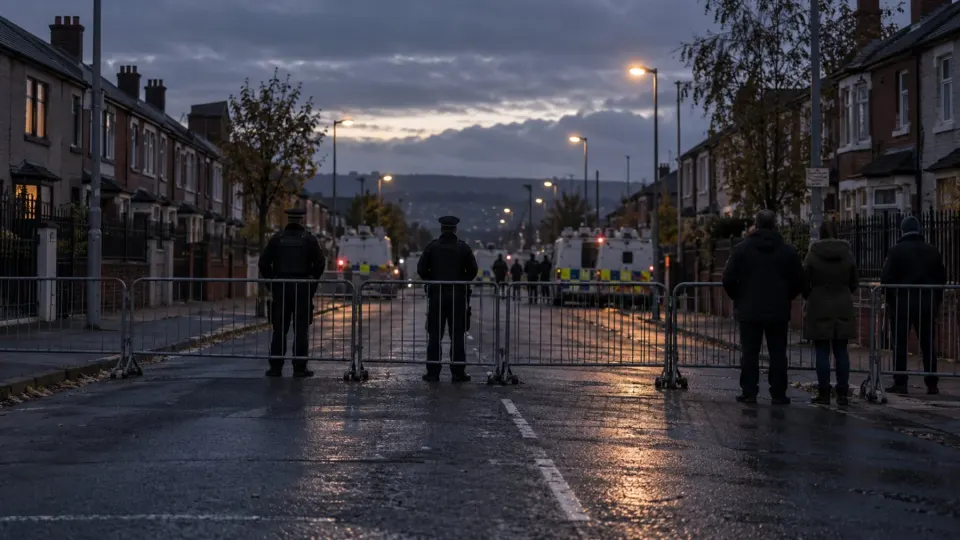
A crowd gathered on the Garvaghy Road early Sunday to protest the permission, Reuters reported. First Minister Michelle O'Neill and Sinn Féin leader Mary Lou McDonald were among those present in social-media video cited by the agency. Democratic Unionist MP Carla Lockhart told reporters that nationalist politicians should respect the rule of law and allow the march. Those are political responses from opposing sides, not independent accounts of what will happen later in the morning.
The Saturday judge, Patricia Smyth, urged parties to find agreement and warned that the old dispute could escalate, according to Sky News's court reporting. Her concern is a reminder that a legal ruling can settle an immediate application without creating consent. The most important practical questions now are whether everyone observes the stated conditions, whether police and stewards can keep people safe, and whether leaders use language that lowers rather than raises the temperature.
There is an uncomfortable balance here. Freedom of assembly and expression are important. Residents also have legitimate interests in safety, dignity and peaceful use of their street. The Parades Commission exists to make decisions in that difficult space. Courts can review whether decisions are lawful. Neither institution can force neighbours to trust one another overnight.
One can understand why a parade restricted to a small group and stripped of bands looks different to organisers from the full route they might have wanted. One can equally understand why residents still see its passage as a profound change after decades of exclusion. Reporting both does not imply the two experiences are interchangeable. It gives readers the context needed to understand why a short walk has generated urgent legal action.
OutOut's UK coverage will need to update the account if Sunday's event, conditions or further legal position changes. At publication, the established development is the overnight removal of the legal block, not a completed march and not a forecast of disorder. Images circulating online should be checked for date and location before being presented as today's scenes; Drumcree has a long visual archive that can easily be miscaptioned.
The OutOut verdict
The legal timetable has moved faster than the community conversation. Four changes of position in two days may satisfy the court calendar, but it leaves residents and marchers facing one another with very little time to absorb the final answer. A route this burdened by history deserves precision from every official and every publisher.
The test today is straightforward to describe and difficult to deliver: observe the limits, keep people safe, and avoid treating a court win as a licence to humiliate anyone. The headline may belong to the judges; the consequences belong to the people who live there.