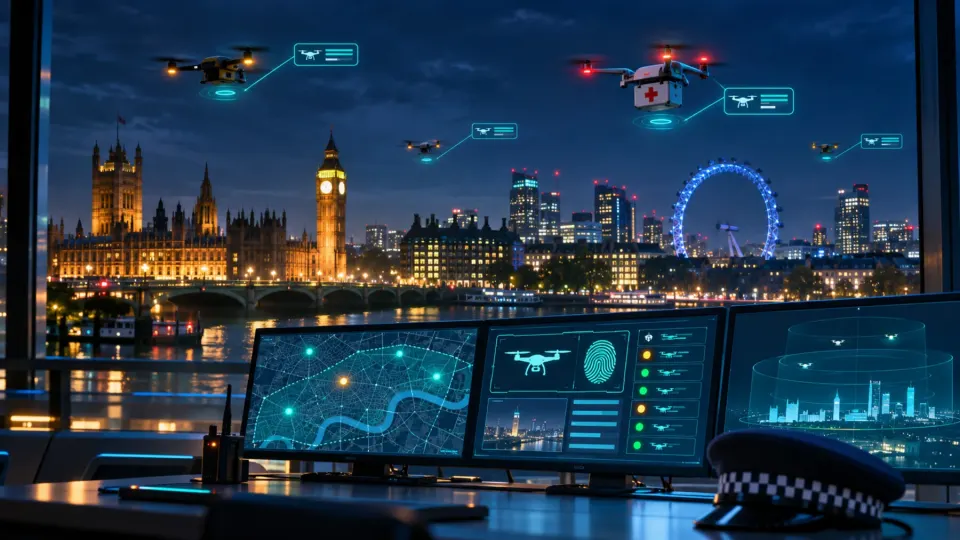
Police in London will test technology designed to detect drones' digital identities over greater distances, under a government-backed programme worth nearly £2 million. Announced on Tuesday 24 November, the trial is intended to help officers distinguish authorised flights from nuisance or dangerous activity around events, transport and sensitive sites.
The Department for Transport is providing £1.2 million, with a further £500,000 from the Regulatory Innovation Office for equipment and infrastructure. The National Police Chiefs' Council will decide where the equipment is deployed. The government has not published a map of sensors, a named supplier or a performance evaluation, so the story is a funded trial—not the instant arrival of an all-seeing anti-drone shield above every garden shed.
Existing systems can broadcast a drone's identity and location like a digital number plate, but the government says detection is generally confined to a limited vicinity. New equipment is supposed to improve accuracy and range, giving police a broader picture of activity across the capital.
What a digital number plate means
The phrase is deliberately familiar. A car carries a visible registration that can be read by people and cameras. A drone's remote-identification signal can transmit identifying and location information electronically to compatible receivers. Officers can then compare what is in the sky with authorised operations and investigate flights that may breach restrictions.
Identification is not interception. Detecting a signal does not automatically prove an offence, reveal the operator's intention or safely bring an aircraft down. A legitimate flight can be near an event; an illegal operator can attempt to avoid compliance; and a technical alert still needs trained people, aviation rules and evidence. The number plate starts the question. It does not deliver the verdict in a tiny envelope by propeller.
The trial follows disruptive incidents cited by the government, including drone activity around an Arsenal match, seizures around Oasis concerts and an illegal drone encountered near Heathrow in October. Those examples explain the security interest, but the announcement does not say the new system would definitely have prevented each event.
Security and useful drones share the same sky
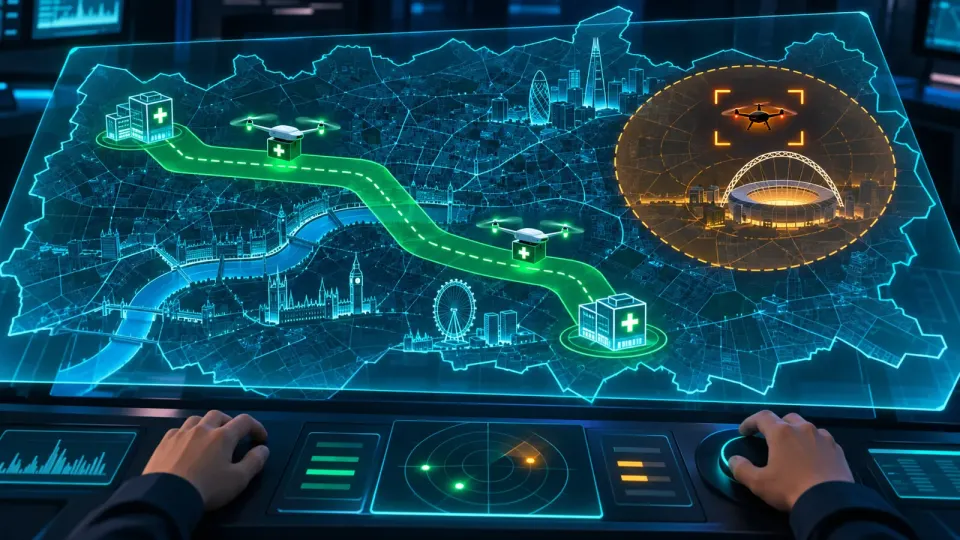
The programme also aims to support legitimate operations. The government says autonomous-logistics company Apian will expand NHS services in London, with ambitions for faster movement of pathology samples, medicines, blood and transplant organs between hospitals and laboratories. Better identification could help police recognise those flights instead of treating every small aircraft as a suspicious buzzing parcel.
Drones are already used for infrastructure inspection and emergency support. Sensors beside Birmingham rail infrastructure are giving police and Network Rail information about nearby airspace. The broader policy goal is to let authorised services scale while making unauthorised activity easier to identify.
That balance matters for privacy as well as safety. A system able to map aircraft identity and location needs rules about data retention, access, accuracy and how information is linked to registered operators. The government announcement focuses on operational benefits and does not set out a full privacy framework for the London deployment. Those details should be published before a trial quietly becomes permanent infrastructure.
There is also a cybersecurity question. Digital identity is useful only if it is difficult to spoof and if receivers can distinguish missing, false or duplicated signals. The trial should test failure modes, not merely demonstrate the ideal case on a calm afternoon with three cooperative aircraft and a minister pointing at a laptop.
What the money buys
The combined announced contributions total £1.7 million, described as nearly £2 million. The DfT says funding will support the trial, while the Regulatory Innovation Office's contribution covers police equipment and infrastructure and helps remove barriers to scaling drone operations. A detailed procurement breakdown has not been published in the announcement.
The government estimates the UK drone sector could contribute up to £103 billion over 25 years. That is a forecasted potential, not money already added to the economy or guaranteed by this particular trial. Long-range estimates should be read as a case for investment, not as a cheque hovering over London waiting to land.
OutOut's Technology coverage follows the difference between a promising deployment and a proven nationwide system. Our reporting on the CHOSEN BRICK spyware warning made the same practical point from another direction: technology policy matters most when capabilities, limits and evidence are stated separately.
The OutOut verdict
London needs a way to tell an NHS sample flight from somebody filming a concert from the air because the ticket view was disappointing. Stronger remote identification is a credible part of that job. It can improve awareness, shorten investigations and let lawful operators prove they belong.
But “number plates of the sky” is a metaphor, not a magic spell. Roads have registration plates and Britain has somehow not eliminated dangerous driving. Enforcement still needs coverage, reliable data, legal powers and humans capable of distinguishing a threat from a delivery route.
Run the trial, publish the performance, disclose the privacy safeguards and explain what happens when a drone does not broadcast obediently. If it works, scale it. If it mostly produces a very expensive map of compliant operators, the sky will have gained bureaucracy without much protection.
Sources
- UK Government: new digital number plates to help police crack down on criminal drone use, published 24 November 2026.
- Civil Aviation Authority: flying drones and model aircraft in the UK, rules and safety guidance accessed 25 November 2026.
- Civil Aviation Authority: Remote ID for drones, technical background accessed 25 November 2026.