
Britain has joined ten other countries in NATO's STARLIFT initiative, a plan to build a more flexible network for launching military satellites at short notice. The UK government announced its participation on Sunday 22 November, five days after NATO publicly introduced the multinational programme.
The aim is resilience. Satellites support navigation, communications, weather forecasting, financial transactions and military operations. If one launch provider, site or supply chain becomes unavailable, allies want alternative routes into orbit rather than a queue and a strongly worded meeting.
STARLIFT is an initiative and a set of four initial projects, not a new fleet of rockets already standing ready across Europe. The announcements do not provide an overall budget, delivery timetable, named commercial contracts or a complete list of launch sites. Those missing details determine whether “responsive launch” becomes an operational capability or remains a particularly elegant diagram.
What the eleven countries signed
The UK joined Belgium, Canada, Finland, Germany, Italy, the Netherlands, Norway, Türkiye, Sweden and the Republic of Korea. NATO says the initiative is designed to secure launches for military purposes, using commercial services and national infrastructure where possible.
The four projects will develop common ways to identify and contract launch capacity, test responsive operations, improve launch infrastructure and logistics, and address regulatory barriers including air, maritime and space-traffic management. Pooling demand could help allies buy services more efficiently and avoid every country attempting to maintain a complete sovereign launch chain.
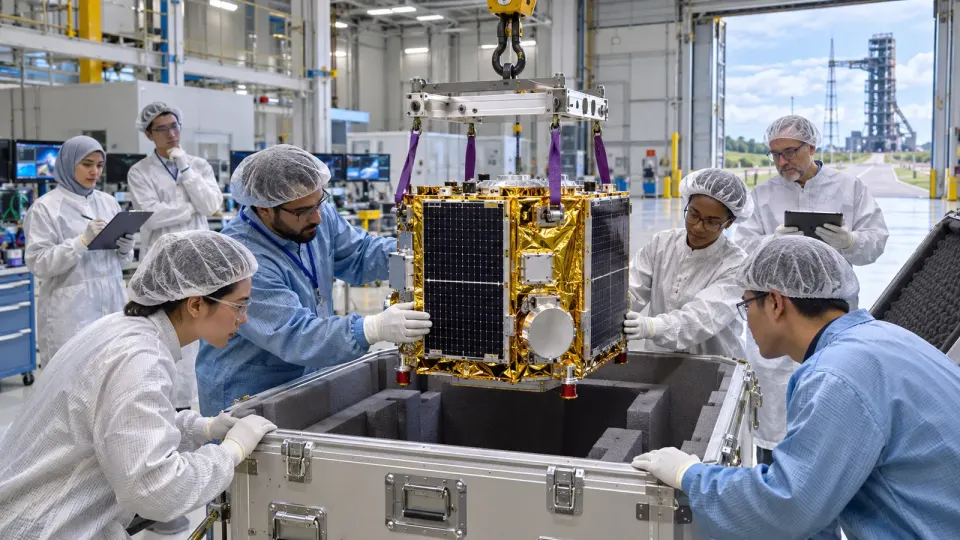
Responsive launch means being able to place a satellite into orbit faster than a traditional mission cycle, potentially replacing a lost capability or adding capacity during a crisis. Speed depends on far more than the rocket. A satellite has to be available, compatible with the vehicle, transported, integrated, licensed and assigned a safe orbital path. Weather and range safety remain stubbornly unimpressed by the word “urgent”.
Where the UK fits
The government highlighted SaxaVord Spaceport in Shetland, the UK's licensed vertical orbital launch site. It is approved for up to 30 launches a year, and ministers announced £30 million in September to accelerate infrastructure needed for regular orbital activity. Approval and investment create capacity; neither is a record of 30 successful launches.
Britain also has an established satellite-manufacturing, research and services sector. Joining STARLIFT could connect those capabilities to allied demand and give UK launch providers access to larger programmes. The commercial benefit, however, will depend on contracts won and missions completed. Membership alone does not guarantee work for a British company.
The UK release links STARLIFT to a national Space Strategy containing more than £7.8 billion for security and growth. It also cites Titania, a UK military satellite launched under Programme ISTARI. These examples show how space services fit into defence planning, but they should not be added together as if every pound were allocated to STARLIFT. No specific British contribution to the initiative was disclosed in Sunday's announcement.
OutOut's coverage of the UK–US AI defence partnership raised a similar accountability test: cooperation can strengthen capability, but budgets, milestones and boundaries matter. STARLIFT needs public measures of success that do not compromise operational security—such as exercises completed, contracting time reduced and compatible launch options demonstrated.
Why satellites have become a security issue
Modern life depends on systems most people never see. Navigation signals support transport, timing and telecoms. Earth-observation satellites contribute to weather and disaster response. Military forces use space for communication, intelligence and coordination. Disruption can therefore travel quickly from an orbital problem to a terrestrial one.
Space is also congested and contested. Satellites can fail, be jammed, suffer cyberattack or become vulnerable during conflict. Debris and traffic complicate operations even without hostile action. Resilience means protecting existing systems, distributing functions across more spacecraft and having a credible way to replace capacity.
Rapid launch is only one layer. A replacement satellite is useless if its ground network is compromised or its components depend on one fragile supplier. Conversely, distributed constellations may reduce the need for a dramatic emergency launch if spare capacity already exists. NATO should explain how STARLIFT fits with those wider plans rather than treating a rocket as the entire resilience strategy.
There are environmental and regulatory questions too. More launches affect local communities, airspace, maritime zones and emissions, while additional spacecraft must be managed to limit debris. The UK says one project will address traffic management and regulatory obstacles. “Obstacle” cannot become shorthand for safety rule everybody finds inconvenient at 48 hours' notice.
The OutOut verdict
The strategic logic is strong. If allies depend on satellites, relying on one pad, one company or one national queue is a vulnerability. A shared network can provide options, competition and mutual support.
The press-release version nevertheless performs its favourite manoeuvre: it launches the aspiration before the reader can inspect the payload. We know who joined and what the four workstreams are meant to do. We do not know the budget, schedule, launch providers, exercise dates or how quickly “rapid” is supposed to be.
STARLIFT deserves to move from announcement to demonstration. Put a compatible satellite, rocket, licence and multinational team through a timed exercise. Publish the non-sensitive results. Until then, NATO has built a promising launch network on paper—where the weather is always clear and every component arrives before lunch.
Sources
- UK Government: UK reaches for stars with NATO space launch plan, published 22 November 2026.
- NATO: multinational space initiative STARLIFT begins, published 17 November 2026.
- UK Government: UK Space Strategy and SaxaVord funding, published September 2026.