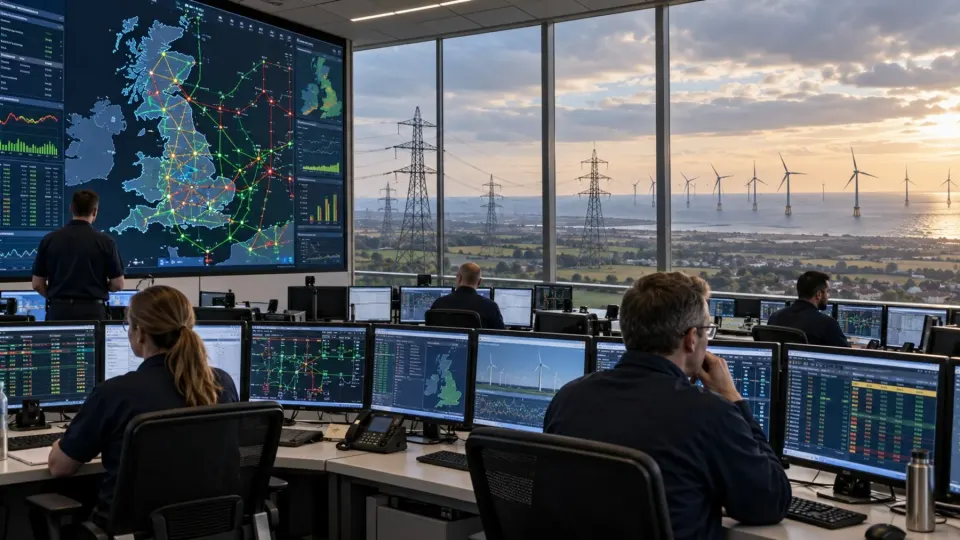
The government is launching a state-owned body called Great British Grid, with a promise to accelerate electricity connections, integrate renewable power and bring industrial energy costs closer to those paid by competitors in Europe. It is an attempt to turn the national grid from an obstacle described at every business conference into infrastructure that arrives before the opening ceremony has gone home.
Prime Minister Andy Burnham is expected to place the new organisation under Great British Energy. According to Reuters, it will coordinate investment, increase competition in the connections system and work towards cutting business electricity costs to European levels over the next decade.
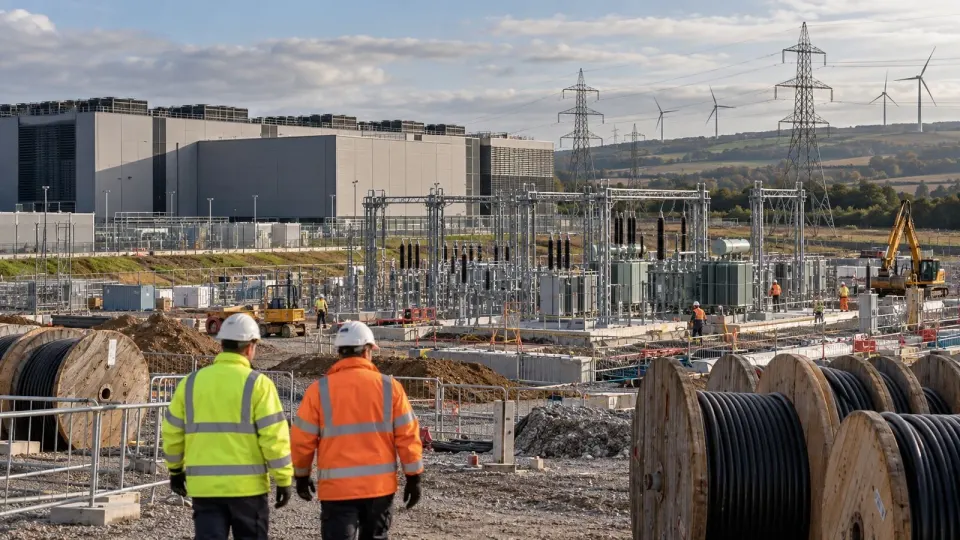
The objective addresses a genuine problem. A factory, battery project, housing development or data centre can secure land and finance yet still wait years for enough network capacity. Renewable generators can also sit in a connection queue while the transmission lines needed to move their power are planned, approved and built. Britain does not merely need more electricity; it needs the right wires in the right places at the right time.
What has been announced—and what has not
Great British Grid is a new coordinating entity, not a completed set of pylons. The launch does not instantly reduce a bill, connect a factory or create capacity at a constrained substation. The public test will be measurable: shorter average connection times, removal of speculative projects from the queue, faster planning and procurement, lower network constraints and a credible path for business prices.
The government's long-term ambition is to push British industrial electricity costs towards European levels. That is not the same as a guaranteed price cut of a stated amount on a stated date. Bills reflect wholesale generation, network charges, policy costs, taxes and the shape of industrial support. Grid reform can improve several of those pressures, but it cannot control international gas prices or make every energy-intensive process cheap.
The queue itself is not a single line in which every project ahead is ready to build. Some developers hold connection positions while finance, land or planning remains uncertain. Reform therefore needs milestones that move viable schemes forward and remove projects that cannot demonstrate progress. Done well, that releases capacity. Done crudely, it risks changing rules after serious developers have already spent money.
Why faster connections matter
For manufacturers, long waits turn investment decisions into location decisions. A company comparing Britain with another European country will examine power price, reliability and connection date alongside wages and grants. A ministerial promise made in 2026 carries little weight if the factory cannot operate until the 2030s.
For households, the route is less direct but still important. New network capacity can connect cheaper renewable generation and reduce the sums paid to switch off generators where the grid cannot carry their output. It can also accommodate heat pumps, electric vehicles and housing growth. Yet grid construction has a cost, and consumers ultimately fund much of the system. The useful question is not whether investment is free; it is whether spending now prevents larger constraint and delay costs later.
Communities will see the physical consequences. Transmission upgrades mean pylons, substations, cables and construction. Planning must allow necessary infrastructure to proceed while compensating affected communities fairly and assessing environmental impact honestly. Calling every objection obstructionism is lazy; pretending a modern electricity system can be built without visible equipment is equally unserious.
Great British Grid also needs a clear relationship with National Grid, Ofgem, electricity-system bodies, network operators and devolved governments. A new logo does not simplify a crowded institutional map unless authority is explicit. Who decides priorities? Who owns assets? Who carries delivery risk? Who can be held responsible when a connection date moves again? These are operational questions, not bureaucratic trivia.
The link to Britain's industrial problem
Energy-intensive firms have spent years warning that British costs weaken their competitiveness. The recent decision by Ineos to mothball three chemical plants in Hull brought those pressures into sharp focus. OutOut examined the jobs, supply chains and energy-cost argument. Great British Grid will not reopen those plants by announcement, but it must help prevent the next investment from concluding that Britain has excellent speeches and unaffordable electrons.
The plan may also support the government's clean-power objectives. Offshore wind and other renewables are useful only when their electricity can reach consumers. Storage and flexible demand can ease pressure, but they still depend on market rules and network access. Coordination across generation, transmission and industrial demand is sensible; the danger is that “coordination” becomes a meeting whose output is another strategy document.
Success should be published in a dashboard with baseline data: median connection time, capacity added, queue size, constraint costs, major projects delivered on schedule and business-price comparisons using consistent definitions. Without that, almost any new cable can be declared proof of success while delayed customers continue refreshing their inboxes.
The OutOut verdict
Britain needs to build the grid it keeps assuming exists. A state-owned coordinator can help if it has authority, engineering capacity, money and a ruthless focus on delivery. It will fail if it becomes a ceremonial plug socket attached to the side of Great British Energy.
The launch answers the easy question—who gets the new name. The harder questions concern which projects move, how quickly they connect and whether businesses see the difference in their bills. The queue does not need another steward with a clipboard. It needs fewer years in it.