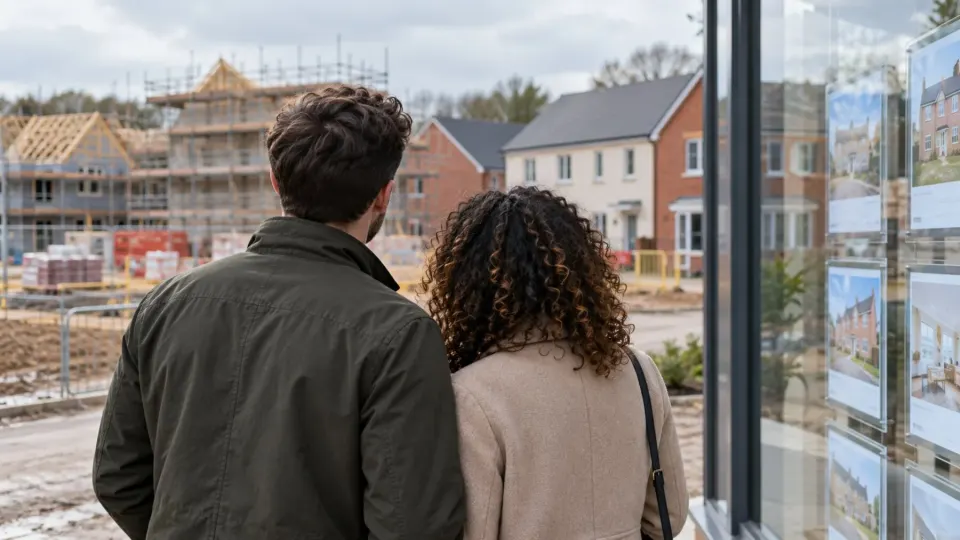
The government announced on Saturday 26 September that a new equity-loan scheme called Your First Home will be confirmed in next month's Budget. Its eye-catching promise is to help eligible first-time buyers in England purchase a participating developer's new-build home with a deposit of just 2.5%, supported by a government-backed equity loan of up to 20% of the property's value.
For someone watching deposits outrun their savings, that sounds like a door opening. The important word is “scheme”, not “gift”. An equity loan is money that must be repaid, and its amount is tied to the value of the home. The policy is not yet open for applications; ministers say its costs, implementation date, household-income limit and local property-price caps will be set out at the Budget. Nobody can honestly promise a particular buyer that they qualify today.
The Ministry of Housing says the loan will have an initial interest-free period. Reuters reports that the proposed terms include five years without interest and repayment on sale, within 25 years or in line with the main mortgage. The final legal terms have not been published. Buyers should treat those details as announced proposals and wait for the definitive scheme guide before signing anything or comparing precise costs.
What a small deposit does — and does not — solve
On an illustrative £300,000 eligible home, 2.5% is £7,500. A full 20% equity loan would represent £60,000 at purchase. That arithmetic shows how the scheme could reduce the cash a buyer has to find up front. It is not a quote from a lender, an eligibility assessment or a guarantee that a £300,000 home will fall within the eventual local cap.
The buyer would still need a mortgage, plus money for legal work, moving costs and other fees. The lender would assess income, debts, credit history and affordability. A smaller deposit cannot make the monthly payment comfortable if the underlying home price is too high. It may also leave less of the property owned outright on day one than the phrase “getting on the ladder” suggests.
An equity loan can grow in pounds if the home's value rises. If a 20% share remains attached to a property that later sells for more than its purchase price, repaying that share may cost more than the original amount borrowed. If the value falls, the mathematics and the buyer's exposure are different, but mortgage debt and sale costs still matter. The final scheme rules will determine the precise repayment mechanism. Anyone considering it should ask for worked examples at different future sale prices.

The government says people could save hundreds of pounds a month compared with a 95% mortgage. That is its claim about a possible comparison, not a universal saving. Actual monthly cost depends on mortgage rates, term, loan size and how interest or fees on the equity share evolve. A cheaper first five years can be followed by a more expensive later stage if the buyer has not planned for repayment.
Why new builds are central to the plan
Your First Home is expected to apply only to new-build homes sold by developers that sign up. The government says developers will be expected to contribute to the scheme's costs. It hopes stronger buyer demand will support construction as builders face rising costs and a difficult market. This is a housing-supply policy as well as a first-time-buyer policy, and the two goals may not always align neatly.
First-time buyers who prefer an existing property, cannot find a suitable new build locally or do not meet the eventual income cap may get no help from this particular route. Local price limits could stop support flowing to the most expensive areas, but set too low they might exclude much of the available new-build stock there. Those limits will make the difference between an announcement that looks generous nationally and one that works in a real town.
There is another familiar criticism of buyer subsidies: if more people can bid for a limited number of homes, some of the support may be absorbed by higher prices. That is a risk to examine, not a claim that it will definitely happen with this scheme. It depends on whether new construction actually expands, how developers price participating homes and whether competition keeps increases in check.
The government describes Your First Home as a revival of Help to Buy, which operated between 2013 and 2022 and helped more than a third of a million buyers, according to Reuters. That history shows there is a working administrative model. It also means the new proposal should be judged on lessons from the old one: who benefited, how loans were repaid and whether extra demand translated into homes that would otherwise have been built.
The questions to ask before making plans
The Budget needs to settle more than the headline deposit. Buyers need a clear eligibility test, an explanation of whether the income cap changes by region, the local price limits, participating lenders and developers, any fees, the interest schedule and how early repayment works. It should also explain what happens if someone wants to remortgage, move, separate from a partner or sell after a fall in value.
One detail deserves scrutiny: Reuters described a possible 75% mortgage alongside a 2.5% deposit and a loan of up to 20%. Those figures do not, by themselves, add to 100%. The government's Saturday press release does not specify a standard mortgage percentage. Until full rules show how the funding stack works, buyers should not build a budget around a fixed loan-to-value figure repeated in an early report.
The announcement applies to England. Housing arrangements in Scotland, Wales and Northern Ireland are separate. OutOut's Money section will follow the Budget details because a national deposit headline is only useful once the local caps, dates and actual costs are known.
The OutOut verdict
A 2.5% deposit can bring the starting line closer for people stuck saving while prices move. It does not make a £300,000 home cost less, and the government is still leaving the important small print for the Budget. The scheme deserves a fair hearing and a very large calculator.
For now, save the announcement and resist the urge to put a reservation fee on a property because an estate-agent window says help is coming. The practical decision begins when the final rules and a proper mortgage illustration sit side by side.