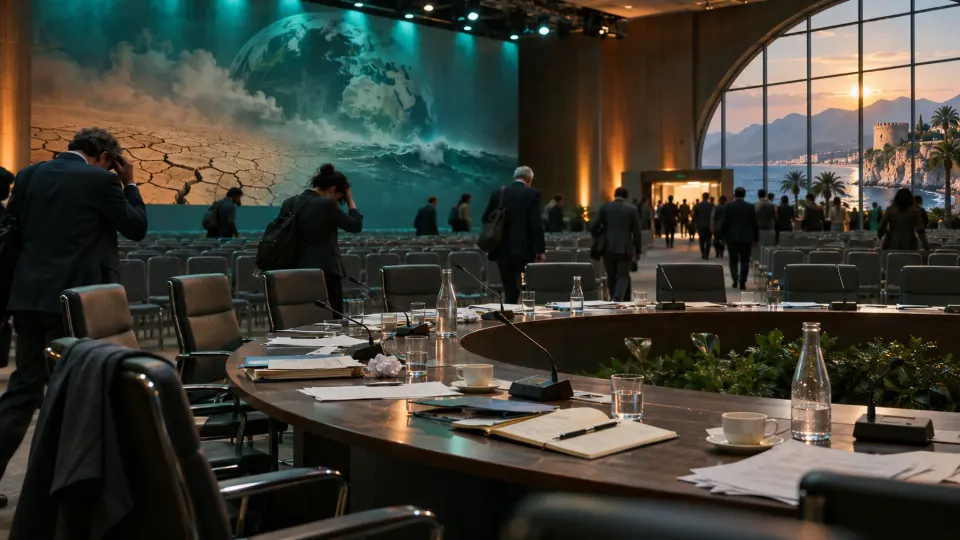
COP31 has closed in Antalya without consensus on the summit's proposed overarching political agreement, the Antalya Pact. The United Nations climate chief, Simon Stiell, said on Sunday 22 November that the conference had been unable to agree on the two presidency-led decisions and shared the “deep disappointment” of many delegates.
That is a serious breakdown, but it is not the same as every piece of COP31 disappearing into the Mediterranean. Specific negotiating decisions were adopted, including work on a just transition, while voluntary packages on electrification and other areas continued. The Paris Agreement also remains in force. The accurate headline is therefore awkward but important: the summit lost its binding political umbrella, not its entire contents.
What failed in Antalya
COP decisions normally require consensus among more than 190 parties with different economies, energy systems and levels of exposure to climate damage. The presidency-led Antalya Pact was intended to be the big-picture decision connecting the summit's work and signalling collective direction. It did not secure that consensus before the conference formally concluded on 22 November.
The UK government said it could not support the proposed cover decision because it believed the text moved backwards on climate science and compromised where it should have increased ambition. Ministers cited the need to accelerate clean electrification, deliver the transition away from fossil fuels and prepare for an overshoot of 1.5C. That is the British government's account of its negotiating position, not a neutral finding that every disputed line had only one possible interpretation.
Stiell's closing remarks were similarly blunt about the failure while preserving a distinction between the political impasse and other work. He said the world could not afford a repeat, called for lessons about transparency and consensus-building, and noted progress across COP31's action agenda. Negotiations produced decisions and initiatives; they did not produce the overarching pact the presidencies wanted.

What survived the collapse
The UK Department for Energy Security and Net Zero said progress was made on climate finance and a just transition, as well as voluntary commitments on electrification, methane, forests, oceans and resilience. UNFCCC's closing statement highlighted a just-transition decision and an electrification delivery package. Those claims will need to be judged against the final texts, finance actually delivered and projects completed—not the number of nouns that can be arranged around the word “package”.
Previous agreements were not automatically reopened. The Paris Agreement remains in place, countries retain their existing commitments and the next formal conference is COP32 in Addis Ababa. Governments can also act between summits through domestic law, bilateral finance, industry rules and coalitions. A failed cover decision narrows collective momentum; it does not issue a global permission slip to stop.
Britain says it will work with partners over the coming year on fossil-fuel transition, forests, electrification, adaptation finance, oceans and communities dependent on mountains and glaciers. Those are commitments to future activity rather than completed results. The useful test will be whether they produce money, timetables and emissions reductions before diplomats assemble another enormous temporary village of lanyards.
The dispute also lands in a British policy argument that cannot be outsourced to Antalya. OutOut has previously examined how the proposed Rosebank and Jackdaw developments put UK energy policy on the spot. A government can demand stronger language abroad while still being challenged on how its own energy, transport, buildings and industrial choices align with that language at home.
Why this matters beyond conference language
Cover decisions matter because they provide shared political direction across subjects that are otherwise negotiated in separate rooms. Investors, campaigners, governments and vulnerable countries read them for evidence that previous promises are being strengthened rather than quietly sanded down. Losing the agreement sends the opposite signal: the coalition could not find words every party was prepared to own.
The failure also exposes a structural problem. Consensus protects smaller countries from being routinely overruled, but it can allow a small number of objections to block a result. Stiell argued that consensus works best when built from the ground up through transparency and listening. Reforming the process without stripping weaker states of protection will be much harder than declaring the process due for reform, which is why COP communiqués have enjoyed this idea for years.
There is uncertainty around the practical effect. Markets and national policies do not respond to one document in a uniform way. Some governments will proceed with clean-energy programmes; others may use the absence of a pact as political cover for delay. Climate impacts will not pause while negotiators conduct a governance review.
The OutOut verdict
COP31 did not end with nothing. It ended with something worse for public confidence: enough progress for every institution to produce a list, but no overarching agreement strong enough for all parties to sign.
The roast writes itself only if we ignore the stakes. Nearly 200 governments spent two weeks discussing a rapidly warming world and finished unable to agree the document intended to explain what they had collectively decided to do about it. That is not proof diplomacy is useless. It is proof that diplomacy without political movement becomes an extremely expensive group-editing session.
Officials are right to protect the gains that survived. They are also obliged to stop describing a broken centre as a broadly successful edge. COP32 now inherits both the unfinished substance and the procedural repair job. The next summit needs more than a sturdier adjective. It needs a deal.
Sources
- UK Government position on COP31 Outcome, published 22 November 2026.
- UK Government: COP31 outcomes—questions answered, published 22 November 2026.
- UNFCCC: Simon Stiell's COP31 closing remarks, delivered 22 November 2026.