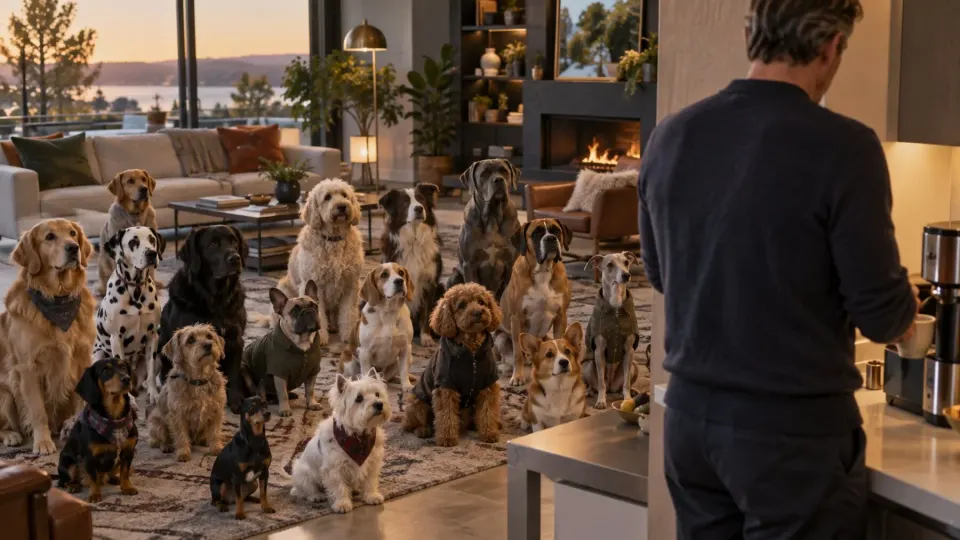
Brad Pitt has made a coffee advert with 16 dogs, and the dogs appear to have concluded that the famous actor is the least capable member of the household.
The nearly two-minute De’Longhi film was directed by Spike Jonze. Rather than asking Pitt to stare meaningfully into an espresso while sunlight falls across an expensive kitchen, it gives the animals subtitles and lets them criticise his waking time, coffee decisions and attitude.
When Pitt starts preparing a cold drink, the dogs demand a hot one. One tells him he cannot have coffee until his behaviour improves. He eventually tries to reassert human authority by ordering them to fetch a stick, only to discover that the instruction has been returned to sender.
The advert promotes the Magnifica Duo machine, priced at roughly £700 in the UK. The appliance is technically the product. The real advertisement is for the idea that Brad Pitt will accept workplace notes from a dog called Kyle.
Why this advert feels different
Celebrity advertising normally removes surprise. A famous person appears in immaculate clothes, uses a product, smiles and receives enough money to make the entire scene financially comprehensible.
Jonze instead builds a miniature comedy around a power reversal. The dogs are not cute accessories waiting for approval; they are a committee. Pitt is the unreliable assistant attempting to satisfy a room of demanding clients who cannot operate the machine themselves but have extremely clear views about temperature.
The subtitles are crucial because the animals remain real dogs rather than computer-generated talking characters. Their stillness and ordinary glances become funnier when paired with the confidence of people delivering a performance review.

Why 16 dogs?
The number creates visual absurdity before anybody speaks. One dog might be a pet. Three could be a chaotic morning. Sixteen suggests a takeover with governance structures.
There is also a convenient connection with Pitt’s new film The Heart of the Beast, which centres on a damaged man’s bond with a dog. The commercial is not a trailer, and viewers should not treat it as footage from the film, but the timing allows both projects to benefit from the actor’s sudden association with canine co-stars.
For Jonze, whose feature directing credits include Being John Malkovich and Her, the advert is a reminder of his ability to make a simple premise feel precise and peculiar. Commercials have long offered directors a compact form with large budgets and fewer narrative obligations. Here, the product demonstration survives inside a short comedy rather than pausing it.
Does viral attention sell coffee machines?
Only De’Longhi will know the conversion figures. The advert has already achieved the first task of marketing: people are voluntarily sharing a film about an appliance.
Its challenge is that the joke may be more memorable than the model name. Viewers can easily leave with a strong desire to watch Pitt argue with dogs and no idea which button produces a flat white.
That is still better than indifference. A £700 machine is a considered purchase, so the campaign’s job is partly to make De’Longhi the brand remembered when somebody eventually decides their kettle has failed to express enough Italian confidence.
For more film, television and celebrity stories, see OutOut’s Entertainment section. Our report on John Malkovich’s cancelled Tel Aviv performance covers a much less amusing collision between publicity and a famous name.
The OutOut verdict
The advert works because Pitt is allowed to be funny and the dogs are allowed to be unreasonable. Everybody understands the domestic experience of being judged by an animal that contributes nothing to rent or dishwasher loading.
It may not persuade Britain to spend £700 on coffee. It has, however, established the correct structure for future celebrity advertising: fewer inspirational monologues, more dogs telling actors to sort themselves out.