You surrender your legroom. You pay £6 for a sandwich containing approximately three atoms of chicken. You spend several hours sitting beside a stranger who believes the armrest is part of their sovereign territory.
But passengers aboard AirAsia flight AK1516 discovered a previously unadvertised feature of budget aviation:
Forty minutes inside a flying toilet.
The overnight flight had left Kota Kinabalu in Malaysia at around 10.30pm on 18 August and was approaching Shanghai Pudong International Airport in the early hours of the following morning when sleeping passengers began waking up.
Not because of turbulence.
Not because the captain had switched on the seatbelt sign.
Because somebody's digestive system had apparently declared war on row 26.
SOMETHING HAS GONE TERRIBLY WRONG IN ECONOMY
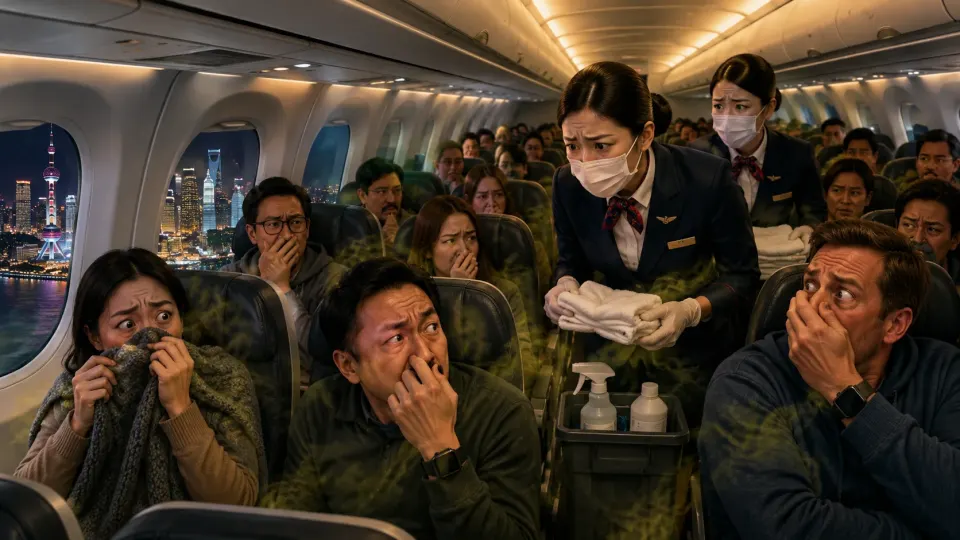
According to passenger accounts reported by Asian media, the smell began spreading through the cabin roughly 40 to 50 minutes before touchdown.
People woke up.
Heads appeared above seats.
Noses began filing formal complaints.
Initially, passengers reportedly assumed somebody had vomited.
An understandable conclusion.
Aircraft are essentially pressurised metal tubes containing hundreds of people, airport lager and questionable pre-flight food. Vomit occasionally comes with the territory.
Then somebody looked at the aisle.
Oh.
That wasn't sick.
Faeces had reportedly ended up on both a passenger's seat and the aisle carpet.
At this point the overnight service to Shanghai had officially stopped being a flight and become the world's fastest-moving public toilet.
THE TOILET WAS FIVE METRES AWAY
And here comes the detail that transforms an unfortunate incident into an international news story.
According to a passenger seated nearby, the aircraft toilet was approximately five metres away.
And reportedly still available.
Five metres.
Usain Bolt could cover that distance before you've finished saying unexpected hygiene complication.
However, reports suggest there was more to the incident than somebody simply deciding that 26E looked sufficiently bathroom-shaped.
The woman was reportedly seen heading towards the lavatory carrying a plastic bag, and one witness said she appeared to have used the bag before its contents spilled onto the seat and carpet.
When challenged by understandably distressed passengers, she reportedly said she had been feeling unwell.
Which is an important distinction.
This may have been a humiliating medical emergency rather than deliberate behaviour.
Unfortunately for everyone else aboard the aircraft, intestines do not employ public-relations departments.
CABIN CREW ENTER THE BOSS LEVEL
There are jobs where you know approximately what the day might involve.
Accountant: spreadsheets.
Builder: bricks.
Dentist: teeth.
Cabin crew?
Apparently there is always the possibility that at two o'clock in the morning somebody will hand you an airborne faecal emergency and expect you to solve it while descending towards Shanghai.
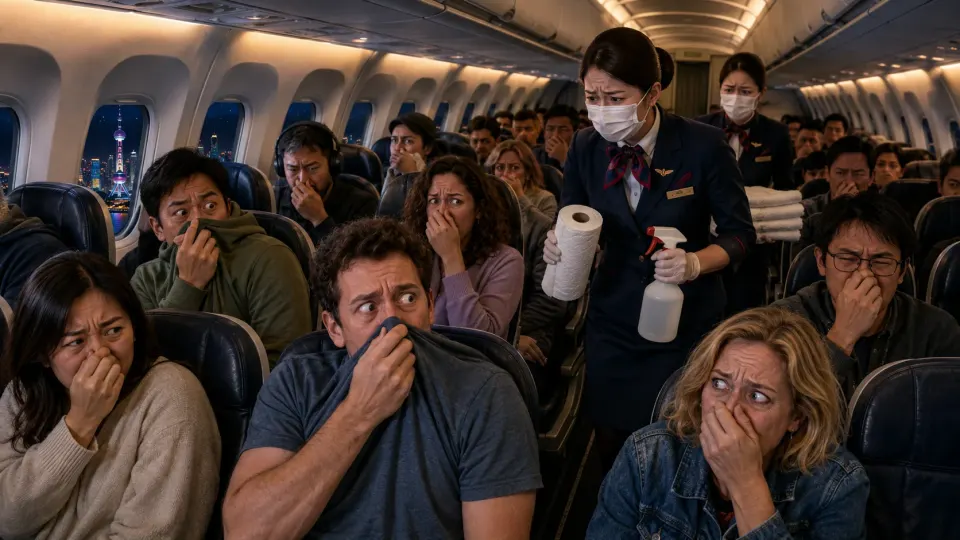
Crew reportedly used gloves and towels to perform an initial clean-up of the affected area.
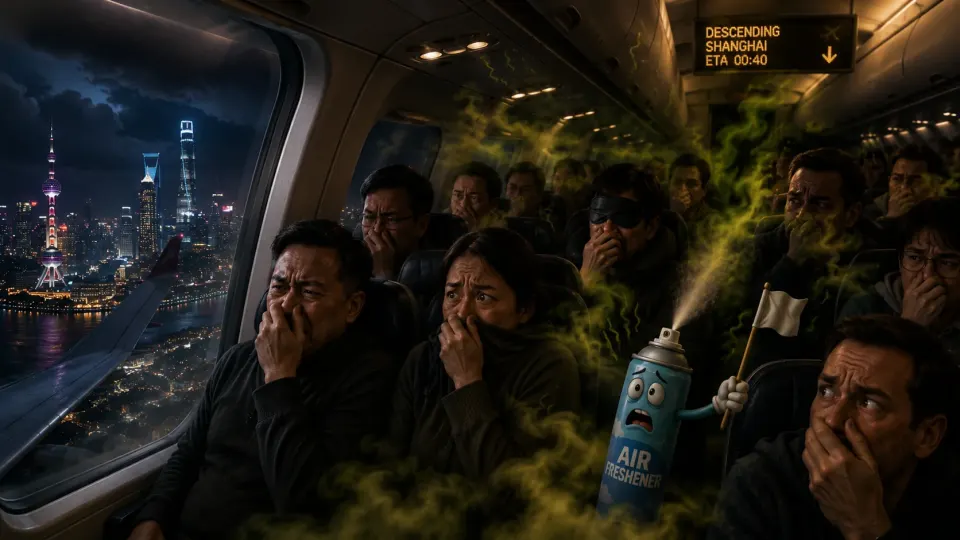
Air freshener was also reportedly deployed.
A heroic gesture.
Completely inadequate, obviously, but heroic.
Trying to defeat that situation with air freshener is like attempting to extinguish a burning warehouse with a Febreze bottle.
Lavender Meadow versus Human Digestive System.
There was only ever going to be one winner.
AND THEN THE VENTILATION JOINED THE ENEMY
Passengers said the remaining descent lasted around 40 minutes.
Making matters considerably worse, one witness said the aircraft's air-conditioning had been switched off as part of preparations for landing.
So there you are.
Trapped in a metal cylinder.
Thousands of feet above China.
Seatbelt on.
Windows sealed.
An industrial-strength smell circulating through economy.
And absolutely nowhere to go.
This is presumably the moment when several passengers began reconsidering every decision that had led them to purchasing that particular ticket.
AIRASIA CONFIRMS SOMETHING VERY UNUSUAL HAPPENED
AirAsia subsequently confirmed that cabin crew encountered what the airline described as an unusual hygiene situation in the aisle while the aircraft was preparing to land.
That may be the greatest piece of corporate language ever written.
Unusual hygiene situation.
Technically flawless.
Emotionally nowhere near sufficient.
The airline said crew prioritised landing the aircraft safely while carrying out an initial clean-up using protective gloves and towels.
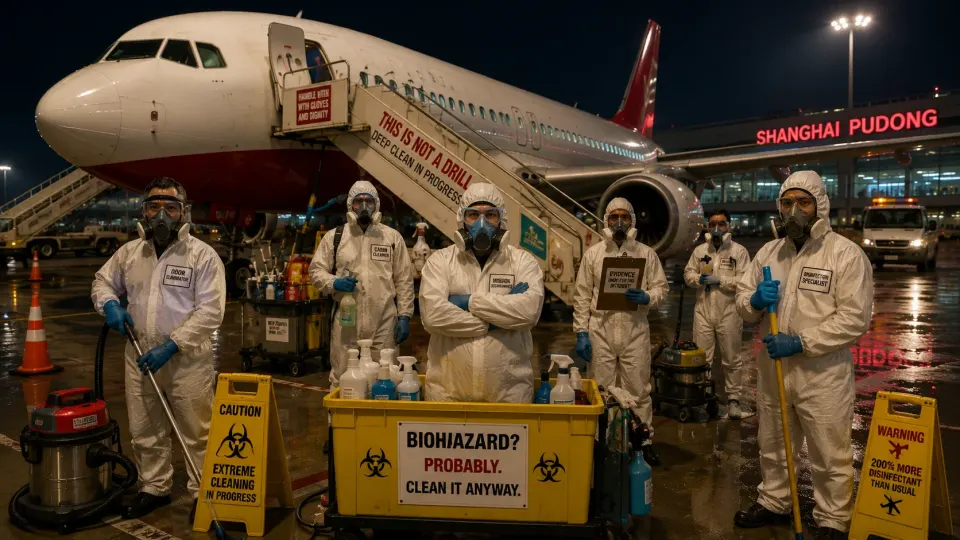
The captain and ground team were informed, and once passengers had disembarked in Shanghai, cleaners thoroughly cleaned and disinfected the affected area.
Crew operating the return flight were also briefed about what had happened.
Presumably with the sentence:
"Right lads, you're going to want to hear this before boarding."
AirAsia China general manager Frank Tang Ting praised the crew for remaining professional and composed throughout the incident.
And frankly, fair enough.
Anyone capable of dealing with that at 30,000 feet without simply opening LinkedIn and searching “jobs nowhere near the general public” deserves recognition.
THE INTERNET, NATURALLY, HAS QUESTIONS
The incident quickly spread across Chinese social media before being picked up internationally.
And inevitably much of the discussion focused on that tantalising little measurement:
Five metres.
But without knowing precisely how ill the passenger was, judging her too harshly would be unfair.
Anybody who has experienced a sudden stomach emergency knows the distance between you and a toilet is not measured using conventional mathematics.
Five metres can become 200 miles surprisingly quickly.
There is therefore a perfectly reasonable possibility that this was simply somebody experiencing the worst and most publicly humiliating few minutes of their life.
For her, awful.
For the cabin crew, horrific.
For the passengers?
They paid for transportation from Malaysia to China and accidentally received a 40-minute immersive sensory experience that no airline loyalty programme has yet dared introduce.
PLEASE REMAIN SEATED UNTIL THE SMELL HAS STOPPED
Eventually AK1516 landed safely at Shanghai Pudong.
Passengers escaped.
The aircraft was disinfected.
Normal aviation resumed.
And somewhere inside AirAsia's headquarters, somebody presumably opened the company's emergency procedures manual and quietly added another page.
Because aviation has spent more than a century preparing for engine failures, fires, severe turbulence, decompression and emergency landings.
Turns out it also needed a plan for:
“Passenger has catastrophic bowel incident during final approach.”
Flying really is remarkable.
Humanity learned to build machines capable of carrying hundreds of people through the sky at hundreds of miles per hour.
We developed jet engines.
Satellite navigation.
Autopilot.
International air-traffic control.
And after all that technological progress, the entire passenger experience can still be brought to its knees by one plastic bag and an unhappy digestive system.