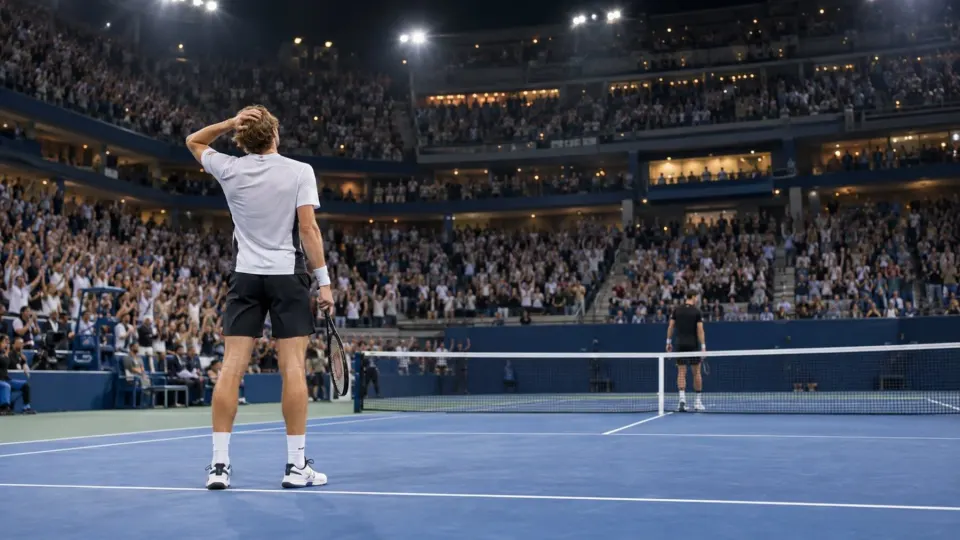
Alexander Zverev has finally won the US Open, defeating Ben Shelton 6–3, 7–6 (7–2), 5–7, 6–2 on Sunday 13 September — and briefly failing to notice that the final point had completed the job.
Shelton sent a return long on championship point. Zverev walked back towards the baseline as though preparing to receive another serve, until the umpire announced the result and the standing ovation supplied the remaining administrative detail. He smiled, ran to the net and embraced the American.
It was an oddly human end to a performance built on control. Six years earlier, Zverev had led Dominic Thiem by two sets in the 2020 final before losing. This time he took the first two sets, dropped the third and refused to let old history borrow the fourth.
A final shaped by the opening game
Shelton entered his first major final carrying the hopes of a home crowd and a 23-year wait for an American men’s Grand Slam champion. He also double-faulted on break point in the opening game, immediately giving the top seed control.
Zverev absorbed the noise and dominated the second-set tiebreak, racing to a 5–0 lead. Shelton’s serve-and-volley experiments could not consistently disrupt the German’s rhythm.

The American did not disappear. He saved a break point in the third, increased the weight of his baseline hitting and broke to force a fourth set. The crowd revived; the 2020 memory entered every television commentator’s working area.
Zverev answered by winning a 25-shot rally to establish the early break in the fourth. He protected it to the finish. The title arrived on his 11th appearance at Flushing Meadows and earned a record $5.5 million winner’s prize.
What the result changes
Zverev’s breakthrough French Open victory in June had already ended his long wait for a major. Winning in New York converts relief into range: clay and hard-court Slams in the same season, separated by three months.
It also settles one particular sporting ghost. The 2020 collapse had become an unavoidable paragraph in every deep run he made at the tournament. Returning to the same stage, taking the same two-set advantage and closing the match creates a redemption story so neat that a screenwriter would be asked to make it less obvious.
For Shelton, defeat extends the United States’ wait for a home men’s champion. Reuters reported that he became the first Black American man in 54 years to contest the New York final, following Arthur Ashe. That achievement is not erased by one difficult evening.
His route forward is visible. The serve and explosive athleticism already create pressure. Major finals demand a more stable floor when the spectacular shots are not landing, particularly against an opponent comfortable absorbing pace and lengthening rallies.
Zverev’s career also carries serious off-court context. Reuters noted past allegations of domestic violence, which he has repeatedly denied. Sporting success does not adjudicate those allegations, and reporting the result should not quietly remove them from the public record.
For tennis, the final offered a generational contest without requiring the old “next generation” label to be unpacked again. Zverev is now a two-time major champion; Shelton has reached the stage where the next questions concern titles rather than potential.
Find more major-event reporting in OutOut’s Sport section.
The OutOut verdict
Zverev spent six years trying to reverse one New York afternoon. When the reversal arrived, he was so concentrated that the umpire had to notify him his redemption had been delivered.
Shelton made the final competitive, the crowd made it loud and Zverev made it conclusive. The only person not immediately certain he had won the US Open was the man holding the racquet. Elite sport: where even triumph occasionally needs a push notification.