
to make a hole-in-one. One is to strike a perfect shot, watch it track towards the flag and prepare a suitably modest reaction while everybody else loses their minds. The other, according to the latest Fatmates Golf Sunday Roast, is to pull the ball towards trouble, announce “Off the bank!”, lose sight of it completely and let the landscape do the difficult bit.
Noz took the second route. In Edition 25 of the Roast, the society’s writer Fluff describes watching the shot bounce down a bank, roll across the green and disappear into the hole on Hadden Hill’s seventh. Brokey was also in the group, the account says. Noz’s first reported response when told it had gone in was “Has it?” If you wanted a cinematic celebration, you may have to hire actors. If you wanted a story that friends will tell for years, that is an excellent start.
This is the group’s eyewitness account, rather than an independently verified competition record. The distinction does not diminish the moment. Amateur golf lives on witnesses, scorecards and the immediate argument about whether somebody really saw the ball land. The spectacle here is not only that the ball went in. It is that the player was apparently the last person on the tee to know.
More than one lucky bounce
Fatmates is an informal Sunday golf society based around Hadden Hill near Didcot, Oxfordshire. Its own description makes clear that it is a hobby project run by members, independent of Hadden Hill Golf Club. The usual format is Stableford, with weekly results, front-nine and back-nine honours and nearest-the-pin prizes. Nobody needs to mistake the website for the club’s official membership or booking system.
Yet what began as friends playing a regular round now has much of the furniture of a larger sporting community. The site records results from previous weeks, current handicaps, attendance, money lists and individual player profiles. A season centre pulls the weekly honours together, so a single Sunday can count towards a longer story. It tracks the front nine, back nine, overall winner and five designated pin holes as an eight-part set of achievements. There are awards, comparisons and a weekly Roast that provides an unofficial oral history with considerably more swearing than the average county-golf newsletter.
That combination is what takes a golf group to the next level. A scorecard tells you who won today. An archive tells you who keeps showing up, who is improving, who once produced a ridiculous round and who will never be allowed to forget a missed putt. A player profile gives a nickname a record; a season table gives the next Sunday a reason to matter. None of that turns a friendly society into a professional tour. It gives an ordinary group a shared memory.
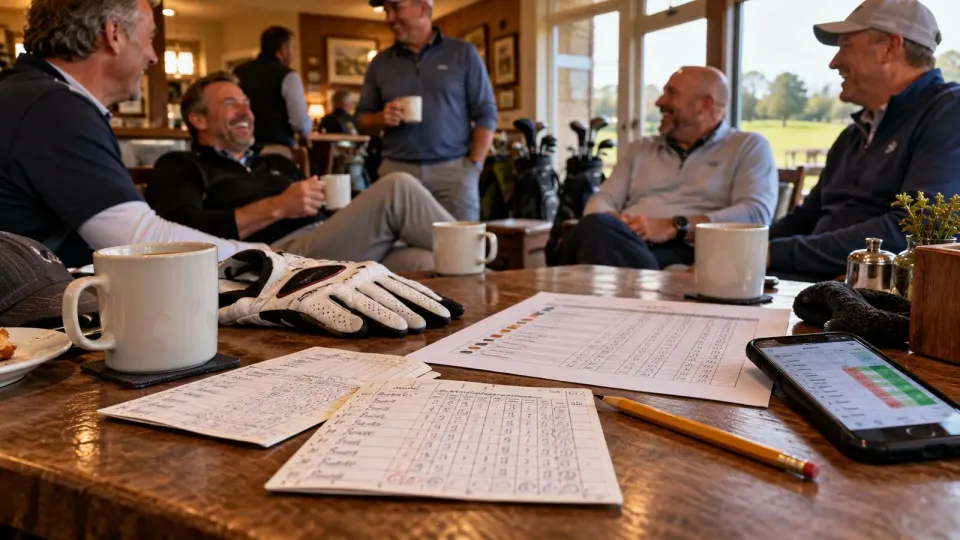
The round had other material
The ace is the clean headline, but Edition 25 is emphatically not a clean sheet. Fluff’s report describes Scouse missing the ball on three swings and, on another hole, aiming a putt at a flag being held well away from the actual cup. These are the Roast writer’s comic observations, not a scoring audit. As an image of friendship expressed through mercilessly detailed eyewitness testimony, they are difficult to improve.
The results section credits Grootz with an eagle in the two-in-two, a share of the front-nine honours with Noz on 19 points and the back-nine prize on 20. The article then makes a running joke about what one playing partner did or did not witness on the scorecard. It reads as familiar clubhouse ribbing; there is no basis here for OutOut to suggest the recorded results were fraudulent. The valuable fact for an outside reader is that weekly prizes and season-long records provide the structure beneath the comedy.
Tetley supplies another example. According to the Roast, he remained in the Sunday draw, then remembered a prior golf booking in Cornwall and removed his message after the draw. The writer says the group expects a £20 fine under a rule Tetley had supported. We cannot independently establish whether it has been paid. What the episode illustrates is that the society has moved beyond “who is free on Sunday?” to actual routines: sign-up deadlines, a draw and a consequence when somebody leaves a space after plans are set.
There is a practical lesson for any group that wants to last. People return for the game, but they stay connected through the habits around it: a reliable tee sheet, a record they trust, a story worth reading on Monday and the gentle certainty that their friends will notice if they disappear. Fatmates has put those habits online without pretending the technology is the point. The website makes the Sunday visible; the friendships give the website something to record.
A clubhouse with its own voice
The Roast is written for the people in the group. Its adult language and private jokes can be much sharper than a mainstream sports report, and some references need years of shared context. OutOut is not importing every punchline or asking a stranger to take the insults literally. The interesting story is how recognisable the dynamic remains even if you have never met Noz, Grootz or Tetley: one mate gets absurdly lucky, another has an excellent round, and somebody else forgets a commitment until the group has already organised itself around him.
Fatmates’ player profiles and results archive also answer a problem many amateur groups know well. Without a record, every old performance becomes a memory contested over a drink. With one, the facts can sit in a table while the argument continues for entertainment. The site says its betting-style features are for fun and that it does not operate real-money online gambling. That is a useful boundary to keep clear when a playful money list or fictional bookie appears beside actual competition results.
There is no need to claim this model will transform British golf, or that every society should build a similar site. A smaller group can keep a paper notebook and achieve the same human purpose. Fatmates has chosen to make its running jokes, honours and player histories easy for members to revisit. It is a step from playing together to building a little institution together, one Sunday at a time.
The professional game gets cameras and leaderboards as a matter of course. OutOut’s wider Sport coverage follows those big stages, but there is something equally familiar about a small society preserving its own unlikely highlights. For the people who stood on the seventh tee, the bank-assisted ace needs no television replay to count as a headline.
The OutOut verdict
Noz’s ball found the hole without requiring Noz to see it happen. That is the golf gods doing public relations for chaos. But an ace lasts longer when somebody writes down how it happened, who witnessed it and what everyone said afterwards. Fatmates has built the machinery for exactly that, then filled it with the personalities that make the score worth checking. The group may never resolve the question of whether “off the bank” was inspired course management or a wildly confident request to the universe. It already has a better prize: a story its members can keep.