
Britain's retailers are ordering fewer goods from their suppliers at the fastest pace recorded by the Confederation of British Industry since its survey began in 1983. On Thursday 24 September, the CBI said its balance for orders placed upon suppliers dropped to minus 62 in September, from minus 29 in August. Retailers expect that measure to remain at minus 63 in October.
There is an awkward twist. A separate survey published late on Thursday, for release on Friday 25 September, suggested British households feel more confident than at any time in more than two years. It would be tempting to choose one headline and declare the other wrong. The better story is about the distance between what consumers say about their finances and what shops decide to put on next month's order sheet.
The CBI's retail sales balance fell to minus 55, compared with minus 48 in August. Its online-sales balance dropped to minus 68 from minus 43, the fastest reported decline in online volumes since October 2023. These are survey balances, not percentages by which total national sales or orders fell. Treating minus 62 as a claim that orders collapsed by 62% would be an error big enough to require its own checkout.
The record is about retailers' answers
A balance captures the difference between respondents reporting increases and those reporting decreases, weighted according to the survey's method. A deeply negative figure tells us weakness is widespread among respondents. It does not tell us the number of pounds removed from the country's purchasing budget or what will happen at every individual high street.
The survey covered 46 retail chains and 71 wholesalers, with responses collected between 27 August and 14 September, according to Reuters. That timing matters: this is a snapshot of what those businesses saw and expected before all of September had finished. It is neither a census of every British shop nor the Office for National Statistics' official measure of sales made to customers.
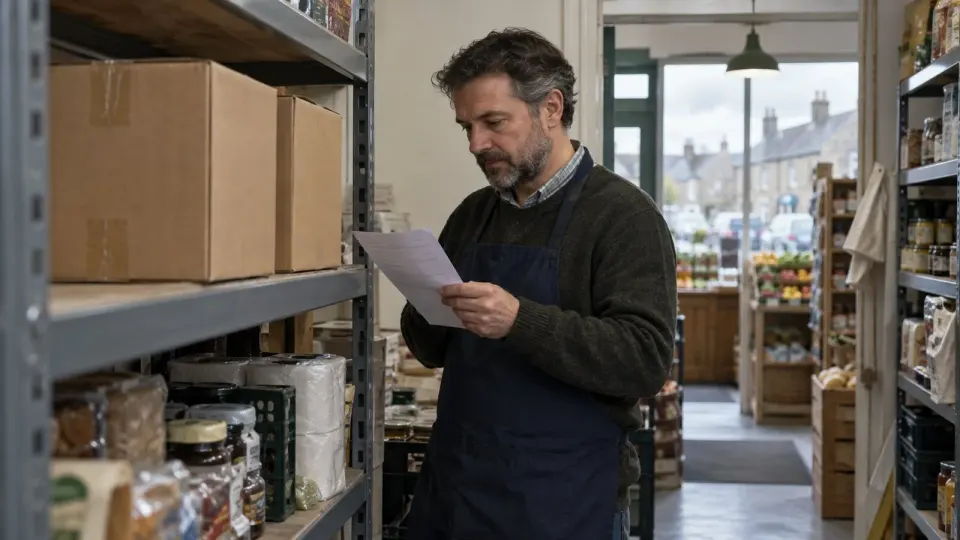
When retailers order less, their suppliers notice before the shopper sees an empty display. A buyer may trim the next delivery of clothes, electrical goods or household items because stock is moving more slowly, because financing it costs more, or because managers expect consumers to hesitate. The effect can travel along warehouses, transport operators and manufacturers without any single business announcing a dramatic closure.
Some ordering restraint can also be ordinary stock control: if a chain overbought previously, it can clear shelves before placing fresh orders. The CBI says the volume of stock relative to expected sales was below its long-run average, however. That makes the record orders balance harder to dismiss simply as a mountain of unsold stock being worked off. It does not, by itself, establish the cause.
Why a more cheerful consumer survey is not a contradiction
GfK's consumer-confidence barometer, reported by Reuters late on 24 September, increased by one point to minus 13 for September. That is its strongest reading since August 2024 and better than economists' forecast of minus 16. Households expressed greater optimism about their own finances, while the broad economic-outlook measure also improved.
The number remains negative. More importantly, an answer about confidence is not a receipt from the till. A person can feel slightly better about next year, still worry about fuel and energy bills, and decide to postpone replacing a television. Retailers can simultaneously be anxious about current volumes and cautious about future purchases from suppliers.
There are also differences of timing, respondents and subject. One exercise asks companies about their sales and orders; the other asks individuals about confidence. Other consumer surveys have produced mixed results, Reuters noted. None should be made to carry a sweeping claim about an economy that contains households with very different savings, debts and housing costs.
The official retail-sales figures provide another essential check. Reuters reported that the Office for National Statistics had shown 2.7% annual growth in sales volumes excluding fuel in the year to June. That is an earlier period and a different measurement. Set it beside September's CBI responses to understand the uncertainty, not to invent a direct one-for-one dispute between them.
What this could mean for the autumn budget
The CBI argues that lower employer National Insurance contributions and reform of business rates would help shops invest and hire. That is a lobbying proposal by a business organisation, not an independent finding that either policy would immediately reverse the survey. The government will face competing demands over revenue, public services and the cost of supporting the high street.
If weak orders persist, the more concrete things to watch are sales volumes, the pace of restocking, vacancies, supplier trading statements and eventual employment decisions. A single negative survey does not prove a recession is coming. Equally, a one-point rise in a confidence indicator cannot guarantee a thriving Christmas trading season.
For households, this is not a signal to panic-buy. It is a reason to look for price transparency, compare genuinely useful discounts, and avoid converting anxiety into an expensive purchase. For shop staff and suppliers, however, sustained cutbacks have an immediate significance: fewer deliveries can become fewer hours and less certainty about next season's work.
OutOut has been following the changing cost of the weekly shop and the wider squeeze in its Money section. The useful question is not whether one day's survey is cheerful or gloomy enough to win an argument online. It is whether orders and actual purchases begin to move in the same direction over several months.
The OutOut verdict
It is possible for customers to report a brighter mood and shops to order as though a rain cloud has moved into the stockroom. Britain's economy is not obliged to keep its surveys in the same group chat.
The real warning is the record breadth of the ordering pullback, not an imaginary 62% collapse in goods purchased. Watch what shoppers actually buy and whether retailers replenish it. Until then, a cautiously happier household and a very cautious buyer are both telling us something worth hearing.