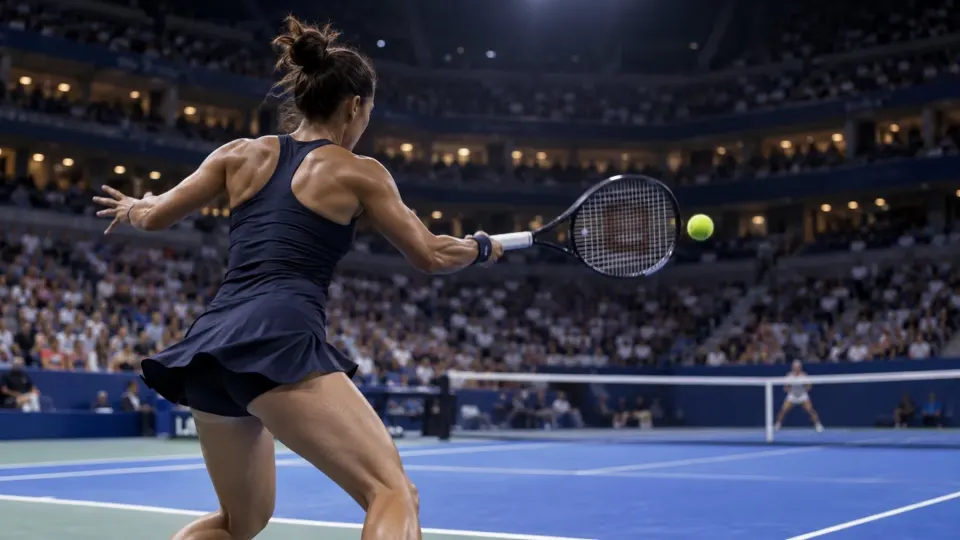
Aryna Sabalenka is one victory away from a third consecutive US Open title after beating Jessica Pegula 7-5 6-2 in Thursday night’s semi-final.
The world number one reached her fourth straight final in New York with a performance that became more decisive as the match progressed. Reuters reported 29 winners and seven aces for Sabalenka, whose power repeatedly shortened rallies and forced Pegula to defend from uncomfortable positions.
The score looks straightforward now. The first set was not. Pegula stayed with the defending champion through its critical stages before Sabalenka broke late and closed it 7-5. The second set moved faster as Sabalenka took control.
Why the streak matters
Reaching four consecutive finals at one Grand Slam is rare in an era of deep fields, changing conditions and intense physical demands. Winning three consecutive US Open women’s titles would place Sabalenka alongside a very short list of modern champions.
Serena Williams was the last woman to win three in a row in New York, from 2012 to 2014. Chris Evert also achieved the feat in the Open era. Sabalenka still has to win Saturday’s final before those comparisons become an accomplishment rather than a possibility.
Her record nevertheless demonstrates unusual consistency on hard courts. A player can dominate early rounds and still have to solve different styles in the second week: counterpunching, first-strike serving, awkward movement and the pressure of opponents playing with less to lose.
How Sabalenka beat Pegula
Sabalenka’s serve gave her cheap points and protected her when rallies became tense. Her return position and weight of shot put pressure on Pegula’s service games, while the winner count reflected an ability to finish exchanges rather than wait for an error.
Power alone does not explain the result. Sabalenka has improved her shot selection and emotional control over several seasons. The old version could produce spectacular tennis and then donate a run of errors. The current version is better at deciding when to attack and recovering after a missed chance.
Pegula’s first-set resistance mattered because it forced Sabalenka to prove that control. The American absorbed pace, redirected the ball and kept the scoreboard close. Once the opening set slipped away, maintaining that level while taking greater risks became much harder.
Statistics should be read in context. A high winner total can come with errors, and aces do not show how often a server began the point on favourable terms. The match video and point patterns explain more than a single box-score column.
The final challenge
Sabalenka’s opponent will arrive with a different plan and the freedom that comes with trying to stop history. Recovery will be important after an evening semi-final, as will managing the attention around a potential three-peat.
The favourite label can become heavy. Every routine service game is expected, every lost point treated as a warning. Sabalenka’s task is to keep the final at the scale of one rally at a time rather than play all the previous champions simultaneously.
For more major-event coverage, visit OutOut’s Sport section. Our World section follows the bigger stories surrounding international events.
The OutOut verdict
New York keeps changing the opponent and Sabalenka keeps arriving at the final as if the tournament forgot to change the lock.
She was the stronger player against Pegula, but Saturday is not a coronation. The historical line only counts after the last point. That is the beauty and cruelty of knockout sport: four years of consistency can be summarised by one evening, two sets and whether the first serve lands when everybody knows exactly what is at stake.