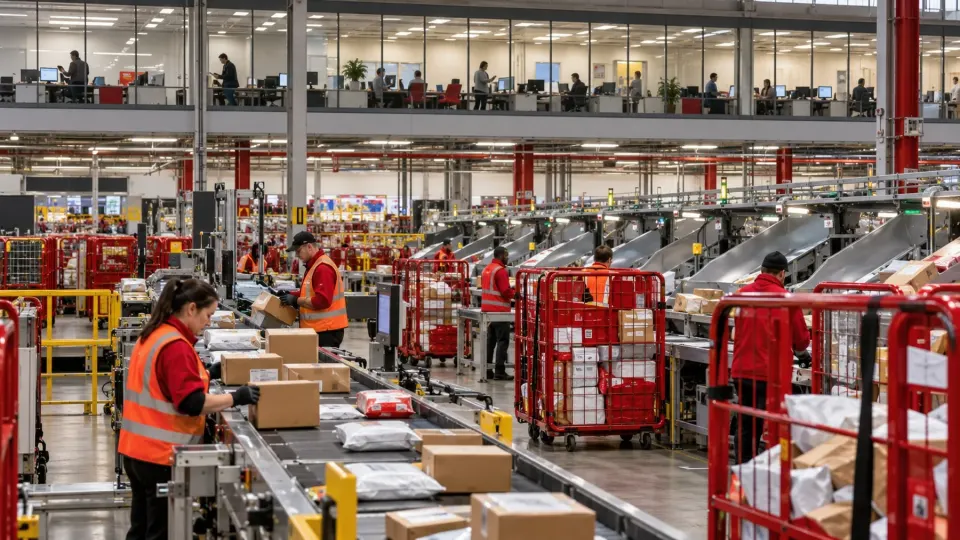
Royal Mail says it plans to remove up to 2,500 head-office and support roles by the end of 2027, the latest restructuring of a national institution trying to deliver fewer letters to more addresses while customers and regulators continue asking where their post went.
The company announced the proposal on Wednesday 7 October. It said the affected posts represent less than 2% of a workforce of more than 131,000 and that the reductions would be pursued through natural attrition and voluntary redundancy. Frontline roles, including posties and drivers, are not included in this plan.
Those qualifications matter. This is not an announcement that 2,500 delivery workers will vanish immediately, and consultation with the Communication Workers Union and Unite CMA is under way. It is nevertheless a material proposed reduction in the people who plan, administer and support a service used by almost every household and business in Britain.
Why Royal Mail says it is doing this
Letter volumes have fallen by more than 70% from their peak, Royal Mail says. Email, online billing and messaging have removed much of the routine post that once funded a dense daily network. Parcels have grown with ecommerce, but that market is fiercely competitive and includes businesses built around flexible gig-economy labour rather than a centuries-old universal obligation.
Royal Mail chief executive Alistair Cochrane said the changes would remove duplication, speed decisions and allow further investment in customer service. The business is implementing reforms to the Universal Service, the legal framework that requires mail to be carried nationwide at uniform prices and service standards.
That is the commercial case. The public-interest test is whether fewer support staff genuinely simplify work or leave frontline employees trying to navigate thinner planning, technology, safety and customer-service functions. A job being away from the doorstep does not make it decorative.
The proposed cuts arrive after sustained regulatory pressure over delivery performance. Ofcom has repeatedly scrutinised missed targets. Customers experience those failures locally: a delayed hospital letter, bank card or small-business order is not improved by being told the national average had an awkward quarter.

A network with two opposite trends
The structural problem is easy to describe and difficult to solve. Royal Mail serves a growing number of addresses while carrying a shrinking number of letters. The cost of walking or driving a route does not fall in proportion to the number of envelopes in the bag. A postie still has to reach the street.
Parcels help fill vehicles and bring revenue, but competitors can concentrate on profitable volumes and routes. The universal provider must maintain reach. That is why changing the Universal Service is politically contentious: flexibility may make the network sustainable, but excessive dilution would leave households and small firms with a nominal promise and a longer wait.
The company has said frontline delivery posts are outside this restructuring. That should prevent lazy claims that the announced cuts directly remove 2,500 people from rounds. It does not end the debate about capacity. Head-office and support work includes decisions about routes, staffing, equipment, property, complaints and systems. The quality of a public-facing service depends on the organisation behind it.
Our report on Britain’s recent rise in factory orders made the same wider point from a different direction: business indicators are useful only when translated into actual orders, investment and work. Here, a smaller support structure must be judged by delivery results, not the elegance of its organisational chart.
Ownership has changed; obligations have not
Royal Mail’s parent was bought by Daniel Křetínský’s EP Group in 2025. New ownership increases attention on costs, investment and commitments made around the takeover. The postal service is a private business with public obligations, an arrangement that produces a familiar argument whenever finances and service standards collide.
Managers are entitled to remove genuine duplication. Customers are equally entitled to expect the promised service, and workers are entitled to a meaningful consultation. A voluntary exit is still a lost role, and natural attrition can still strip knowledge from an organisation if vacancies disappear faster than processes improve.
The announcement should therefore be followed by measurable commitments. Royal Mail could show how many roles sit in each function and region, what investment the savings fund, how delivery quality will be monitored and how customers can obtain redress. Without that, “faster decision-making” is a slogan that can only be tested after the desks are empty.
What happens next
Formal consultation means the final number and shape may change. Employees should receive detailed proposals through the company and their representatives rather than rely on headlines. The timetable runs to the end of 2027, allowing reductions to occur through departures as well as voluntary redundancy.
Ofcom will continue to regulate the Universal Service and performance. Government also has an interest because letters remain important for courts, health services, elections, benefits and people who are not fully online. The national conversation about post too often treats letters as nostalgia until an urgent one fails to arrive.
Customers do not need to panic about an immediate removal of their local postie on the basis of this announcement. They should, however, keep records of delayed or lost items and use formal complaint and compensation routes where applicable. Evidence is more useful to regulators than a social-media foghorn, satisfying though the latter can feel.
The OutOut verdict
Royal Mail is trying to operate a nationwide physical network in a country that replaced the birthday card with a thumbs-up emoji and then ordered three parcels before lunch. Something has to change.
The sensible question is not whether every office role must be preserved for eternity. It is whether this particular reduction produces a leaner service or merely a thinner one. If duplication disappears and delivery improves, management will have a case. If targets are missed while complaints enter an automated maze, Britain will have achieved the modern corporate miracle of making fewer decisions slowly.
The red post box is an icon. The service behind it is a logistics system, a regulated obligation and thousands of jobs. All three deserve a plan more detailed than “simplify”.