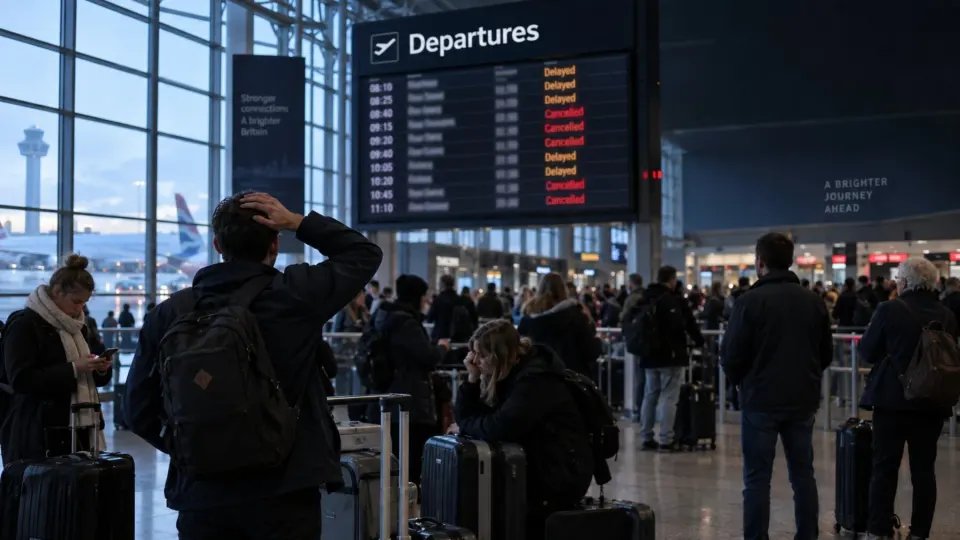
Britain's air-traffic-control provider has been given one week to explain the systems failure that caused about 2,000 flight cancellations and left airlines trying to rebuild schedules long after the technical fault was fixed.
Transport Secretary Heidi Alexander met NATS chief executive Martin Rolfe on Wednesday, 9 September. Reuters reported that Alexander said the incident was not thought to be a cyberattack and that she did not accept it was unavoidable. The Civil Aviation Authority is also expected to carry out an independent review.
The failure began on Tuesday and affected departures and arrivals across at least 15 UK airports. NATS said the immediate fault involved its flight-processing system. Although the system returned during the afternoon, the operational damage rolled into Wednesday because aircraft and crews were no longer where the timetable expected them to be.
That distinction matters. A computer can be restored at 4.40pm; an aircraft diverted to another country cannot be teleported back to its first scheduled departure the next morning.
What passengers should do now
The first source of truth is the airline, not a general airport queue, a social-media rumour or somebody's uncle who once worked near baggage reclaim. Check the flight status before travelling and keep screenshots of cancellation notices, rebooking offers and receipts.
Where a flight is cancelled, airlines must generally offer a refund or alternative transport. They also have duties of care that can include food, drink, accommodation and transport to that accommodation when an overnight delay makes those things necessary. If an airline cannot provide them directly and a passenger has to make reasonable arrangements, itemised receipts become important.
Separate cash compensation is more complicated. Reuters reported that passengers were unlikely to receive the fixed compensation associated with some controllable airline failures because an air-traffic-control outage may be treated as an extraordinary circumstance. That does not erase the right to rerouting, reimbursement or care.
In plain English: “no automatic compensation” does not mean “the airline owes you nothing”. It means the categories of help need to be kept separate.
Why one failure creates days of disruption
Commercial aviation is a tightly connected network. A delayed inbound aircraft can cancel an outbound flight; a crew can run out of permitted working time; an airport stand can be occupied when the next aircraft arrives; baggage and ground teams can be overwhelmed by several disrupted waves at once.
Airlines therefore have to decide which flights can be restored with the aircraft and staff actually available. The result can look irrational to passengers — one service operates while another on a similar route is cancelled — but it often reflects where the aircraft and crew ended up rather than the importance of the destination.
Reuters said about 30% of scheduled UK departures were grounded on Tuesday and disruption remained on Wednesday. British Airways and Ryanair were among carriers reporting substantial cancellations and losses. The incident is especially serious because it follows other major NATS failures in recent years, bringing resilience and backup arrangements back under scrutiny.
The accountability question
The one-week report should establish more than the name of the failed component. It needs to explain why the failure had such a wide impact, what fallback capacity existed, whether recovery procedures worked as designed and which improvements will be made before the next peak travel period.
NATS is a strategically important operator with both private and public ownership. Safety must remain the first priority, but safety and resilience are not rivals: a properly designed fallback should preserve safe capacity when the primary system fails.
The CAA's independent work will matter because an operator investigating itself can identify technical facts while still leaving passengers and airlines asking whether the wider system provides enough challenge and accountability.
The OutOut view
The most British part of the episode is not that a computer failed. Computers fail everywhere. It is that hundreds of thousands of people were left studying a red departure board while every organisation involved explained that the particular bit they controlled was working again.
The serious test is what changes after the report. A week is enough time for an initial explanation; it is not enough for a decorative document followed by another national game of airport-floor camping.
For more UK developments and practical explainers, visit OutOut's UK section.