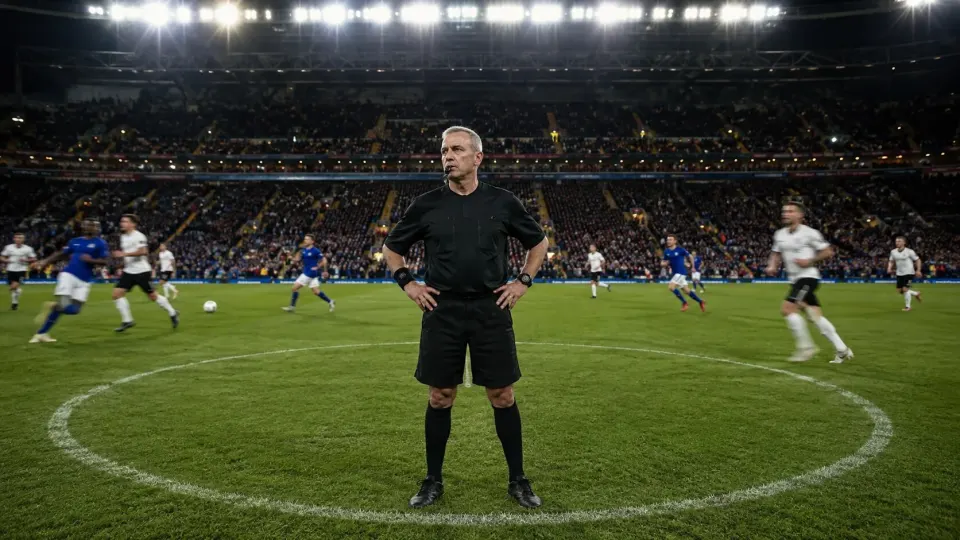
Former Premier League referee Mike Dean has revealed that officials sometimes set themselves informal challenges during matches, because apparently controlling 22 footballers, two dugouts and 50,000 amateur legal scholars was not stimulating enough.
Speaking on Jamie Vardy’s podcast, Dean described what he called little games played “for a laugh”. One was to see how long a referee could allow a match to continue before awarding the first free kick. Another involved trying not to stray far from the centre circle.
Dean claimed he once went roughly 15 minutes while largely remaining in the middle. He also suggested that, before video assistant referees changed the rhythm and scrutiny of games, an official might occasionally reach 20 or 25 minutes without blowing for a foul.
Those comments travelled quickly. Football supporters, rather reasonably, asked whether the match they had paid to watch was occasionally sharing the pitch with an unofficial refereeing side quest.
What did Dean actually mean?
There is a difference between deliberately ignoring a clear offence and consciously allowing a flowing match to continue when contact does not require intervention. Referees are encouraged to use advantage, distinguish trifling contact from fouls and avoid stopping play unnecessarily.
Dean’s colourful wording made that distinction difficult to see. Describing it as a “game” suggests the challenge mattered independently of the football. The more benign interpretation is that experienced officials compared how well they could manage an open match without manufacturing needless stoppages.
After the backlash, Dean issued a clarification saying he had always followed the Laws of the Game. He said his comments referred to applying a high threshold for intervention and trying to let matches flow, not ignoring offences to win a private competition.
Did other referees confirm it?
Not in the broad form implied by the original story. According to talkSPORT, refereeing body Pro Ref reviewed the claims and found no evidence that officials routinely took part in such conduct. Former referee Graham Scott suggested the tale may have grown in the telling.
That leaves football with an anecdote, a clarification and a phrase that will follow Dean into every studio discussion about a missed foul. It does not establish that Premier League referees systematically manipulated matches for entertainment.
It does, however, expose the risk of turning professional judgment into a funny story. A referee’s authority depends on players and supporters believing each decision is made for the match in front of them. Even the appearance of a separate objective damages that confidence.
Why the story has exploded
Dean has always been a memorable figure. He refereed in the Premier League for more than two decades, left on-field duties after the 2021-22 season and then spent a year working as a VAR before moving into media work. His dramatic signals and willingness to talk make better television than a former official calmly saying “the protocol was correctly applied”.
Vardy, meanwhile, built a career around testing the patience and positioning of defenders and referees. Put the two together with microphones and it was unlikely the result would be a quiet seminar on administrative procedure.
The OutOut verdict
Letting a good match breathe is sensible refereeing. Turning “how long can I avoid the whistle?” into an explicit personal target is something else, because the next foul should be judged on its own merits rather than the stopwatch.
Dean says the viral version does not reflect what happened, and there is no evidence of an organised league-wide game. That clarification deserves to travel with the original quote.
Still, the next time a referee spends ten minutes in the centre circle without stopping play, supporters will know exactly what to shout. Football never wastes a new conspiracy.