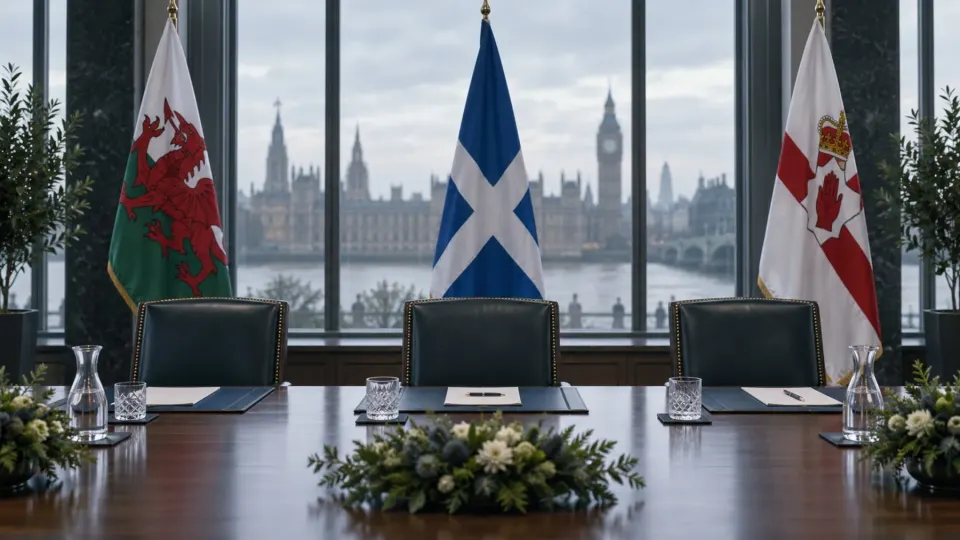
The leaders of Wales, Scotland and Northern Ireland have signed a joint pact calling for constitutional change, closer alignment with Europe and recognition that each nation should be able to determine its own future. Westminster has therefore received the political equivalent of three neighbours appearing together at the front door with a clipboard.
The memorandum was agreed at a summit in Cardiff on Monday 14 September. Reporting by the Associated Press and the Guardian says the participants argued that the present UK settlement is too centralised and that decisions about future constitutional status should not rest with the UK government alone.
This is politically significant. It is not, however, a notice that the United Kingdom has been dissolved before breakfast. A memorandum creates coordination and pressure; it does not alter the constitution, schedule a referendum or automatically transfer any legal power.
What the agreement actually joins together
The three nations do not have identical destinations. Scotland’s nationalist movement wants another independence referendum after the 2014 vote. Sinn Féin’s long-term objective is Irish reunification, for which the Good Friday Agreement provides a separate consent-based route. Plaid Cymru supports Welsh independence, while the immediate Welsh demands also include stronger devolution and parity with powers exercised elsewhere.
Their common ground is therefore procedural as much as ideological: constitutional decisions should reflect voters in the affected nation, Westminster should prepare for change rather than simply refuse it, and the devolved governments want more room to cooperate internationally and align with the European Union.

That shared position matters because Brexit landed differently across the UK. Scotland and Northern Ireland voted to remain in the EU in 2016; Wales voted to leave. Northern Ireland later acquired a distinct trading position because avoiding a hard border on the island was central to the Brexit settlement. One union now contains several relationships with Europe and several arguments about who consented to them.
Three routes, not one exit door
The mechanics are crucial. A Scottish independence referendum requires a lawful route recognised by both Edinburgh and London if it is to settle the issue conclusively. The UK Supreme Court ruled in 2022 that the Scottish Parliament could not unilaterally legislate for an independence referendum outside its powers.
Northern Ireland is different. The Northern Ireland Act 1998 gives the UK secretary of state a role in calling a border poll when it appears likely that a majority would favour Irish unity. Any change would require consent north and south of the border.
Wales has no equivalent statutory referendum mechanism. A move towards independence would therefore involve political negotiation and legislation at Westminster. The pact cannot flatten those differences, however attractive one matching set of podiums may look.
Prime Minister Andy Burnham dismissed the initiative and emphasised national unity and household priorities. That response contains a familiar Westminster calculation: voters may express constitutional dissatisfaction while still ranking bills, housing and public services above a referendum. Nationalist parties answer that power over those daily issues is precisely what the constitutional argument is about.
Why Westminster should still pay attention
The immediate test is not whether three referendums suddenly appear. It is whether joint pressure changes the terms of ordinary government: funding rules, borrowing powers, representation abroad, relations with the EU and the convention that Westminster normally seeks devolved consent before legislating in devolved areas.
A union survives through more than legal authority. It also needs political legitimacy in each of its component nations. Repeating that Westminster is sovereign may win the constitutional footnote while losing the public argument.
Follow developments through OutOut’s UK coverage and our earlier explanation of how an Irish unity vote would actually work.
The OutOut verdict
The pact is neither the breakup of Britain nor a decorative Celtic coffee morning. It is an organised warning that three governments increasingly want Westminster to negotiate with them as political partners rather than regional departments with better scenery.
The difficult bit begins after the photograph. Scotland, Wales and Northern Ireland have different laws, electorates and end goals. But Westminster would be unwise to treat that complexity as permission to ignore them. A union held together only by telling everyone the door is legally locked is not a confident union. It is a pub after closing time.