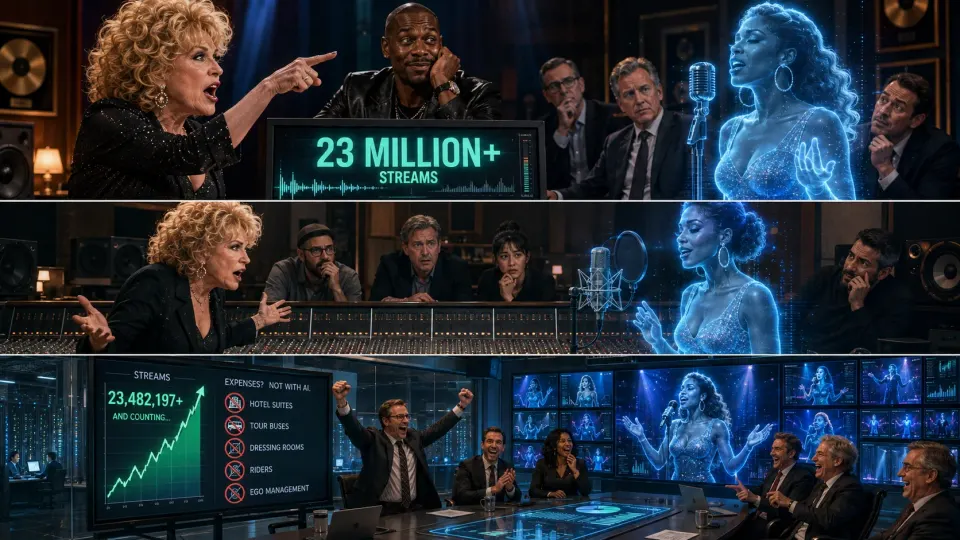
The music industry has finally reached the completely normal stage of technological progress where Bette Midler and Tyrese Gibson are publicly arguing about whether a computer makes better soul music than human beings.
Excellent.
Nothing concerning here.
At the centre of the argument is “Celebrate Me”, the viral neo-soul track released under the name IngaRose.
The song has accumulated more than 23 million Spotify streams, topped iTunes charts earlier this year and helped IngaRose build an audience of more than one million monthly Spotify listeners.
There is just one fairly significant complication.
IngaRose isn't a conventional singer.
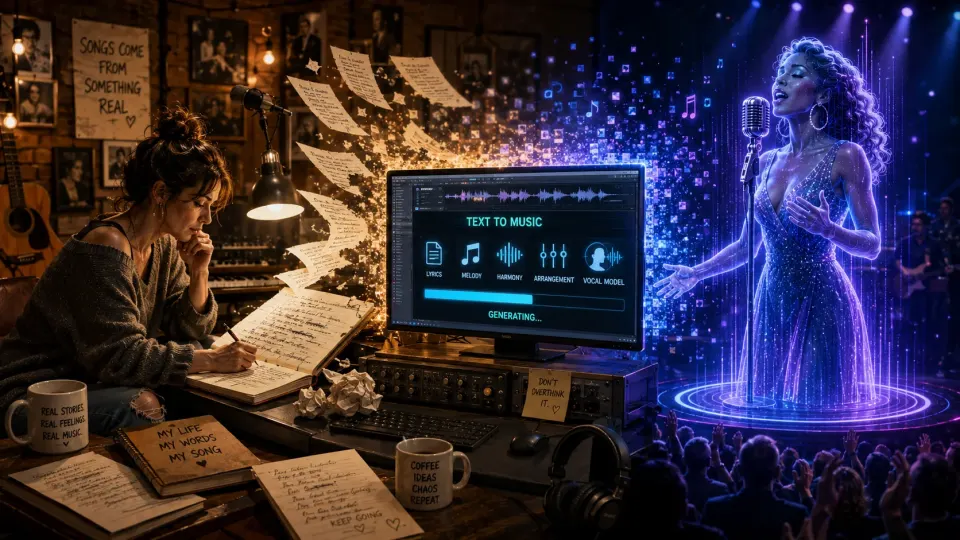
The project says its lyrics and stories are written by a human creator, while AI music platform Suno is used to help turn them into finished songs.
The voice?
Artificial.
The glamorous woman appearing in the project's social-media imagery?
Artificial.
The argument involving several actual Grammy-nominated musicians?
Extremely real.
BETTE HAS ENTERED THE CHAT
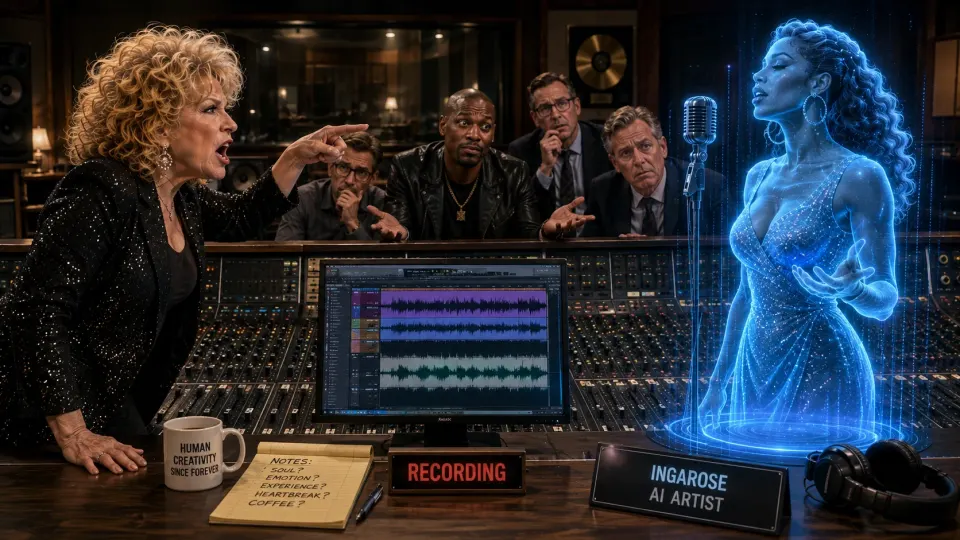
Bette Midler discovered “Celebrate Me” and was not impressed.
Actually, that's not quite accurate.
She was impressed.
That's partly the problem.
Midler described it as a good song before launching into a furious criticism of how generative AI music is created.
Her argument was that AI systems can absorb enormous quantities of existing human creativity — riffs, phrasing, vocal styles and emotional performances — without properly compensating the artists whose work helped make those systems possible.
She finished with two words guaranteed to calm everybody down:
“Cultural genocide.”
So that's subtle.
But beneath the nuclear terminology sits a serious question that the music business increasingly cannot avoid:
If a machine learns to make convincing soul music by analysing human soul singers, who exactly deserves paying when the machine gets 23 million streams?
Unfortunately for Bette, another famous human had already wandered into the comments section.
TYRESE CHOOSES VIOLENCE
Tyrese Gibson — actor, singer and veteran of the Fast & Furious franchise — took almost precisely the opposite position.
His basic argument:
It's good. Deal with it.
Gibson said AI isn't going anywhere and argued that complaining about the song would merely make it more popular.
Which, considering we're now writing another article about it, is annoyingly difficult to dispute.
More brutally, he challenged human musicians to produce something better.
His message essentially boiled down to:
Stop complaining and step your game up.
That's an absolutely savage thing to tell the music industry about a performer who doesn't require sleep, vocal rest, tour buses, hotel rooms, royalties or apparently oxygen.
Humanity spent thousands of years developing music.
Then somebody gave a laptop Wi-Fi and now Tyrese is asking why Adele isn't working harder.
THERE IS ONE PARTICULARLY BEAUTIFUL PROBLEM
“Celebrate Me” is an empowerment song.
It's about hardship.
Heartbreak.
Crying.
Survival.
Getting through life's darkest moments and emerging stronger.
Which would all be perfectly ordinary soul-music territory except that the voice performing those emotions has never experienced any of them.
It has never been heartbroken.
It has never cried.
It has never lain awake at 3am wondering whether sending another text is a terrible idea.
It has never survived anything.
You could unplug the computer halfway through the chorus and technically give it the most traumatic experience of its existence.
And yet millions of people have apparently connected emotionally with the result.
That is where this stops merely being a funny celebrity argument and becomes genuinely fascinating.
BUT THERE IS A HUMAN BEHIND THE CURTAIN
It would also be misleading to portray IngaRose as somebody typing:
“Computer, make hit song please.”
The project explicitly describes itself as using human-written lyrics and real stories, with stems and arrangements refined using Suno.
Its Spotify biography identifies a human songwriter behind the project who writes from personal experience before using AI to bring those songs to life.
So there really are human emotions involved.
They're simply travelling through an artificial performer.
Which somehow makes everything even more confusing.
Imagine writing the most personal song of your life and then deciding:
“Absolutely nobody should hear me sing this. Fetch the robot.”
BETTE HAS BACKUP
Midler wasn't alone.
Natasha Bedingfield joined the criticism and suggested the generated vocal reminded her strongly of real singer Olivia Dean.
India Arie expressed disbelief that AI-generated music was appearing on charts.
Amy Sedaris offered an even more economical review:
“Yuck.”
Several decades of debate about artificial intelligence, copyright, machine learning and the future of human creativity.
Amy has condensed the entire conference into one syllable.
Efficient.
UNFORTUNATELY, PEOPLE LIKE THE SONG
And here lies the music industry's rather uncomfortable problem.
Listeners don't necessarily care how the sausage is made.
“Celebrate Me” became a genuine hit months before this argument erupted.
It topped iTunes in several countries and its Spotify total has now crossed 23 million streams.
IngaRose has more than 1.1 million monthly Spotify listeners.
Those aren't people accidentally clicking something once.
There is an audience.
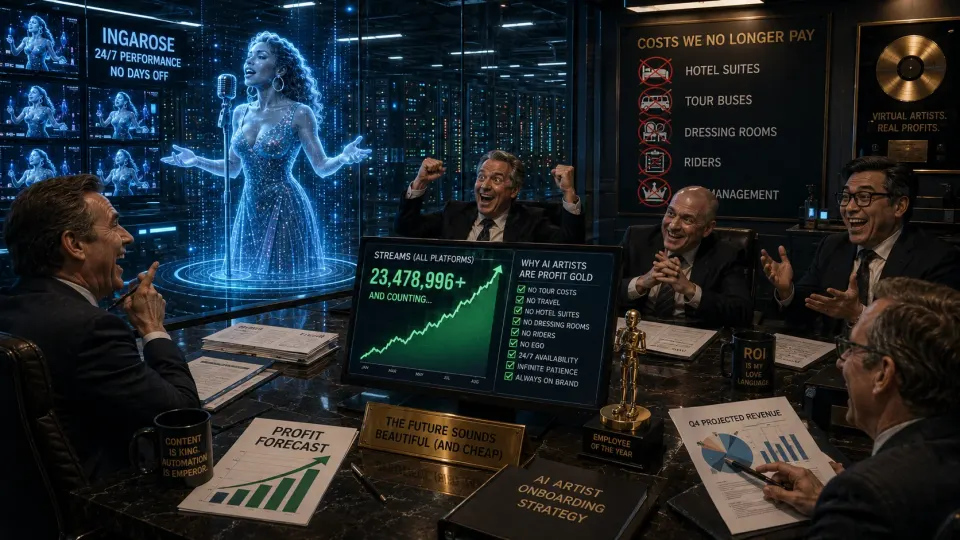
And if audiences begin happily listening to artificial performers, record companies are inevitably going to notice one fairly compelling commercial feature.
Robots are spectacularly low maintenance.
No dressing-room demands.
No missed rehearsals.
No vocal-cord problems.
No tour cancellations.
No drunken interviews.
No drummer announcing he's leaving because of “creative differences”.
No £14,000 hotel minibar bill.
The machine doesn't even need a chair.
From an accountant's perspective, this isn't a singer.
It's Christmas.
WELCOME TO MUSIC'S EXISTENTIAL CRISIS
There are really two arguments happening here.
Midler's is about where AI learned its tricks.
If systems can reproduce the emotional fingerprints of generations of singers because they were trained using enormous quantities of human-created music, what rights should those musicians have?
Tyrese's argument is much simpler:
What if the result is actually good?
And that's the uncomfortable bit.
Because AI music doesn't need to become objectively better than every human musician.
It merely needs to become good enough that listeners stop caring.
We've already watched technology replace physical records with files.
Files with streaming.
Radio DJs with algorithms.
Album artwork with tiny rectangles on phones.
The terrifying next step for musicians isn't necessarily that AI writes Beethoven's Tenth Symphony.
It's that somebody hears an artificial singer in their Spotify recommendations while washing the dishes and thinks:
“Yeah, that's quite nice.”
Then doesn't ask another question.
HUMANITY REMAINS UNDEFEATED*
So who wins Bette Midler versus Tyrese Gibson?
At the moment, probably neither.
Midler is raising legitimate questions about ownership and artistic labour.
Tyrese is pointing towards an equally awkward reality: audiences judge music partly by whether it makes them feel something, not by inspecting the employment status of the vocalist.
Meanwhile IngaRose continues accumulating streams while several extremely famous humans argue underneath an Instagram post.
Which may ultimately be the most 2026 outcome imaginable.
The humans are fighting.
The algorithm is working.
And the artificial singer?
She hasn't even had to respond.