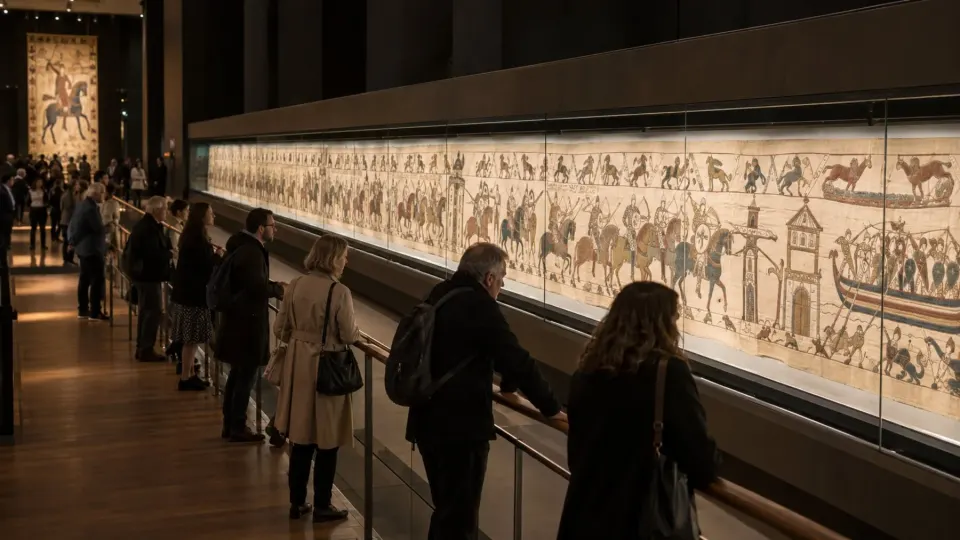
The Bayeux Tapestry has opened to the public at the British Museum, giving Britain a rare chance to inspect the most famous visual account of the moment it was conquered.
The roughly 70-metre embroidered work went on display in London on Thursday 10 September. Reuters reported that it is the first time the tapestry has been in England since it was made almost a thousand years ago, probably by English embroiderers.
It will remain at the museum for about ten months under a reciprocal loan with France. Britain is sending the Sutton Hoo treasures to Normandy while the Bayeux museum is renovated.
What visitors actually see
The tapestry is displayed in a specially designed glass case. Visitors first follow it from an elevated walkway for a continuous view, then return at closer range to inspect individual scenes and stitching. The complete circuit takes about 40 minutes.
Its story follows the events leading to the Norman conquest of England in 1066, culminating in William the Conqueror’s victory over King Harold at the Battle of Hastings. Kings, soldiers, horses and ships fill the main narrative, while borders carry animals, fables and stranger details that have fuelled centuries of interpretation.
It is called a tapestry, but the image is embroidered onto linen rather than woven into the fabric. That technical correction has survived generations of teachers sensibly deciding that “the Bayeux Embroidery” would never command the same school-trip energy.

Why the loan is extraordinary
Moving a fragile object of this age is an engineering and conservation operation. Light, humidity, vibration and physical support all have to be controlled. The work has survived war, revolution, storage and repeated changes in ownership; a modern loan cannot treat that luck as a transport plan.
Its return also carries symbolism. The object tells a Norman victory story but may have been produced in England by people living with the consequences. It is propaganda, record, artwork and cultural evidence at once. Historians use it not only for the sequence of events but for clothing, ships, weapons, food and medieval visual language.
The narrative is not neutral. It presents claims to the English throne, oaths and omens in ways that support William’s legitimacy. That makes it more useful, not less, when read critically. Medieval media understood selective framing long before anyone invented the quote-tweet.
Tickets and access
Demand has been enormous. Reuters said advance ticket sales had raised about £2.5 million, and the British Museum reported that initial allocations were sold out. Further tickets are expected to be released, including another batch in October.
Visitors should use the museum’s official website rather than paying inflated prices or trusting unofficial listings. The long loan means there is time, even if the first wave of booking has recreated the Battle of Hastings using browser tabs.
The exhibition is also an opportunity to ask who gets access to major cultural objects and how loans are negotiated. High-profile exchanges can broaden audiences, but museums must balance spectacle with conservation, scholarship and affordable entry.
For more events and cultural reporting around Britain, visit OutOut’s UK section. Other gloriously improbable stories live in Just Daft.
The OutOut verdict
England has waited nearly a millennium for the Bayeux Tapestry to come back and immediately sold out the available slots. Harold would recognise the planning problem.
Beyond the gag, this is a genuinely exceptional loan: a foundational historical object returning to the place where much of its story happened. See it if you can, read it as an argument rather than a camera reel, and spare a thought for the conservators responsible for keeping 70 metres of eleventh-century linen calmer than the booking queue.