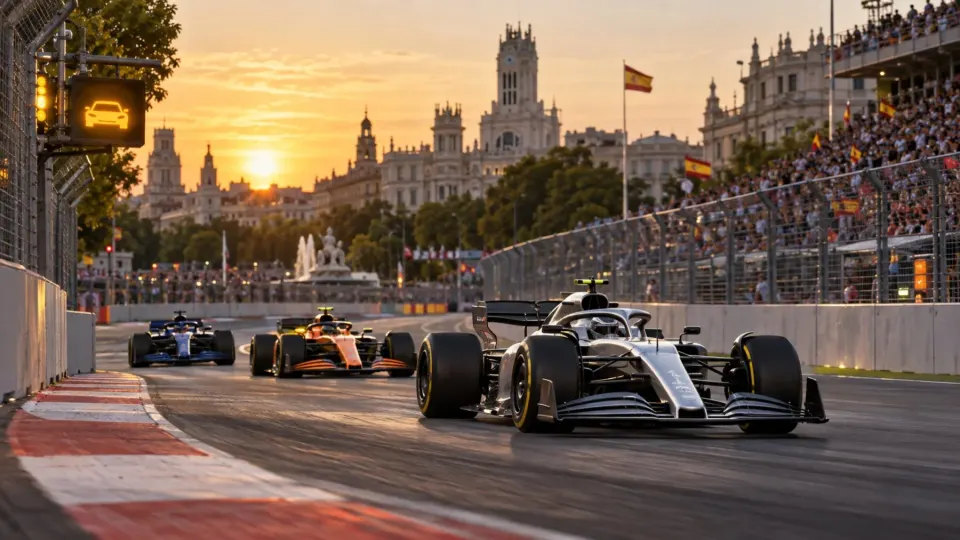
Kimi Antonelli won the first Formula One race staged at Madrid’s new Madring circuit on Sunday 13 September, although even the winner acknowledged that Lando Norris had done the better afternoon’s work.
Norris started from pole, survived an aggressive opening lap and built a lead of more than six seconds. Then Lance Stroll stopped at turn 20 on lap 15, triggering a virtual safety car at precisely the moment Norris had passed the pit entrance.
Antonelli, Max Verstappen and George Russell could stop while the field was slowed. Norris had to complete another lap and pitted after racing resumed. A slow front-right tyre change added insult, but McLaren and Pirelli said the race had effectively been lost before the car reached its mechanics.
Antonelli emerged with the advantage and won by 4.3 seconds from Verstappen. Norris finished a further 0.7 seconds back in third. Formula One calls this strategy, timing and procedure. Anyone wearing papaya calls it being mugged by a light board.
Why the virtual safety car mattered
Under a virtual safety car, every driver must slow to a prescribed delta time. A pitstop therefore costs less relative time because rivals are circulating below normal racing speed. If one driver has already passed the pit entry when the caution begins, the opportunity can vanish before the team can react.
There was no obvious tactical mistake for McLaren to correct. Norris could not reverse into the pit lane, however emotionally satisfying that might have been. The neutralisation arrived in a narrow window and rewarded the cars behind.

His actual stop lasted seven seconds, unusually slow by modern F1 standards. Yet Reuters reported that the team and tyre supplier agreed the delay did not alter the essential outcome. Norris returned fifth on the road, while Charles Leclerc still needed to stop, and eventually recovered to third.
The circuit then became the other character in the story. The Madring had attracted warnings about limited overtaking, and the remaining laps offered little evidence for the defence. Cars followed, tyres aged and the inaugural race turned into a rapid guided tour of Madrid’s barriers.
A huge championship step
Antonelli’s victory was his eighth of the season and extended the 20-year-old Italian’s championship lead over Mercedes teammate Russell to 81 points after 14 rounds. That is more than three race wins under the current points system.
The winner did not pretend luck was irrelevant. He said Norris deserved victory but accepted the result. Verstappen, second for Red Bull, also recognised that the McLaren had been the fastest car before the interruption.
Lewis Hamilton’s afternoon ended with a brake problem. The Ferrari driver fell down the order and retired, while Russell finished fifth. Mercedes moved to 503 constructors’ points, well clear of Ferrari on 358 and McLaren on 306.
There is a useful distinction between deserved and valid. Norris may have driven the strongest race; Antonelli won under rules applied to everyone. Safety interventions are not designed to preserve sporting gaps. They exist to control risk, and randomness is an accepted side effect.
That does not make the format immune from review. A track where overtaking is severely constrained gives chance events disproportionate weight because a faster car cannot recover position. The Madring’s organisers can celebrate a successful first grand prix while still examining whether future changes can create more than one meaningful passing place.
Follow the championship through OutOut’s Sport coverage.
The OutOut verdict
Antonelli did exactly what champions do: remained close enough to inherit the opportunity and made no mistake after receiving it. Norris did exactly what race winners do, except for the awkward final step involving actually winning.
The Madring’s debut delivered impressive scenery, a decisive computer message and a parade after lap 16. Madrid built a brand-new circuit and immediately discovered Formula One’s oldest truth: sometimes the fastest driver loses because somebody else parks badly at the correct second.