At 88, most people would consider two Academy Awards, a knighthood and one of the most celebrated acting careers in history to be a respectable amount of achievement.
Sir Anthony Hopkins has apparently looked at that list and decided it lacks an orchestral album.
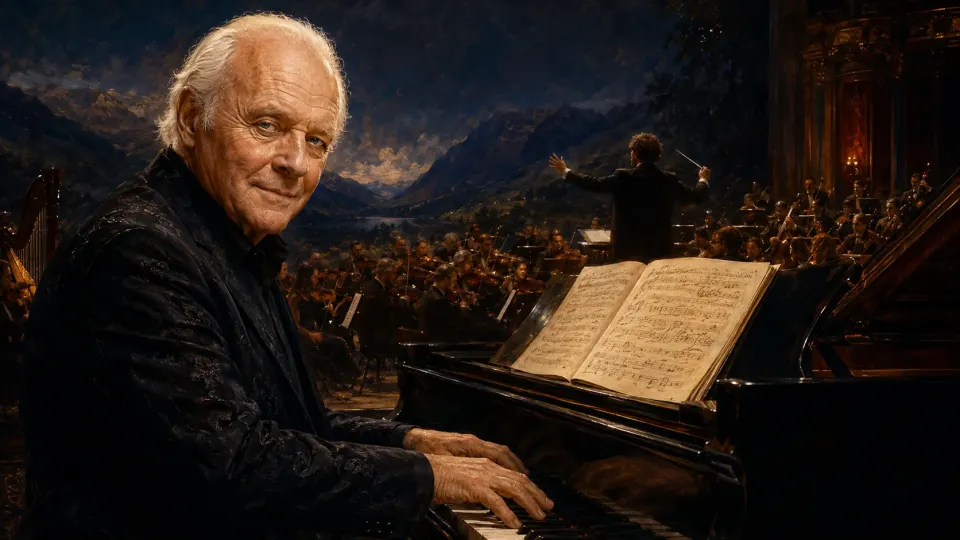
The Welsh actor is releasing Life Is a Dream, a collection of classical compositions written across more than six decades and performed by the Philharmonia Orchestra under conductor Gustavo Dudamel.
It arrives on 21 August with 12 tracks, a major record label and absolutely no indication that Hopkins understands the concept of taking it easy.
Some actors release perfume.
Some open a restaurant.
Hopkins has summoned an entire orchestra.
ACTOR, COMPOSER, OVERACHIEVING MENACE
Hopkins began playing piano when he was four and has been writing music since long before Hannibal Lecter began making dinner reservations.
According to the Associated Press, the album brings together compositions created over approximately 60 years.
This is therefore not a celebrity waking up on Tuesday, purchasing a keyboard and deciding the world requires an experimental concept album by Friday.
Hopkins was writing music during the early stages of his acting career, quietly building a collection while becoming one of cinema’s most recognisable performers.
Most people struggle to answer emails while watching television.
Hopkins was apparently memorising Shakespeare, composing orchestral suites and preparing to frighten the living shit out of Jodie Foster.
THIS IS NOT A CELEBRITY VANITY PROJECT
Celebrity albums can be dangerous territory.
There is always a risk that fame convinces somebody that singing three songs at karaoke qualifies them to release a deluxe vinyl edition.
But Hopkins has not recruited a few session musicians and asked them to make him sound profound.
Life Is a Dream is performed by London’s Philharmonia Orchestra and conducted by Grammy-winning maestro Gustavo Dudamel.
That is the classical equivalent of deciding to try football and immediately phoning Real Madrid.
The project reportedly came together after actor and director Bradley Cooper helped connect Hopkins with Dudamel.
Cooper therefore deserves credit for creating one of the more unexpected introductions in entertainment:
“Gustavo, this is Anthony. He has two Oscars, a knighthood and six decades of orchestral music sitting in a drawer.”
Dudamel appears to have taken the work seriously, describing Hopkins’ compositions as emotional, poetic and deeply personal.
Which is considerably better than politely saying, “It was lovely to meet him.”
WALES RUNS THROUGH THE MUSIC
The album draws heavily on Hopkins’ childhood in south Wales, his family and the passing of time.
One of its central works is 1947 Suite, named after a formative period in his childhood. Its movement Bracken Road recalls the landscape and memories of Margam, near Port Talbot.
Other pieces reflect his Welsh heritage and his relationship with his wife, Stella.
This is not music created to chase streaming trends or accompany somebody pointing at captions on TikTok.
It is the sound of an elderly man looking back across an extraordinary life and attempting to preserve the places, people and feelings that built it.
Admittedly, he has chosen to do that with one of Britain’s finest orchestras rather than a Facebook post containing 46 photographs.
But subtlety has never won an Oscar.
HE HAS BEEN WRITING MUSIC SINCE THE 1960S
Hopkins wrote some of his earliest compositions while still establishing himself as an actor.
Bracken Road dates from the 1960s, and his musical interests have followed him throughout his career.
He has previously written scores for films and stage productions, while one of his waltzes was performed and recorded by violinist André Rieu.
The new release is therefore less a sudden career change and more the opening of a room Hopkins has kept locked for decades.
Inside it are handwritten scores, childhood memories and enough music to keep an orchestra occupied.
This may also explain his acting range.
While everybody else was preparing between scenes by drinking coffee or complaining about the lighting, Hopkins may have been mentally rearranging the cello section.
APPARENTLY ACTING DID NOT PROVIDE ENOUGH CREATIVE FREEDOM
Hopkins has said that music gives him a sense of freedom different from acting.
An actor works with another person’s script, a director’s interpretation and an editor who can remove their finest moment because the film is already three hours long.
A composer begins with silence and is free to decide what happens next.
For somebody who has spent a lifetime inhabiting other people’s words, creating music offered Hopkins something entirely his own.
The album reportedly moves through nostalgia, melancholy, love, ageing and acceptance.
So, despite the obvious temptation, this is not twelve orchestral versions of the Hannibal Lecter theme followed by a bonus track called The Fava Bean Concerto.
It is an intensely personal collection from someone who apparently still has things to say after more than 60 years in public life.
CARNEGIE HALL COULD BE NEXT
Hopkins is even considering performing the music live.
The ultimate ambition would reportedly be Carnegie Hall in New York, a venue connected to a childhood memory of his mother encouraging his ambitions.
Most musicians spend years dreaming about Carnegie Hall before gradually accepting a Thursday evening slot above a pub.
Hopkins has approached the process backwards.
First become one of the world’s greatest actors.
Then wait until 88.
Then casually consider Carnegie Hall.
It is difficult to call that unrealistic when the man has already spent his life achieving things that would sound ridiculous in advance.
A FIRST LOVE FINALLY GETS THE MAIN STAGE
Life Is a Dream will be released by Decca Classics on 21 August, with digital and CD editions followed by vinyl later in the year.
The collection includes music written across Hopkins’ life, performed by musicians capable of giving those private ideas their full scale.
Reuters reports that the project reflects his childhood, family and native Wales, bringing together work he has carried with him for decades.
There is something rather magnificent about waiting until 88 to give your first passion the attention it deserves.
Hopkins does not appear to be desperately launching a new career.
He is simply allowing an old one to step out from behind the acting.
After decades of playing kings, killers, fathers, geniuses and monsters, Sir Anthony Hopkins has finally accepted the most demanding role of all:
bloke at the piano who has brought an entire orchestra with him.