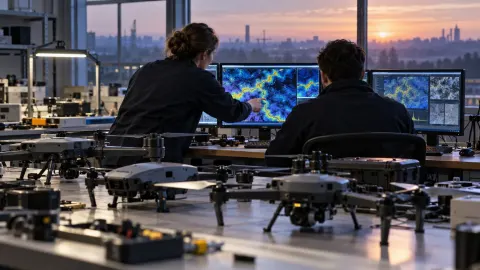
AMD has agreed to buy World Labs, the artificial-intelligence research company led by computer-vision pioneer Fei-Fei Li, in an all-stock deal valued at approximately $8.2 billion. The acquisition is expected to close by the end of 2026, subject to regulatory approval and other customary conditions.
The price buys AMD more than another model with a chat box. World Labs works on “spatial intelligence”: systems designed to understand, generate and simulate three-dimensional environments and physical interactions. That research could support robots, autonomous systems, games, design tools and digital twins. It could also create demand for enormous quantities of computing hardware, which is where the chipmaker's interest becomes less mysterious.
AMD said Li will join as an executive vice-president and chief scientist. The company describes the deal as a way to align its hardware, software and systems with emerging AI models. Reuters reported that World Labs had recently raised around $1 billion and had already worked with AMD graphics processors.
What “physical AI” means
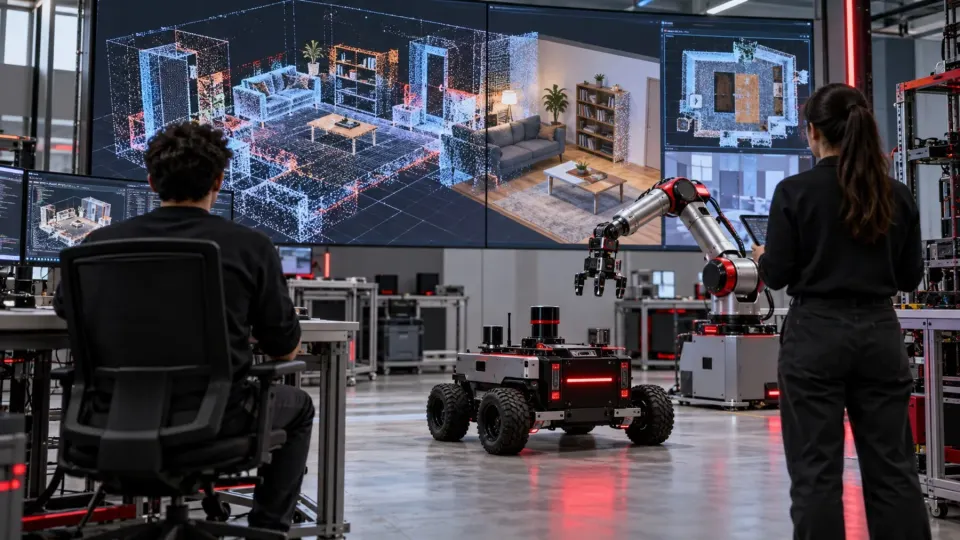
Large language models learn patterns in text and other data, then predict useful outputs. A world model tries to represent how an environment is arranged and how it may change when something moves or acts. It might infer depth from images, build a navigable scene, predict the result of a robot pushing an object or simulate a warehouse before machinery is installed.
That does not mean a machine “understands” a room as a human does. The word is industry shorthand for capabilities demonstrated through tasks. A model can produce a convincing 3D space and still make physically impossible assumptions, miss a hidden hazard or fail when the lighting changes. The better question is not whether it possesses a philosophical inner world, but whether its predictions remain reliable when a real machine depends on them.
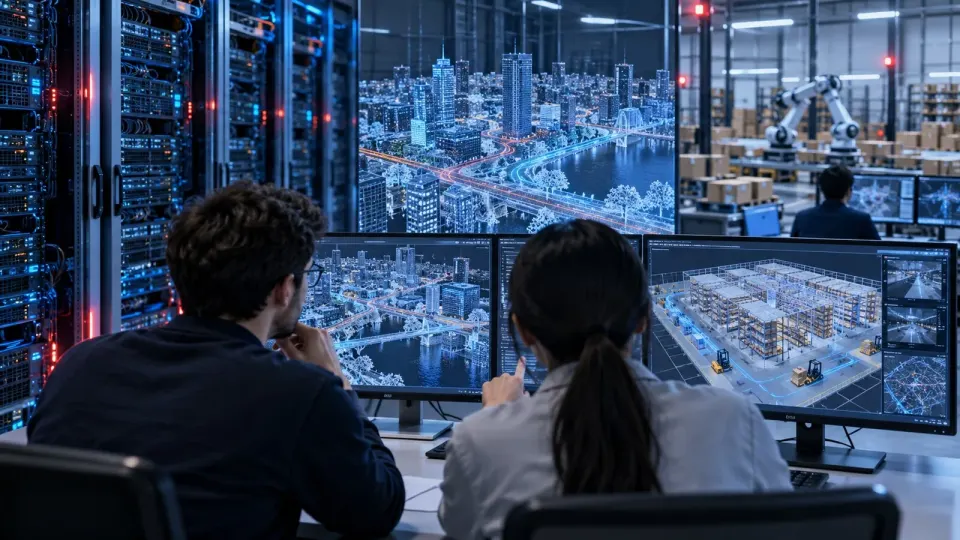
For AMD, the strategic logic is vertical. Nvidia's success has shown that AI competition extends beyond selling silicon. Developers choose chips alongside programming tools, model frameworks, networking and complete systems. Owning a leading research group can help AMD see future workloads earlier and optimise hardware around them. It also means a semiconductor company is spending billions on the people and models likely to consume its processors.
The deal is all-stock, so AMD is paying with shares rather than handing over $8.2 billion in cash. Existing shareholders still carry a cost through dilution and execution risk. The valuation is an agreed transaction value, not proof that World Labs currently produces revenue or profit on that scale. Investors must judge whether research, talent and future market position justify the price.
Why the next AI battlefield may be three-dimensional
Text and image generation brought AI to office work and creative tools. Physical systems expand the market into warehouses, factories, vehicles, laboratories and homes. A robot that can interpret an unfamiliar scene, plan safely and adapt could be useful far beyond a fixed industrial arm repeating one programmed motion.
The difficulty is that mistakes leave the screen. A fabricated paragraph is harmful in some settings; a fabricated doorway used by a moving robot can be immediately dangerous. Spatial models require testing across unusual objects, reflections, weather, occlusion and deliberate attempts to confuse sensors. They also need uncertainty estimates and safe failure behaviour.
World models could reduce the cost of collecting real-world training data by generating simulations. Simulations can expose machines to rare scenarios without crashing actual equipment. They can also reproduce their creators' assumptions. If the virtual world omits a class of obstacle or represents physics badly, a system can become wonderfully skilled at succeeding somewhere that does not exist.
Privacy is another issue. Systems that map homes, workplaces and public spaces may capture people, possessions, layouts and routines. The most detailed spatial data can be commercially valuable and security-sensitive. Developers will need rules about collection, retention, access and whether training data can be reconstructed from a model.
What the acquisition does not prove
It does not establish that general-purpose household robots are about to arrive, that World Labs has solved physical reasoning or that AMD has overtaken Nvidia. A signed acquisition is a bet on future capability. Integration can distract researchers, product roadmaps can slip and expensive talent can leave.
Nor is every spatial model automatically autonomous. The technology can support visualisation, film, architecture and training without controlling a machine. Those uses have different risk profiles and commercial timelines. “Physical AI” is a useful umbrella, but umbrellas are famously spacious places for marketing departments.
The acquisition follows a wider industry shift towards agents and systems that take action rather than merely answer questions. OutOut recently examined the safety warnings surrounding autonomous AI agents. Spatial intelligence adds another layer: the model must interpret a changing environment as well as choose an action.
The OutOut verdict
AMD is paying an extraordinary price for a view of AI beyond the browser tab. The strategic case is plausible: if models move into robots and simulated worlds, the company wants to shape both the workload and the machine running it.
The acquisition should still be judged by products, research quality and safety—not the number of times a press release says “future”. An $8.2 billion world model is impressive. Now it has to avoid walking into the furniture.