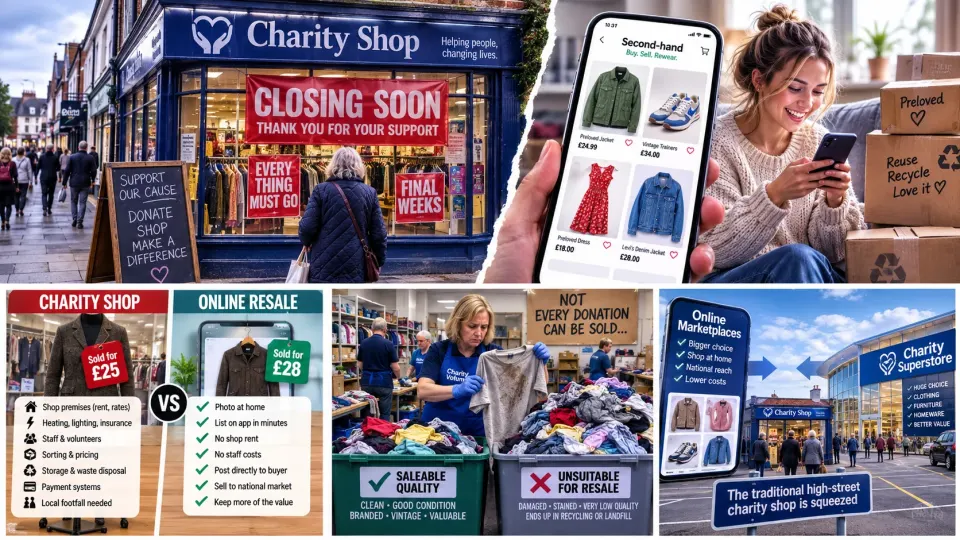
Walk through almost any British town centre and the importance of charity shops is difficult to miss. For decades they have occupied the gaps left by retreating banks, department stores and independent retailers, turning unwanted clothes, books and furniture into money for medical research, hospices, humanitarian organisations and hundreds of smaller causes. At precisely the same time, buying something previously owned has moved from being a budget necessity or niche hobby into mainstream consumer culture. Vinted has become a household name, eBay remains enormous, Depop has made used clothing fashionable among younger shoppers, retailers are developing their own resale programmes and even major companies such as IKEA are moving deeper into the second-hand market.
You might therefore expect Britain's charity shops to be enjoying one of the strongest periods in their history.
Instead, some are closing.
The British Heart Foundation announced plans this summer to close around 150 shops and stores over two financial years. Cancer Research UK has already embarked on a programme reducing its traditional high-street estate to roughly 320 high-performing shops, with around 90 closures planned by May 2026 and potentially another 100 by April 2027. Oxfam, meanwhile, has been examining its retail and warehouse operations against a background of rising costs and difficult trading conditions.
The apparent paradox is worth examining because it reveals something much larger than the fate of charity shops.
Second-hand retail isn't disappearing. It is being reorganised.
And the economic model that made a charity shop unusually resilient for decades is being challenged from several directions at once.
SECOND-HAND SHOPPING IS BOOMING. THAT DOESN'T MEAN CHARITY SHOPS ARE.
At first glance, the numbers appear reassuring. Britain still has more than 9,900 charity shops, according to the Charity Retail Association, employing the equivalent of more than 24,900 full-time workers and supported by more than 223,000 volunteers. Collectively, charity retail generated more than £300 million in profit for parent charities during 2024/25. The average transaction remains relatively modest — around £7.27 in the first quarter of 2026 — but multiplied across millions of transactions, donated goods remain an important source of charitable income.
The difficulty is that a growing market does not guarantee that every business model operating inside that market will benefit equally. Streaming grew while DVD shops disappeared. People still consume enormous amounts of news despite declining newspaper circulation. Online banking expanded as bank branches closed. In each case demand for the underlying service remained, while the mechanism through which consumers accessed it changed.
Second-hand retail is experiencing something similar.
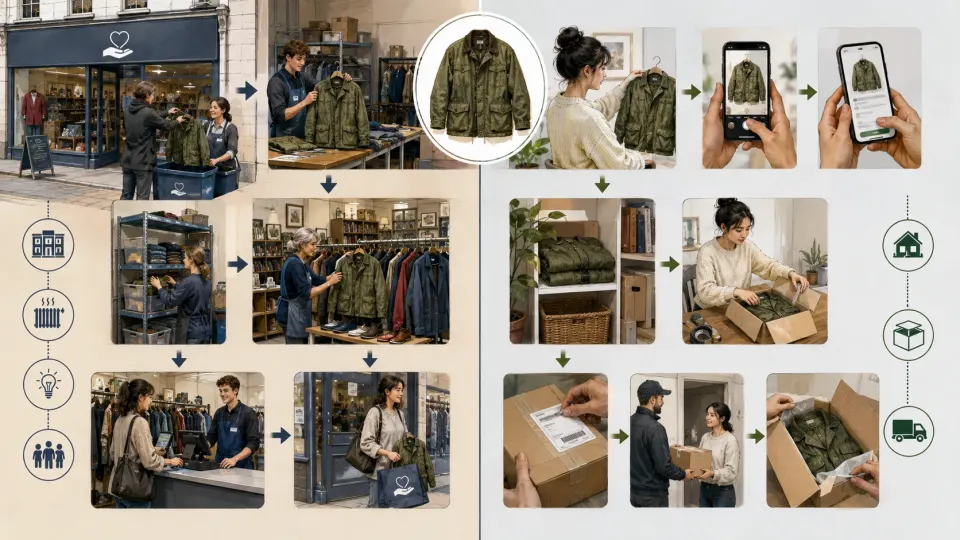
A traditional charity shop relies upon a physical building, a local supply of donated stock, staff and volunteers to process it, customers willing to visit the premises and enough valuable goods passing through the shop to cover its operating costs. Vinted requires none of those things at local level. The seller photographs an item in their bedroom, uploads it, stores it until somebody purchases it and then packages it for delivery.
In economic terms, part of the cost of retailing has effectively been transferred from the platform to the individual seller.
The charity shop still has to turn the lights on at 9am.
THE REAL PROBLEM IS NOT SALES. IT IS MARGINS.
This distinction between revenue and profit is central to understanding what is happening. A shop can be busy and still make surprisingly little money. Every physical store carries fixed and semi-fixed costs: rent, electricity, insurance, security, waste disposal, maintenance, payment systems, logistics and paid employees. Charities receive substantial relief from business rates — qualifying premises can normally receive up to an 80% reduction — but that does not make a retail unit free to operate.
Staffing costs have become particularly important. Charity shops are famous for their volunteers, but large national networks still employ thousands of paid workers to manage stores, warehouses, transport, ecommerce, compliance and administration. Once wages and employer costs rise, the effect is felt across hundreds of locations simultaneously.
This helps explain the scale of some recent decisions. The British Heart Foundation has said that rising operating costs and changing customer habits mean some of its stores are no longer financially sustainable. Cancer Research UK has used almost identical economic reasoning, arguing that although retail has contributed more than £225 million over the previous decade, a smaller number of stronger stores should ultimately generate more money for research than maintaining locations predicted to become unprofitable.
This is an important distinction because charities have a different objective from conventional retailers. Tesco may tolerate a strategically useful store with a narrow margin because it strengthens market share or supports a wider distribution network. A charity must eventually ask whether keeping a shop open produces more money for its cause than alternative uses of the same resources.
A shop generating £300,000 in annual sales may sound successful. If operating it consumes £295,000, however, the charity's underlying purpose receives £5,000. Closing that shop and directing staff, stock and investment towards a stronger location could potentially produce more charitable income despite reducing total turnover.
That is why the headline “charity closes successful-looking shop” can be misleading.
The relevant question is not how much money passes through the till.
It is how much remains afterwards.
THEN THERE IS THE QUALITY OF WHAT WE DONATE
There is another problem hidden inside the familiar black bags left at charity-shop counters: not every donation has economic value.
Charity retail depends upon an unusual supply chain because much of its inventory costs nothing to acquire. That sounds almost unbeatable. A conventional clothes retailer pays manufacturers for stock; a charity may receive a designer coat for free and sell it for £40. On that particular item, the potential gross margin is extraordinary.
But free inventory is not necessarily free to process.
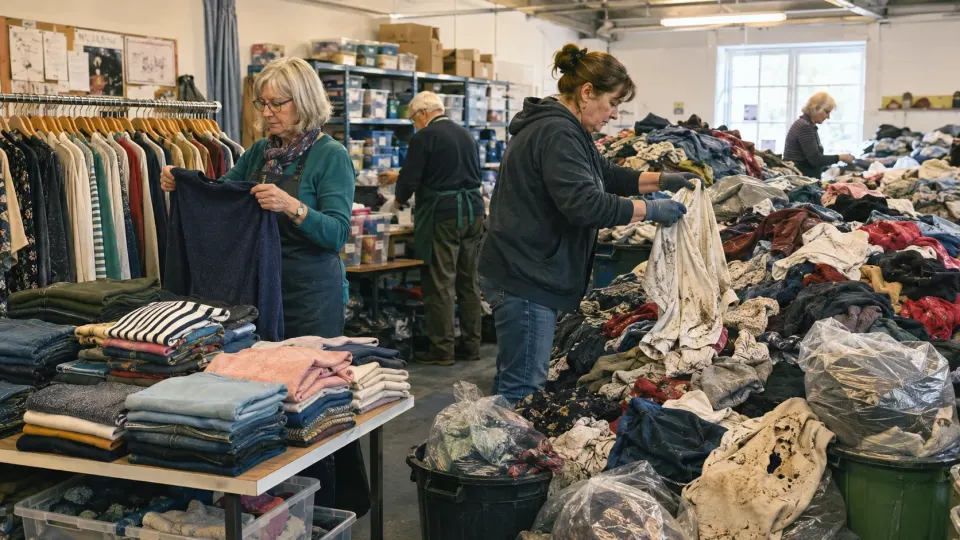
Every donation must be collected or received, transported where necessary, opened, inspected, sorted, priced and displayed. Items that cannot be sold still consume staff time and storage space and may subsequently require recycling or disposal.
The problem has become more pronounced as the quality of some donated clothing has fallen. St Luke's Hospice recently reported that around 60% of clothing donated to its operation could not be sold in its shops, with damaged, stained or very low-quality garments becoming a financial burden rather than an asset. Historically, unsold textiles could still generate income through the recycling or “rag” market. But St Luke's said rag prices had fallen dramatically over the previous two years before stabilising, reducing the value recovered from unwanted textiles.
This creates a strange inversion of the traditional charity-shop model.
A bag left outside the door may look like a donation.
Economically, part of it may actually be a waste-disposal bill.
Fast fashion intensifies the problem. Cheap clothes have dramatically increased the number of garments circulating through wardrobes, resale platforms and donation streams, but more garments do not necessarily mean more valuable stock. A well-made coat capable of having a second, third or fourth owner is economically different from a very cheap garment already nearing the end of its usable life.
Volume and value are not the same thing.
VINTED CHANGED WHO GETS THE BEST STUFF
There is an additional effect that is much harder to measure but easy to understand.
Imagine somebody clearing their wardrobe ten years ago. A barely worn designer jacket, three decent dresses, a pair of trainers, an old supermarket T-shirt and two pairs of worn jeans might all have gone into the same charity bag.
Today, that person has another option.
The designer jacket goes on Vinted.
The trainers go on eBay.
The best dress goes on Depop.
The remaining low-value items go to the charity shop.
The donor has not become less charitable in any moral sense. They may simply recognise that one item could fetch £80 online rather than being given away. But across millions of households, this process can alter the average quality of stock reaching charitable retailers.
Online marketplaces have effectively revealed the market price of objects that people once considered clutter.
That forgotten handbag at the back of a wardrobe is no longer obviously rubbish when an app can show within seconds that similar bags sell for £35.
The result is a phenomenon economists would recognise as adverse selection. Where sellers have more information about the value of their possessions and increasingly efficient ways to monetise them, higher-value goods are more likely to be removed from the donation pool before they ever reach the charity shop.
This does not mean charity shops no longer receive treasures. They plainly do. Nor does it mean Vinted is destroying charitable retail; the growth of second-hand culture can introduce consumers to used goods who later become charity-shop customers themselves.
But the competitive environment has changed.
The charity shop once competed primarily with other shops for customers.
It now competes with the owner's phone for stock.
THE INTERNET ALSO DESTROYED THE INFORMATION ADVANTAGE
For decades, one attraction of charity shopping was the possibility of finding something that had been incorrectly valued. A first-edition book might sit beside airport paperbacks for £2. A designer jacket could be priced as an ordinary coat. Collectors became extremely good at identifying valuable records, ceramics, watches and vintage clothing before the shop did.
That informational imbalance is disappearing.
Charities themselves can check eBay sold prices, use Google Lens, employ specialist ecommerce teams and list rare or valuable goods nationally rather than selling them cheaply to whoever happens to walk through the door in Swindon on Tuesday morning.
This is good for charities because valuable donations can generate more money.
But it changes what remains available in the physical store.
The internet is therefore attacking the old charity-shop model from both directions. Donors can identify valuable possessions before giving them away, while charities can identify valuable possessions before placing them on a £3 rail.
The legendary £5 charity-shop treasure is not extinct.
It simply has far more people looking for it.
WHY DON'T CHARITIES JUST MOVE EVERYTHING ONLINE?
They increasingly do, but ecommerce is not a magical solution either.
Selling thousands of unique second-hand objects online is unusually labour intensive. A conventional retailer can photograph one new jumper and sell 50,000 identical examples from warehouses. A charity might receive 50,000 different jumpers, each requiring inspection, categorisation, photography, measurement, description, pricing, storage and individual picking.
That is one reason technology and artificial intelligence are becoming increasingly interesting to charity retailers. Tools capable of identifying items from photographs, generating descriptions and suggesting prices can dramatically reduce the amount of staff time required to create online listings.
But even highly efficient ecommerce operations need warehouses, software, packaging and people.
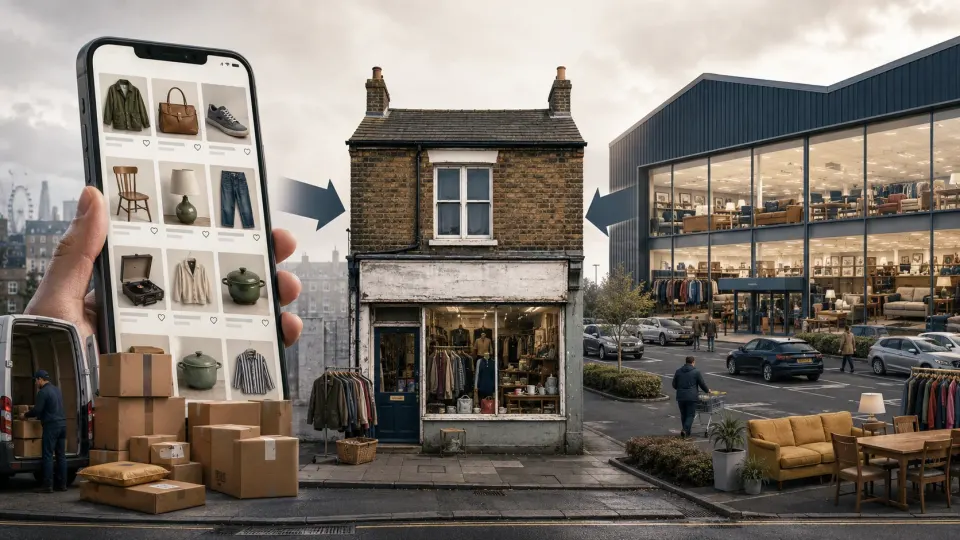
Cancer Research UK's strategy is particularly revealing. Rather than simply transferring its entire traditional operation online, the charity has chosen to concentrate on a smaller estate of stronger shops and expand larger out-of-town superstores.
That resembles changes seen throughout conventional retail.
The struggling middle is being squeezed.
At one end sits ultra-convenient ecommerce.
At the other sit larger physical stores capable of offering enough choice to justify a dedicated trip.
The small high-street unit must somehow compete with both.
CHARITY SHOPS ALSO DO SOMETHING THE MARKET DOESN'T PRICE
There is a risk in analysing charity shops entirely through pounds and pence, because their financial accounts do not capture everything they provide.
More than 223,000 people volunteer in UK charity retail. For some, volunteering is primarily an act of service. For others it provides social contact, confidence, work experience, language skills or a route back into employment. Shops can provide inexpensive household essentials to people living locally, occupy otherwise empty retail units and create human activity on high streets increasingly dominated by vacant premises and service businesses.
The Charity Retail Association has attempted to quantify these broader effects and argues that the social value generated by charity shops extends far beyond the money transferred to parent organisations.
That creates an awkward policy question.
A store could theoretically provide enormous social value to its town while making little financial contribution to the charity operating it.
From the charity's perspective, closing it might be rational.
From the community's perspective, losing it may still represent a genuine economic and social cost.
Both things can be true simultaneously.
This is one reason mass charity-shop closures matter beyond whether shoppers can still find a £4 paperback or an inexplicably large collection of Robbie Williams CDs.
They are part of Britain's informal civic infrastructure.
SO ARE CHARITY SHOPS ACTUALLY DYING?
Probably not.
The evidence points towards restructuring rather than extinction.
There are still close to 10,000 charity shops across Britain and the sector continues to generate hundreds of millions of pounds for charitable causes. Second-hand consumption is increasingly normal rather than embarrassing, environmental awareness has strengthened the appeal of reusing products and household financial pressures give consumers another reason to consider used goods.
Those are powerful long-term advantages.
But the shape of the sector is likely to change.
There may be fewer small stores operated simply because a charity has historically maintained a presence in a particular town. Larger stores may become more important. Ecommerce teams will become more sophisticated. Valuable donations will increasingly be sold nationally rather than locally. Artificial intelligence will help identify and list goods. Donation systems may become more selective, and charities may become much more aggressive about refusing items that cost more to process than they can ever generate.
In other words, charity retail is becoming more like retail.
That sounds obvious, but for much of its history the economics were unusually forgiving. Cheap or donated premises, enormous volunteer workforces, free inventory and limited competition in the used-goods market allowed shops to survive in locations that conventional retailers might reject.
Several of those protections have weakened at once.
THE GREAT SECOND-HAND PARADOX ISN'T REALLY A PARADOX
The strange thing about the current wave of charity-shop closures is that it is happening during what should be an extraordinarily favorable cultural moment.
Second-hand is fashionable.
Consumers want value.
Sustainability matters.
Young shoppers are comfortable buying used products.
Digital marketplaces have demonstrated that enormous demand exists for things other people no longer want.
But that success has created a new market rather than simply expanding the old one.
Vinted transformed a wardrobe into a miniature shop.
eBay made every attic a potential auction house.
Smartphones gave ordinary people instant information about what their unwanted possessions might be worth.
And the same technology allowed charities themselves to remove their most valuable items from local rails and sell them to national audiences.
The second-hand economy has therefore become larger, more efficient and more competitive at exactly the same time.
For Britain's charity shops, that means the old assumption — free stock plus volunteers equals guaranteed profit — no longer holds.
The winners are unlikely to be the organisations with the greatest number of shops.
They will be the ones best able to decide which goods should go into which shops, which should go online, which locations genuinely make money and which donations are actually worth accepting in the first place.
Britain has not fallen out of love with second-hand shopping.
Quite the opposite.
It may have become so good at it that the charity shop now has to compete for its place in the market it helped create.