There are several traditional rewards for reaching the top level of British sport.
A medal.
A tracksuit with your country's name on it.
A photograph on the podium.
Possibly somebody from your old school posting on Facebook that they "always knew you'd do it".
And, if you're 22-year-old judoka Summer Shaw:
another shift at McDonald's.
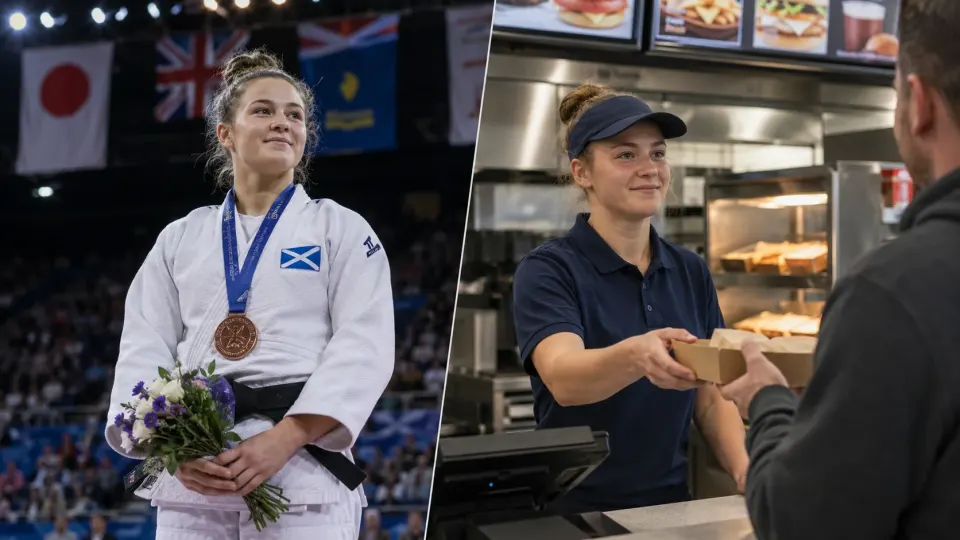
Shaw competed for Scotland in the women's under-48kg judo competition at the 2026 Commonwealth Games in Glasgow on 31 July.
She won bronze.
It was Scotland's first judo medal of the Games.
Friends and family watched her achieve something she had been working towards since childhood.
Then, less than a week later, Shaw put on a completely different uniform and went back to her part-time job.
Her subsequent five-second TikTok rather efficiently summed up the financial realities of competing internationally in a sport that does not involve Premier League television rights.
“Back working at McDs as if I didn't win a Commonwealth medal last week.”
She added:
“And that's on doing a sport no one cares about… someone sponsor me so I don't have to work.”
By 21 August, the clip had been watched more than 1.5 million times.
Which means considerably more people have now watched Summer Shaw explain the economics of elite judo than would probably fit inside every judo venue she has competed in combined.
CONGRATULATIONS ON REPRESENTING YOUR COUNTRY. YOUR SHIFT STARTS AT 11
There is something almost magnificently British about the sequence of events.
31 July: represent Scotland at an international multi-sport event.
Win bronze.
Stand on podium.
Receive medal.
National pride.
Applause.
Achievement of childhood ambition.
Following week: would you mind covering the lunch rush?
It sounds absurd enough to be a sketch, but Shaw's situation is not particularly unusual.
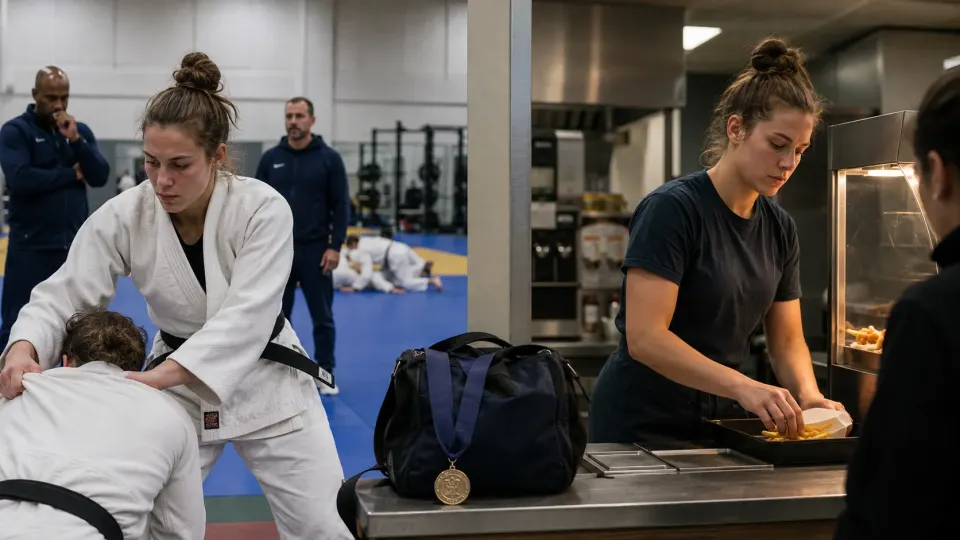
She has worked at McDonald's since she was studying for her A-levels and continues to pick up shifts when she is back near her family home in Surrey. She is primarily based around Birmingham because of her judo training and is also studying biology.
She has spoken positively about her employer, particularly the flexibility it gives her to disappear for training camps and competitions and then return to work when she is home.
That flexibility is valuable.
Because being very, very good at judo does not necessarily mean being very, very financially secure.
ELITE ATHLETE DOES NOT AUTOMATICALLY MEAN RICH ATHLETE
Professional sport creates a slightly distorted picture of what professional athletes earn.
At the top of football, Formula One, tennis, golf and a handful of other sports, successful competitors can accumulate extraordinary wealth.
That is the version we usually see.
Transfer fees.
Sponsorship contracts.
Private jets.
£300,000-a-week salaries.
Somebody launching their own fragrance before turning 24.
But move only a little further away from the world's richest sporting ecosystems and the financial picture changes dramatically.
Shaw receives an Athlete Performance Award through UK Sport and National Lottery funding, which helps support her living and training costs.
She has been clear that she is grateful for it.
But it doesn't mean every part of an international judo career is paid for.
Shaw explained that when a competition falls outside British Judo's funded programme, the athlete can end up financing the trip themselves.
Her August Grand Prix in Peru was one example.
Flights.
Accommodation.
Competition costs.
Training.
Food.
Travel.
All in pursuit of ranking points and experience needed to become good enough to qualify for an Olympic Games.
There is no guaranteed prize cheque waiting afterwards.
Shaw described the reality fairly simply: athletes either spend their own money trying to progress or find additional work.
So she works.
SHE IS LITERALLY TRYING TO FUND THE ROAD TO THE OLYMPICS
The next major target is considerably bigger.
Los Angeles 2028.
Shaw wants to qualify for the Olympic Games.
The International Judo Federation currently lists her among Britain's senior -48kg competitors, with results including Commonwealth bronze and European Open medals.
That means her McDonald's shifts are not financing somebody casually doing judo at weekends.
They're helping support an athlete attempting to reach the Olympics.
There is something slightly uncomfortable about that.
Britain loves Olympic success.
Every four years we become experts in sports many of us have barely watched since the previous Olympics.
For approximately two weeks, the nation becomes emotionally invested in taekwondo, canoe slalom, track cycling, modern pentathlon and whether somebody we've never heard of can defeat somebody else we've never heard of at 8:17 on a Tuesday morning.
If the British athlete wins, everything changes.
Flags appear.
Breakfast television calls.
Politicians congratulate them.
Millions watch.
The medal is described as evidence of Britain's sporting excellence.
But the four years required to get there are considerably less glamorous.
Training twice a day doesn't produce a viral television moment.
Flying across the world to accumulate qualification points isn't necessarily commercially attractive.
Strength conditioning isn't prime-time entertainment.
And companies tend to become considerably more interested in sponsoring an athlete after everyone already knows their name.
Which creates an obvious problem.
The athlete often needs financial support most while attempting to become successful enough to attract financial support.

‘HOW IS THIS POSSIBLE?’
That was essentially the reaction when Shaw posted her video.
People struggled to reconcile two ideas:
Commonwealth medallist.
McDonald's employee.
But the contradiction exists mostly because the public definition of an elite athlete is shaped by the tiny percentage of athletes competing in enormously wealthy sports.
Shaw herself has been much less dramatic about it.
She has described having another source of income as common in smaller sports.
The job also gives her something elite sport often doesn't:
predictability.
Work a shift and you get paid.
Compete internationally and you may improve your ranking, gain experience and move closer to an Olympic dream — while actually ending the month poorer than when you started.
Shaw has even established a crowdfunding page to help finance the road towards Los Angeles.
She also pointed out something spectacularly ordinary that tends to disappear from discussions about elite athletes:
she would eventually like to save for a house.
World-class sporting ambitions apparently do not exempt you from checking Rightmove and discovering that the deposit required for a modest property has become approximately one small Caribbean island.
THERE IS ANOTHER SIDE TO THIS STORY
It would be easy to turn Shaw's experience into an attack on McDonald's.
That would miss the point.
She has actually credited the restaurant with giving her the flexibility required to pursue her sport.
She started there as a teenager.
She has made close friends through the job.
She met her boyfriend there.
And she can pick up shifts around an elite training schedule that many employers would find extremely difficult to accommodate.
The slightly uncomfortable question isn't:
“Why is a Commonwealth medallist working at McDonald's?”
It's:
“Why does reaching Commonwealth-medal level in an international sport still leave an athlete needing additional income?”
There isn't necessarily a simple villain.
Funding bodies have finite budgets.
There are hundreds of elite athletes.
International competition is enormously expensive.
Commercial sponsors naturally concentrate money where audiences are largest.
And not every promising athlete can receive a salary sufficient to train full-time indefinitely.
But Shaw's viral video exposes the enormous gap between how glamorous international sport looks from the grandstand and how it is financed behind the scenes.
FIVE SECONDS OF TIKTOK EXPLAINED IT BETTER THAN A FUNDING REPORT
That may be why the video travelled so far.
There was no lengthy speech.
No graph.
No campaign.
No dramatic soundtrack.
Just a Commonwealth medallist standing at work.
Five seconds.
That was enough.
Shaw had gone from representing her country in front of thousands of spectators to returning to the ordinary job she had before anybody outside judo knew who she was.
And the internet suddenly noticed something athletes in smaller sports have known for years.
The medal is real.
The achievement is real.
The training is full-time.
The sacrifices are real.
The expenses are definitely real.
The money sometimes isn't.
Summer Shaw now wants to turn Commonwealth bronze into an Olympic appearance in Los Angeles.
If she gets there, Britain may well sit down in front of the television and discover overnight that we have extremely strong opinions about women's -48kg judo.
Until then, she has training to complete.
Competitions to fund.
Ranking points to chase.
And apparently, depending on the rota,
a shift to finish.