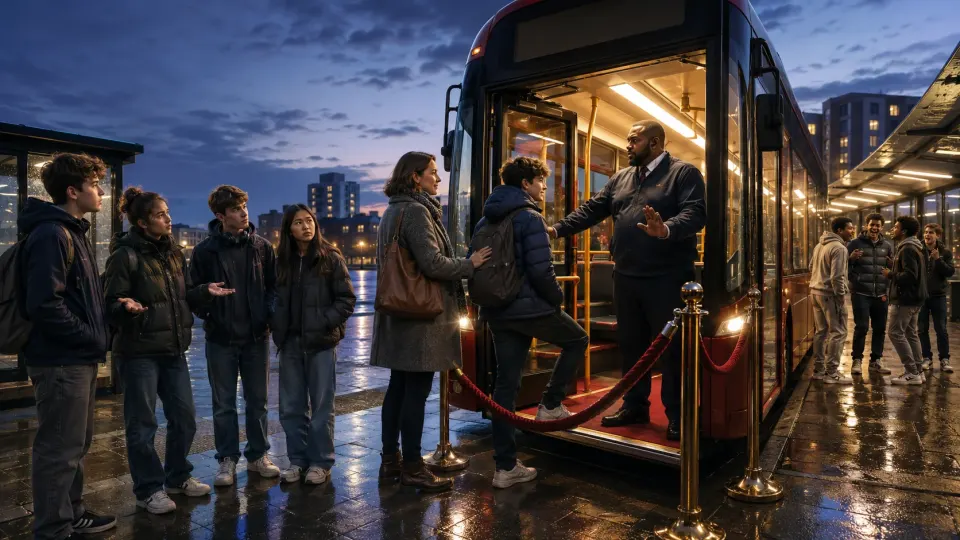
Britain began August with an unusually wholesome idea.
Children aged five to 15 could travel free on eligible local buses across England for the entire month, giving families cheaper days out and encouraging young people to explore somewhere beyond their bedroom ceiling.
The government’s Summer Bus Fare Offer began on 1 August and runs until the end of the month.
Beaches. Museums. Parks. Grandparents. Adventure.
Unfortunately, somebody forgot to include a functioning public-order strategy in the ticket price.
Less than three weeks later, First Bus introduced an evening restriction across Stoke-on-Trent after repeated reports of antisocial behaviour at Hanley Bus Station and aboard its services.
Children aged 15 and under must now be accompanied by an adult after 6pm on 32 affected routes.
The freedom lasted until teatime.
WHEN THE SUMMER SAVINGS MET THE SUMMER HOLIDAYS
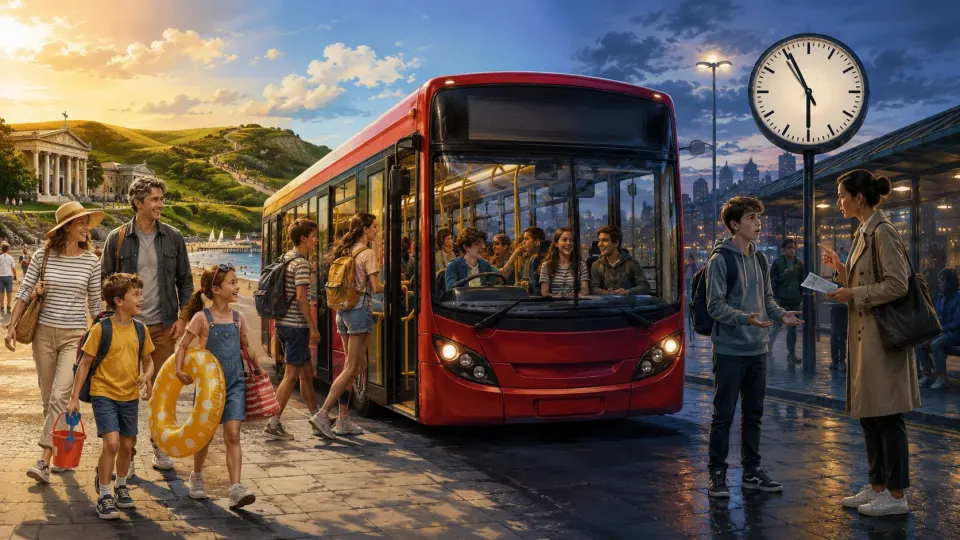
According to First Bus, the restriction followed numerous incidents at the bus station and on its vehicles.
One particularly large disturbance reportedly involved more than 100 young people behaving in what the company described as an intimidating and aggressive manner. Police were called while drivers and passengers were said to have felt unsafe.
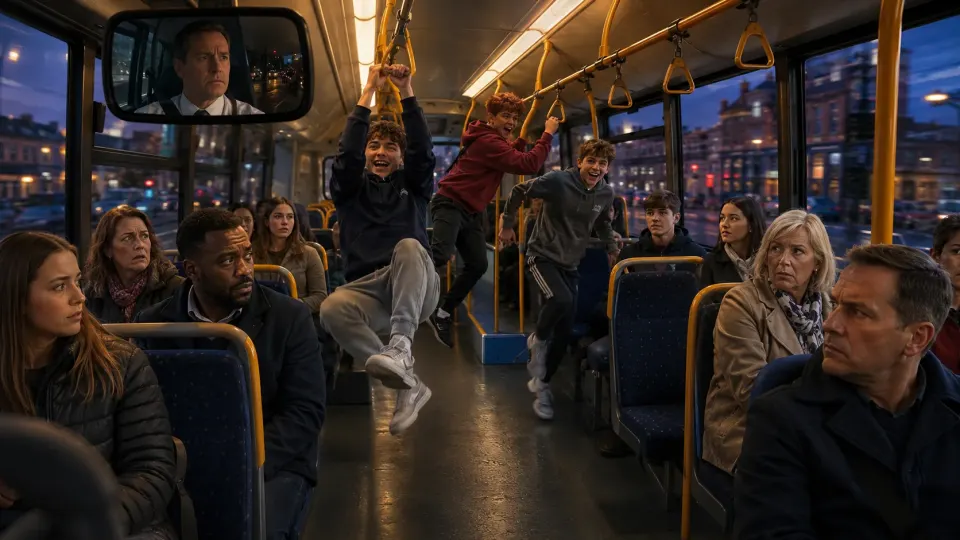
Another driver reported children running through a moving bus and swinging from its strap handles.
A bus is many things: public transport, a cost-of-living lifeline and occasionally the only remaining warm building in a British town centre.
It is not supposed to become Britain’s Got Talent: Moving Vehicle Edition.
Drivers should not have to control several tonnes of machinery while conducting an unofficial school disco behind them. Passengers should not have to complete their journey surrounded by enough noise and movement to make turbulence look restful.
The safety problem is real.
The solution, however, is magnificently British.
EVERY TEENAGER MUST NOW BRING A RESPONSIBLE ADULT
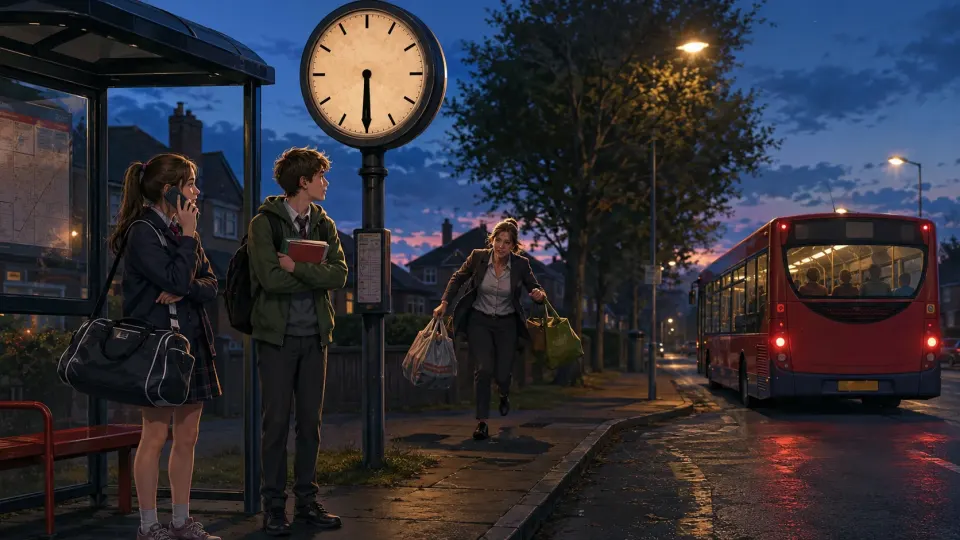
From Friday 21 August, anyone aged 15 or under travelling after 6pm on the affected First Bus services operating to or from Hanley Bus Station must have an adult with them.
The company says 32 services are covered, with the restriction remaining in place until further notice.
Drivers can use their discretion where an unaccompanied child is vulnerable or refusing travel might place them in danger.
That is important because this is not a complete ban on children using buses after 6pm.
It is a chaperone policy.
Public transport has briefly become a nightclub where the doorman asks whether your mum is coming.
BRITAIN’S FAVOURITE SOLUTION: PUNISH THE WHOLE YEAR GROUP
The problem with blanket restrictions is that they are extremely efficient at restricting people who were not causing the problem.
A well-behaved 15-year-old returning from sports practice, visiting a friend or travelling home from a family day out is caught by exactly the same rule as somebody running along the aisle and attempting aerial gymnastics from the handrails.
If a group of adults caused trouble in a pub, nobody would announce that every adult in the city must now bring their father.
Teenagers, however, are still treated by public policy as one enormous shared organism wearing a black puffer jacket.
One misbehaves and the entire species loses bus privileges.
Stoke-on-Trent’s cabinet member for transport, Finlay Gordon-McCusker, told The Guardian that the overwhelming majority of children affected had done nothing wrong.
He argued that additional transport safety officers could have been deployed instead of imposing a restriction on every unaccompanied young passenger.
First Bus, meanwhile, said the measure had been discussed with the council and Staffordshire Police, approved by the Department for Transport and would be reviewed daily.
Everybody therefore agrees there was a problem.
They simply disagree over whether the answer was better enforcement or requiring half of Stoke’s parents to become unpaid evening conductors.
FREE TRAVEL DID NOT INVENT TEENAGERS
The government scheme did not create antisocial behaviour.
Teenagers did not spend July sitting quietly at home before suddenly receiving a complimentary bus ticket and discovering chaos.
Free travel simply made it easier for large numbers of young people to gather in the same place. Behaviour that might previously have been scattered across parks, estates and shopping areas arrived together at a transport hub, where drivers, passengers and CCTV cameras could all enjoy it simultaneously.
That makes the difficulty more visible. It does not automatically make the scheme a failure.
Cheap public transport gives young people independence, helps families struggling with summer costs and allows teenagers without access to a parent’s car to participate in normal life.
Removing that independence from everybody because a minority behaved badly is easier than identifying offenders.
It is not necessarily better.
THE OUTOUT VERDICT
First Bus has a duty to protect its drivers and passengers. Nobody should be expected to tolerate intimidation, aggressive behaviour or dangerous nonsense aboard a moving vehicle.
But the restriction is also an admission that the system could not separate the children causing trouble from those simply trying to get home.
The government spent the summer encouraging young people to leave the house, explore England and use public transport.
Stoke’s revised message is equally clear:
Please explore responsibly, bring an adult and make sure your childhood independence finishes by six.