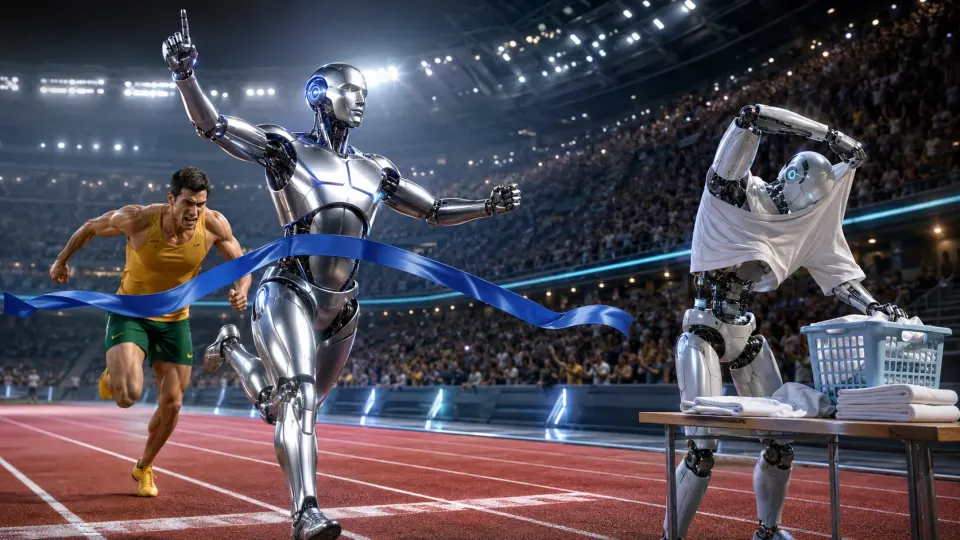
There is bad news and good news.
The bad news is that humanoid robots can apparently run faster than the quickest human being who has ever lived.
The good news is that some of them cannot stop, one required a stretcher and another spent several minutes being defeated by a T-shirt.
Humanity remains competitive.
Just.
THE ROBOTS HAVE TAKEN THE 100 METRES
At the World Humanoid Robot Games in Beijing, a machine called Tiangong Ultra completed 100 metres in a reported 9.39 seconds.
Usain Bolt’s human world record, set in Berlin in 2009, is 9.58 seconds.
The robot therefore covered the distance 0.19 seconds faster than the quickest officially recorded human sprint.
A second machine, Honor’s Lightning, reportedly completed the race in 9.47 seconds. Its manufacturer had previously claimed an even faster 9.32-second run during testing.
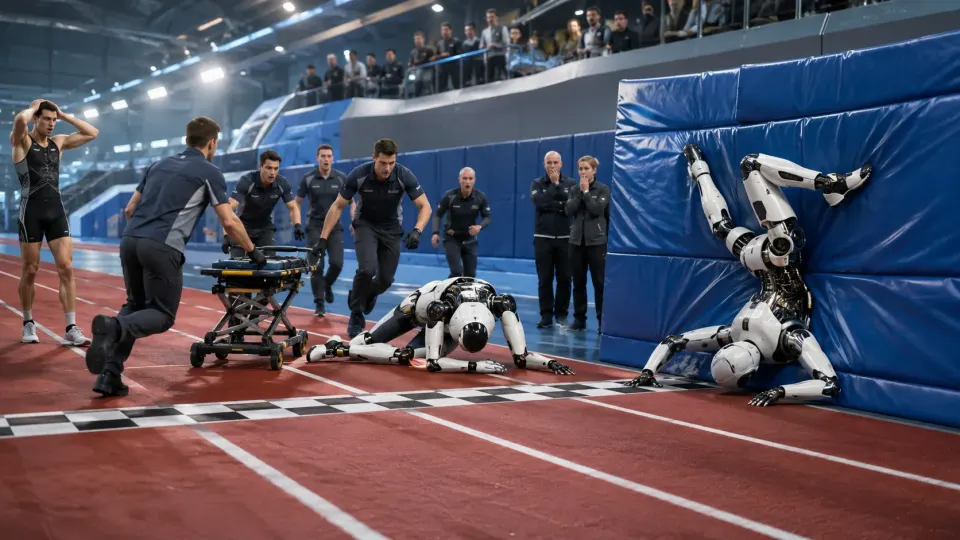
According to Reuters’ report from Beijing, Tiangong stumbled into the sidelines after finishing while Lightning collapsed and had to be removed on what appeared to be a stretcher.
The machines had successfully conquered human speed.
Braking technology will apparently arrive in the next software update.
USAIN BOLT’S RECORD HAS NOT ACTUALLY BEEN DELETED
Before anybody removes Bolt from the history books and replaces his photograph with a charging cable, an important distinction is required.
This was a robot competition, using machines designed specifically to compete against other machines.
The reported times were supplied by organisers and manufacturers. They were not performances governed or ratified by World Athletics, and no robot is eligible to take possession of the human men’s 100-metre record.
Bolt remains the fastest human being over the distance.
The robots have beaten his time, not taken his record.
It is still an extraordinary engineering achievement. Getting a human-sized machine to balance, accelerate and coordinate two mechanical legs at that speed represents a dramatic improvement in control systems, motors and physical design.
It also creates the slightly concerning prospect of being chased by something that can outrun an Olympic champion but has not yet mastered stopping.
THE HIGH-JUMP COMPARISON REQUIRES EVEN MORE SALT
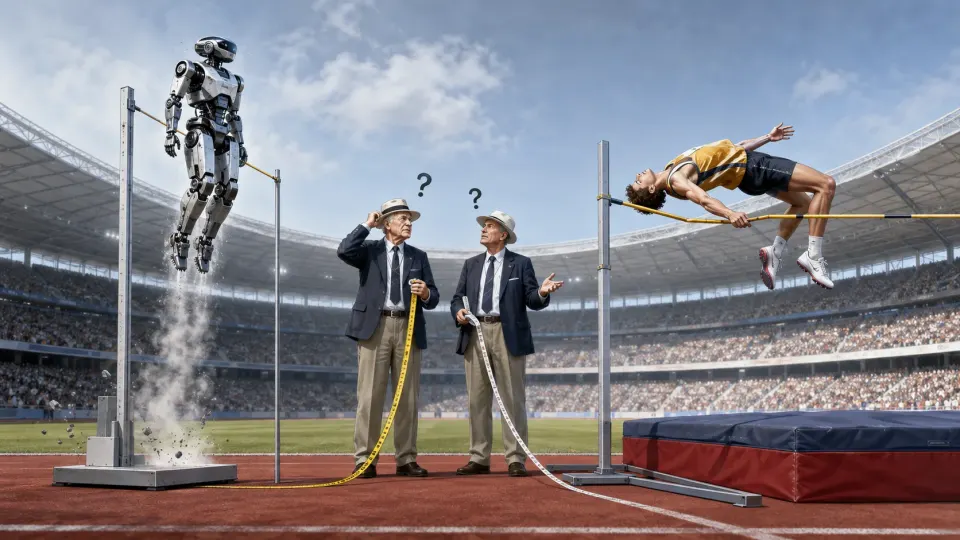
Organisers also announced that a humanoid robot achieved a 2.88-metre standing jump, up from a reported 0.95 metres at last year’s event.
That number was presented alongside Javier Sotomayor’s 2.45-metre human high-jump record.
The Associated Press reported both performances, but they are not directly comparable sporting events.
A human high jumper takes a curved running approach, launches from one foot and bends over a horizontal bar without knocking it down.
The robot performed a standing mechanical jump.
Comparing the two is a little like placing a crane beside a pole vaulter and announcing that construction equipment has qualified for the Olympics.
The technology is impressive.
The marketing department, however, had already cleared the bar.
2,056 ROBOTS AND 666 TEAMS
The five-day competition features 2,056 humanoid robots representing 666 teams, with participants from 16 countries.
If 666 feels like an unfortunate number for an event demonstrating thousands of increasingly athletic machines, the organisers have chosen not to address that particular piece of science-fiction branding.
There are 51 events and more than 1,000 individual competitions, including:
Sprinting
Football
Table tennis
Weightlifting
Tug-of-war
Martial arts
Factory work
Hotel services
Household tasks
The sporting events attract the cameras, but the practical competitions may ultimately be more important.
A machine can be specially prepared to sprint along a controlled track. A commercially useful robot must recognise unfamiliar objects, handle them without breaking anything, recover when a task goes wrong and continue working without three engineers following it with a laptop.
That is a rather more demanding job description.
FASTER THAN BOLT, DEFEATED BY A CABLE
The robotics industry has become extremely good at producing spectacular demonstrations.
Robots can dance, box, perform backflips and now apparently travel 100 metres faster than Usain Bolt.
However, Reuters reports that the real commercial test involves comparatively unglamorous challenges such as packing boxes, connecting cables, feeding materials into machinery and completing repetitive tasks without human intervention.
A cable positioned at the wrong angle can become a mechanical boss battle.
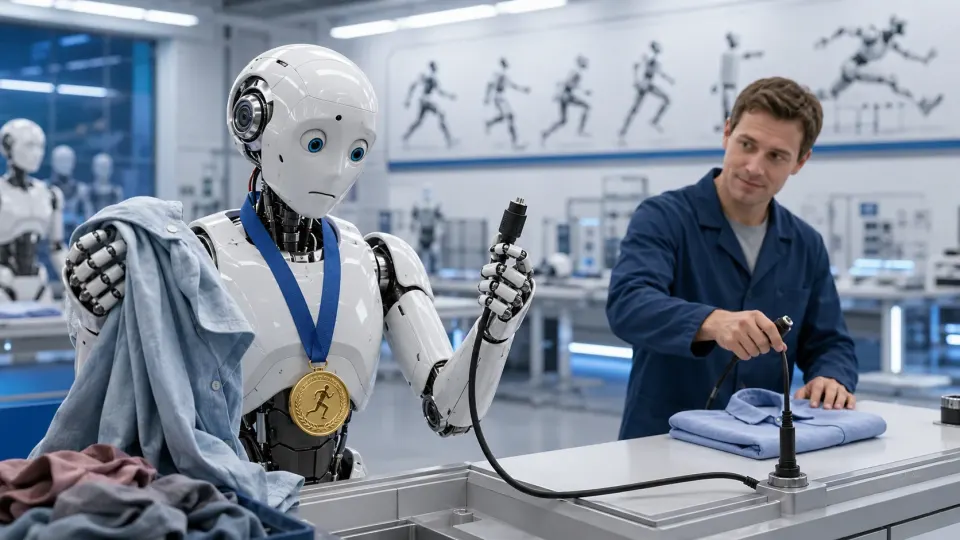
An object placed slightly outside the expected location can turn an expensive artificial worker into a decorative coat stand.
Current industrial humanoids reportedly cost between 300,000 and 500,000 yuan, while one industry estimate suggests they would need to cost around 160,000 yuan—including maintenance—to repay their purchase price within two years against a human worker.
That is a substantial investment for something that might require technical support after encountering an unfamiliar cardboard box.
THE LAUNDRY REMAINS HUMANITY’S LAST DEFENCE
At the accompanying World Robot Conference, several companies demonstrated machines intended to help with domestic work.
One robot attempted to fold a shirt.
After several minutes, it still could not do it.
The failed demonstration was witnessed by Associated Press journalists covering the conference.
In fairness, fabric is genuinely difficult for robots. It bends, wrinkles, hides its own edges and changes shape whenever it is touched. Researchers continue to treat manipulating clothing as a major robotics challenge.
Humans have evolved sophisticated hands, vision and muscle control specifically suited to handling objects like these.
We then use those abilities to place the shirt over a chair and announce that we will deal with it tomorrow.
The robots may have speed.
We still hold the world record for pretending a chair is a wardrobe.
THE REAL RACE IS NOT AGAINST HUMANS
The Beijing demonstrations are not really about replacing athletes.
Nobody urgently needs a humanoid robot to win the Olympic 100 metres, collect a medal and immediately run through the back wall of the stadium.
The valuable advances are in balance, movement and control.
Those capabilities could eventually allow robots to work in dangerous factories, disaster zones, warehouses, hospitals and environments where sending a person would be difficult or unsafe.
China already accounts for an estimated 82% of global humanoid robot shipments, and enormous sums are flowing into the industry.
But running quickly for ten seconds and working safely for an eight-hour shift are completely different achievements.
Speed produces viral videos.
Reliability produces customers.
THE OUTOUT VERDICT
The robot performances are genuinely remarkable.
A humanoid machine completing 100 metres in 9.39 seconds would have sounded like science fiction only a few years ago. The progress in balance, power and mechanical control is undeniable.
But Usain Bolt’s official record remains exactly where it was, the high-jump comparison mixes two different events and the robots’ finish-line collapses demonstrate how far the technology still has to travel.
Machines can now outrun us.
Humans remain better at stopping, connecting cables, folding shirts and quietly abandoning clean laundry in a basket for six days.
The takeover can begin once the robots master the fitted sheet.