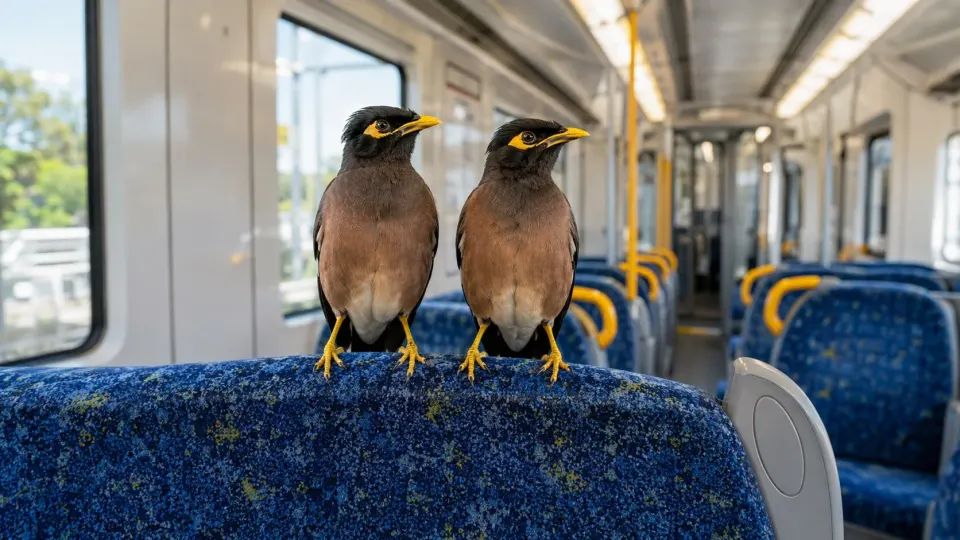
Two birds in Sydney appear to have learned how to use the train, immediately placing them ahead of every passenger still standing in front of the doors when other people are trying to get off.
Footage filmed by ABC producer Jackie Dent shows a pair of common mynas travelling on the city’s North Shore line. They perch inside the carriage, observe their surroundings and leave with the confidence of commuters who have made this trip before.
That confidence may be justified. A train guard reportedly said the birds are regular passengers between Lindfield and Artarmon, where they get off to forage before making another journey.
The video has gone viral because it looks delightfully deliberate. These are not panicked birds trapped inside a strange metal box. They appear calm, familiar with the environment and entirely unconcerned about whether their tickets will survive an inspection.
Do they really understand the route?
Nobody has yet produced a tiny travel card or interviewed the birds under controlled conditions. Experts nevertheless say the behaviour is plausible.
Sean Dooley of BirdLife Australia told The Guardian that common mynas are intelligent, adaptable birds. Behavioural ecologist Andrea Griffin said the repeated pattern was likely learned behaviour and could involve the same pair using reliable environmental cues.
Those cues might include station sounds, journey time, light, familiar views or the opening of doors at a particular stop. Animals do not need to read a route map to recognise a sequence. City birds already learn traffic patterns, feeding times, bin locations and the precise moment a café customer stops defending a croissant.
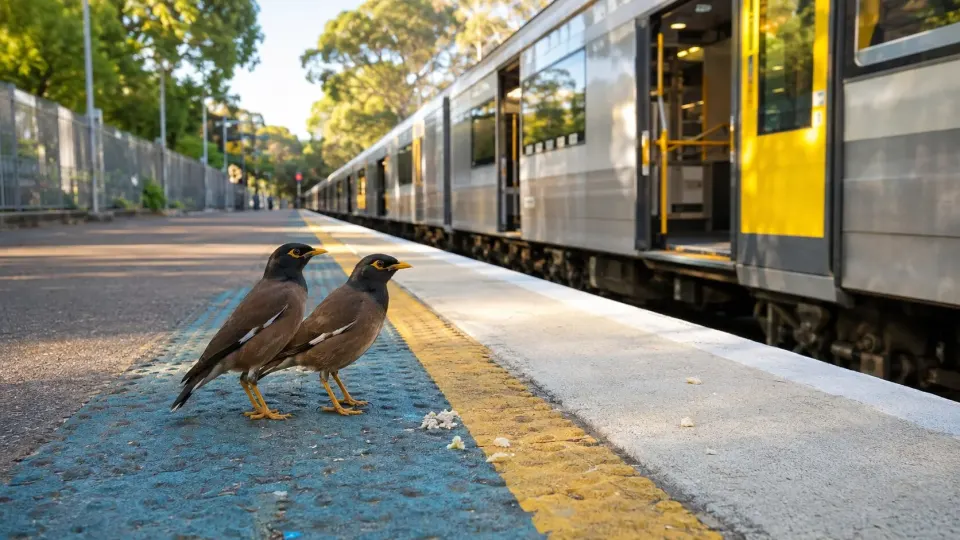
Why would a bird catch a train?
The same reason a person does: it moves quickly between useful places while requiring very little personal flight.
Foraging opportunities around stations can be predictable. Platforms, nearby shops and busy streets provide dropped food and shelter. A train journey may link two known feeding areas more efficiently than navigating buildings, roads and territorial boundaries in the air.
Common mynas are native to parts of Asia but have become established in Australia, where they are considered an invasive species. Their success comes partly from their ability to exploit human environments. A railway is simply another piece of urban habitat — one that happens to arrive every few minutes and announce its destination.
The pair’s behaviour also demonstrates how quickly wildlife can incorporate infrastructure into daily routines. Pigeons use stations, foxes follow roads and gulls have mastered school lunch timetables. The Sydney mynas have taken the next logical step and outsourced the commute.
Are the birds safe?
A moving train is not a risk-free place for wildlife. Doors, crowded carriages and separation from a companion can create danger. Passengers should give the birds space rather than attempting to feed, grab or chase them for a better video.
If they are genuinely regular travellers, railway staff will be best placed to monitor whether intervention is needed. The ideal outcome is that the birds continue their routine without becoming a platform attraction surrounded by people pointing phones at them.
The OutOut verdict
The video works because it combines intelligence, absurdity and flawless commuter body language. The birds get on, mind their business and get off where the food is. No loud phone call. No bag occupying the next seat. No announcement that the buffet is unavailable.
They may not understand fares, timetables or replacement buses, but they have grasped the central principle of public transport: know your stop and move decisively when the doors open.
Sydney now has two model passengers. Unfortunately, neither contributes to the operating budget.