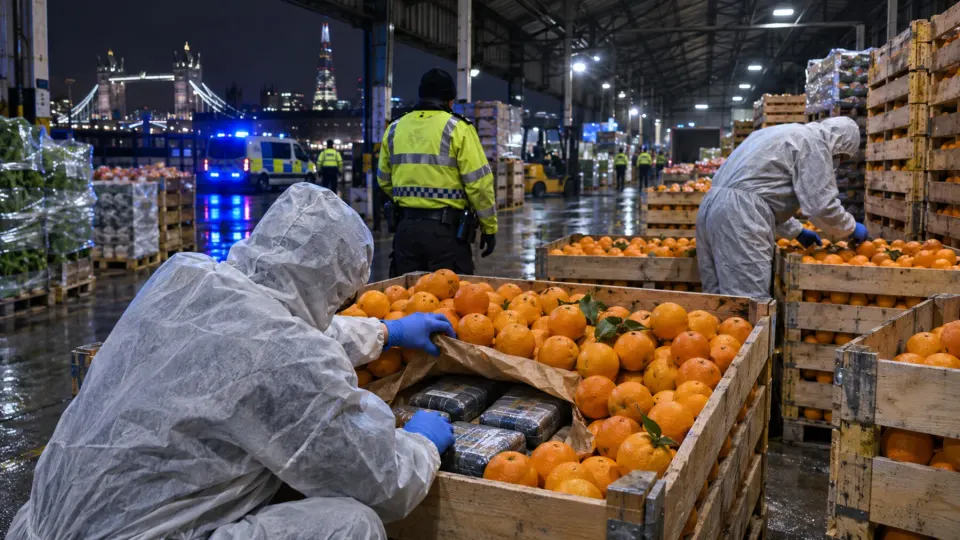
Metropolitan Police officers have arrested eight men after seizing 893kg of suspected cocaine in an operation centred on boxes of oranges at New Spitalfields Market in east London. Police also recovered an estimated £450,000 in cash and say the investigation is continuing.
The figures and allegations come from a Met statement published at 6.43pm on Monday 23 November. No one has been convicted, the substance is described as suspected cocaine pending the relevant evidential process, and all eight men were in custody when the update was issued.
It is one of the largest drug seizures the Met says it has seen. It is also a reminder that organised crime has no respect for the visual dignity of a fruit aisle. Somewhere, a criminal logistics presentation apparently reached the slide marked “893 kilograms” and still selected oranges as the supporting graphic.
What police say they found
The operation began at New Spitalfields Market in Leyton on Sunday evening, 22 November. Police said a large quantity of suspected cocaine was discovered hidden in boxes of oranges. Five men aged 27, 33, 41, 43 and 58 were arrested on suspicion of conspiracy to supply class A drugs.
A sixth man, aged 44, was arrested nearby with 100kg of suspected class A drugs, according to the Met. In a connected operation, officers executed a warrant at a property in Cheshunt, Hertfordshire, arrested a 48-year-old man on the same suspicion and seized about £450,000 in cash.
Police also stopped a lorry near Maidstone and took it to Dover for a search. Around 250kg of suspected cocaine was recovered, and the 50-year-old driver was arrested on suspicion of conspiracy to supply class A drugs. The total seized across the investigation was 893kg.
Those details describe a police case at an early stage. “Connected”, “suspected” and “conspiracy” are investigative and legal terms, not a verdict on each arrested person. The Crown Prosecution Service would decide any charges presented to it, and a court would determine guilt if charges followed.
Why one seizure does not mean one solved market
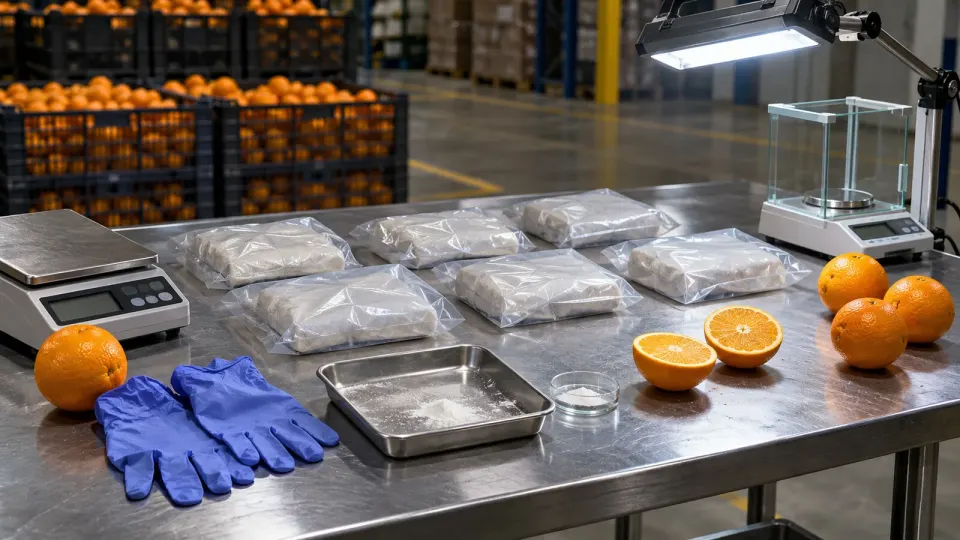
Detective Superintendent Lindsey Billany said the drugs would have been worth millions of pounds and described their loss as significant to the criminal enterprise under investigation. Police have not published a final street value, purity analysis, origin route or complete organisational structure.
Large seizures are operational successes because they remove product, create intelligence opportunities and impose costs on traffickers. They can also reveal the scale and adaptability of supply. The National Crime Agency's 2026 strategic assessment says cocaine seizures in the UK rose from 3.4 tonnes in 2015 to 18.5 tonnes in 2025, an increase of more than 440% over ten years.
That growth cannot be read in one direction. Higher seizures may reflect stronger enforcement, more cocaine entering the market, or both. The NCA assesses the cocaine threat as high and says robust, adaptable supply chains and high production in source countries contributed to availability and lower prices in 2025.
In other words, confiscating nearly a tonne matters enormously without proving Britain has confiscated its way to the end credits. Organised crime treats a seized load as a loss, studies how it was found and tries another route. Enforcement therefore needs to follow money, communications, freight movements and corrupt assistance as well as the powder itself.
Fresh-produce supply chains offer both opportunity and camouflage. Perishable goods move quickly through ports, roads, wholesale markets and distribution centres. Delays cost legitimate businesses money, creating pressure for efficient clearance. Criminal networks attempt to hide within that volume, exploiting containers and loads that would look entirely ordinary if nobody opened the wrong box.
That does not make fruit importers, drivers or market workers collectively suspect. Wholesale markets are essential infrastructure populated overwhelmingly by lawful businesses. Investigators must identify individual evidence rather than allowing a dramatic hiding place to stain an entire trade.
The harm beyond the headline weight
The Met linked drug trafficking to violence on London's streets. The NCA describes illicit drugs as a major driver of serious and organised crime harm in communities, including violence, firearms offending, exploitation and illicit finance.
There is a public-health cost too. The NCA assessment says deaths in England and Wales where cocaine was a contributory factor rose by 14% to 1,279 in 2024, eleven times the 2011 figure. A seizure is therefore not merely a scoreboard for police units; it represents a commodity linked to addiction, medical emergencies and deaths.
Policy still cannot stop at supply enforcement. Treatment, prevention, early intervention and support for communities affected by county lines and exploitation are part of reducing demand and harm. A country that celebrates the photograph of seized packages but underfunds recovery services is only tackling the half of the market that fits neatly on a warehouse floor.
Readers can follow verified police and court developments through OutOut's UK news section. Our coverage of two men charged over an alleged Manchester plot also explains why suspicion, charge and conviction must remain separate at every stage.
What happens next
Laboratory analysis can establish the substance and purity. Financial investigators will examine the seized cash and any account or transaction evidence obtained lawfully. Freight records, phones, CCTV and communications may be used to test whether the incidents form the conspiracy police suspect.
The eight men may be released, bailed, charged or face other decisions as enquiries progress. Reporting should change with those decisions. Publishing ages and a dramatic quantity does not permit the public to assign roles that police have not announced.
The market and logistics businesses involved will also want reassurance that evidence has been secured without unnecessarily disrupting legitimate trade. Effective organised-crime work must be intrusive enough to find concealed loads and precise enough not to turn every orange into a witness.
The OutOut verdict
Nearly a tonne of suspected cocaine is a serious removal from a harmful market, and the coordinated stops, warrant and cash seizure suggest investigators were following more than a lucky citrus hunch. The Met is entitled to call it significant.
The comic detail is the fruit. The serious story is the system required to move hundreds of kilograms across borders and into London. That system involves money, transport, storage, communications and people who expect legitimate supply chains to carry the risk for them.
Britain should enjoy the absurdity of cocaine among the oranges for exactly one headline, then ask the harder questions. Can investigators climb from the boxes to the organisers? Can assets be recovered? Can international routes be disrupted? Can demand and deaths be reduced?
Eight arrests and 893kg are an opening result, not a solved national problem. The oranges have had their photograph. Now follow the money.
Sources
- Metropolitan Police: arrests after almost a tonne of suspected cocaine found among oranges, published 23 November 2026.
- National Crime Agency: National Strategic Assessment 2026—how threats changed, accessed 24 November 2026.
- The Guardian: Metropolitan Police seize 893kg of cocaine hidden in boxes of oranges, published 23 November 2026.