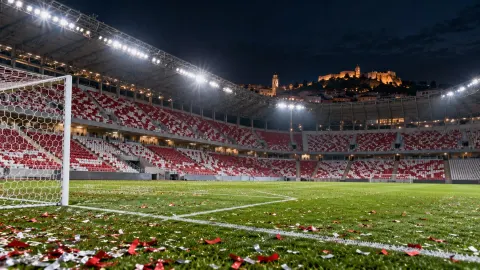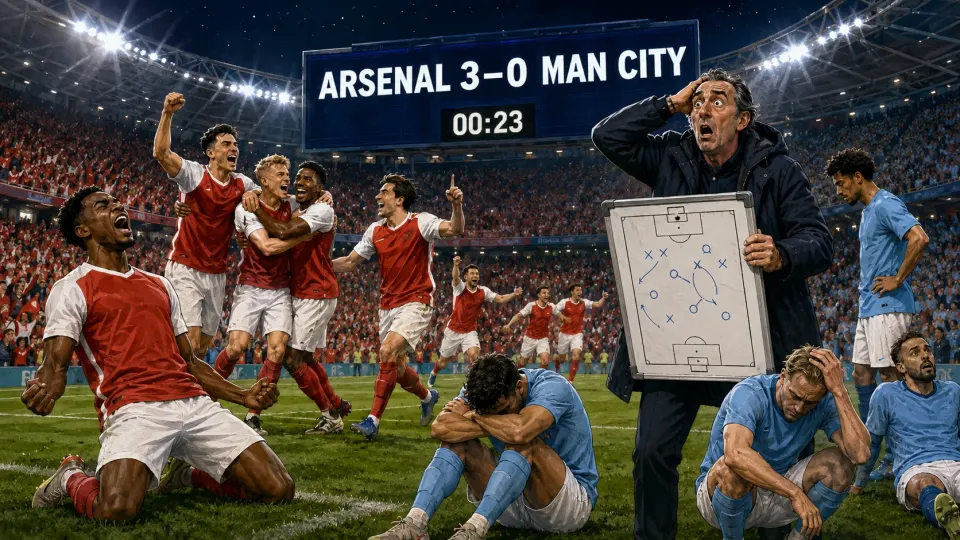
Manchester City’s post-Pep Guardiola era required exactly 23 seconds to go from exciting new chapter to has anyone checked whether the old manager’s number still works?
Riccardo Calafiori scored before thousands of supporters had located their seats, Arsenal won 3–0 and Enzo Maresca’s first competitive match in charge became less of a managerial debut and more of a televised hostage note from reality.
Kai Havertz added the second after 28 minutes. Martin Ødegaard scored the third shortly after half-time. By the end, Arsenal had the Community Shield and City had 59% possession, 519 completed passes and the haunted expression of a family discovering Dad took the Wi-Fi password with him.
TWENTY-THREE SECONDS: EVEN THE APOLOGY TO THE FANS TOOK LONGER
Calafiori’s opening goal arrived after just 23 seconds — the fastest Community Shield goal since 1968, according to the FA’s official match report.
Twenty-three seconds.
That is not enough time to make a cup of tea, skip an advert or regret paying stadium prices for a pint. It was, however, enough time for Manchester City’s defensive structure to disappear like Guardiola spotting an available taxi.
Maresca had spent pre-season installing ideas, adjusting roles and preparing his players for life after the most successful manager in the club’s modern history.
Arsenal apparently spent pre-season practising how to kick the front door off before City had finished hanging the new curtains.
The whistle went. Calafiori went through. The ball went in. Maresca’s tactical plan went directly into the recycling.
MARESCA SAID IT WASN’T A FRIENDLY. ARSENAL AGREED
Before the match, Maresca insisted the Community Shield was a proper trophy and not simply another friendly. That was recorded in City’s own pre-match coverage.
Arsenal clearly listened.
City appeared to hear the word friendly, nod politely and mentally begin planning where everyone would go for dinner afterwards.
This is the eternal beauty of the Community Shield. Win it and you have secured the first silverware of the season. Lose it and everybody suddenly remembers it is merely a posh curtain-raiser organised for charity.
Unfortunately, that escape route becomes slightly less convincing when your own manager described it as a trophy before watching his team get folded into a carry-on bag.
POSSESSION: THE LAST REFUGE OF THE THOROUGHLY BEATEN
Manchester City had 59% possession. They completed 519 passes. They recorded 12 shots.
Arsenal had 41% possession, completed 352 passes and took nine shots.
The final score was Arsenal 3–0 Manchester City.
According to City’s official match statistics, Arsenal produced 2.19 expected goals. City managed 0.77.
City did not control the match. They controlled the location of the football during the portions in which Arsenal were not using it to score.
Those 519 passes created all the danger of an office screensaver. The ball moved left, right and backwards with tremendous technical precision while Arsenal waited patiently for somebody in sky blue to remember that possession is generally supposed to lead somewhere.
It was intricate, patient and completely harmless — death by a thousand passes, except City were the only ones dying.
HAVERTZ DELIVERS THE SECOND NOTICE
Kai Havertz made it 2–0 after 28 minutes, by which point the new era was already asking whether it could return itself within the cooling-off period.
Arsenal were sharper, more direct and considerably less interested in winning the passing spreadsheet.
City’s defenders looked like four people who had been added to the same group chat but never introduced. Every Arsenal attack carried the possibility of another goal, another collapse or another close-up of Maresca reconsidering every professional decision that had led him to Cardiff.
The most alarming part was how ordinary Arsenal made it look.
No miracle. No freak deflection. No controversial intervention from a referee armed with a microscope.
They simply attacked Manchester City and discovered Manchester City could be attacked.
THE HALF-TIME RESET SURVIVES THREE MINUTES
Half-time offered Maresca an opportunity to calm everyone down, reorganise the shape and deliver the inspirational speech that would launch a heroic comeback.
Ødegaard scored in the 48th minute.
Whatever was said in that dressing room had a shelf life shorter than supermarket sushi.
Arsenal’s captain made it 3–0 and transformed the remaining match into an extended administrative procedure. Arsenal had to avoid doing anything stupid. City had to pretend there was still a meaningful sporting contest taking place.
The cameras periodically returned to Maresca, who wore the expression of a man attempting to remember whether his contract contained a trial period.
HAALAND BECOMES VERY EXPENSIVE SCENERY
Erling Haaland spent much of the afternoon waiting for service that never arrived.
City possessed one of the most devastating goalscorers in world football and deployed him like an ornamental statue commemorating previous achievements.
There were runs. There were gestures. There were occasional hopeful deliveries. There was very little that forced Arsenal to experience an emotion stronger than mild professional awareness.
This was not solely Haaland’s failure. A striker cannot eat when the midfield keeps delivering empty plates.
But watching City circulate the ball endlessly while Haaland remained stranded ahead of them was like owning a flamethrower and deciding to defeat the enemy with passive-aggressive emails.
THE POST-PEP EXCUSE HAS ALREADY LEFT THE STATION
Of course City are changing.
Guardiola has gone. Maresca is installing new ideas. Players must adapt to different instructions, relationships and demands. Rúben Dias acknowledged the scale of that transition after the game, while also calling the performance “not good enough.”
He was correct on both counts.
Nobody sensible should declare City’s entire season dead after one August showpiece. New managers require time and the Community Shield has never been a reliable crystal ball.
But transition cannot become a magic word that turns a 3–0 battering into a valuable workshop.
City were not introducing football to a previously uncontacted tribe. These are elite players with years of experience, enormous resources and a striker apparently assembled in a Scandinavian laboratory.
They should be capable of surviving longer than 23 seconds without the former manager physically supervising them.
ARSENAL LOOKED LIKE CHAMPIONS
While City wandered around searching for the emergency Pep signal, Arsenal looked organised, aggressive and brutally efficient.
They did not need endless possession. They needed space, movement and the knowledge that City’s defence currently had the structural integrity of wet cardboard.
Calafiori struck immediately. Havertz punished them before the half-hour. Ødegaard finished the job after the restart.
Arsenal did not dominate the ball. They dominated the events people will remember.
That is the difference between controlling possession and controlling a football match. One produces attractive statistical graphics. The other produces three goals and a trophy.
WHAT CITY SHOULD ACTUALLY WORRY ABOUT
Losing the Community Shield is not a catastrophe.
Being sliced open immediately, generating only 0.77 expected goals and spending large stretches looking completely disconnected is rather more inconvenient.
The scoreline can be dismissed. The ease of it cannot.
Maresca now has to rebuild City’s confidence, reconnect the attack and convince his defenders that the opening whistle is not merely a helpful notification that the match will be starting later.
There is still an entire season ahead. City have the talent and resources to recover quickly.
They will need to.
Because Arsenal brought 41% possession, 352 passes and three goals to Cardiff.
City brought 59%, 519 passes and the general atmosphere of a company whose founder has just left without revealing where any of the passwords are kept.
Pep Guardiola is gone. Enzo Maresca now owns the keys.
Twenty-three seconds into his first competitive match, the front door fell off.