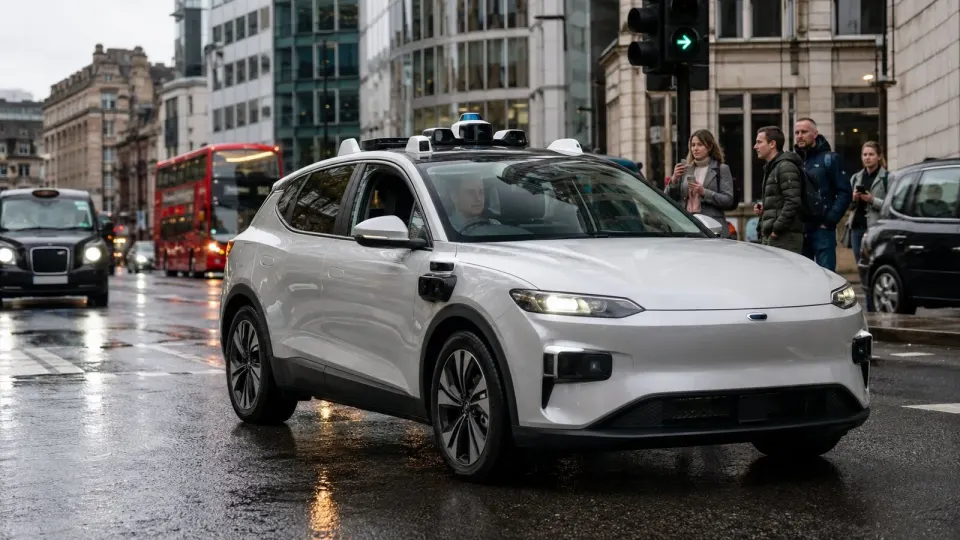
London has finally acquired self-driving taxis, although “self-driving” currently means “driving itself while a licensed professional sits inches from the wheel, trying not to look like the world’s most overqualified passenger”.
Uber and British artificial-intelligence company Wayve launched the capital’s first commercial robotaxi service on Thursday. The opening fleet is deliberately tiny: 15 Ford Mustang Mach-E vehicles in a city with roughly 100,000 private-hire cars.
That makes this less of a robot uprising and more of a robot focus group.
How do you get one?
There is no separate app, secret password or need to wave a circuit board at the kerb. People who request an UberX, Comfort or Electric ride can be matched with a Wayve-powered car at no extra charge, provided their journey falls inside the operating area.
About 100,000 London users registered interest before launch. If one of the 15 cars actually appears, passengers are allowed to decline it and ask for a conventional vehicle instead.
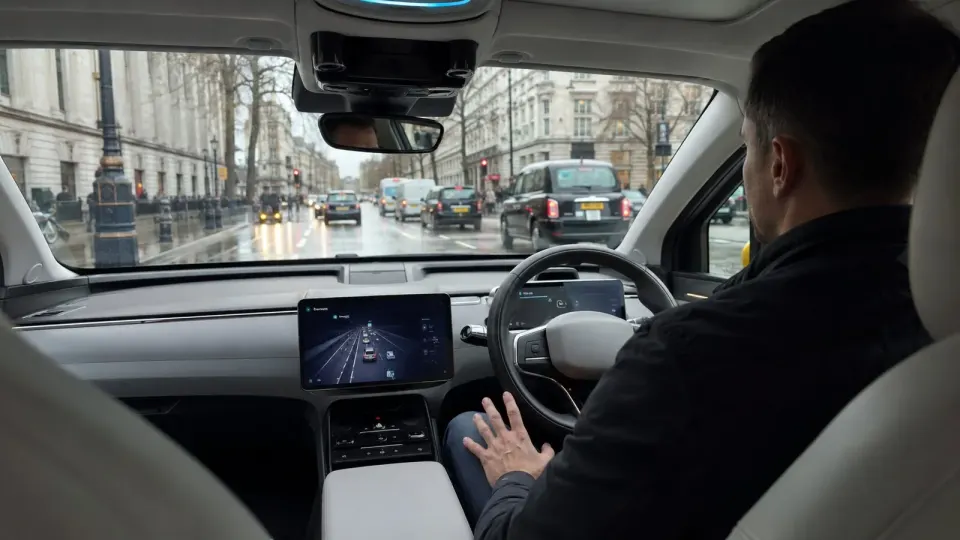
Before the trip starts, the safety driver explains what is happening. The car then handles the driving while the human remains ready to intervene. Passengers can also ask the driver to take over. In other words, the future has arrived wearing a seatbelt, clutching a backup plan and being monitored by someone with the correct licence.
What is the car actually doing?
Wayve’s pitch is that its AI learns to interpret roads in a more human-like way instead of depending entirely on a vast, pre-mapped rulebook for every street. Cameras and other sensors feed the system information about traffic, pedestrians, road markings and the particular London tradition of a delivery rider materialising from nowhere.
The company says the approach can adapt to different cities more easily. London is the second European city where Uber has offered robotaxi rides, following Zagreb.
The difficult test is not whether software can travel down a clear road. It is whether it can deal with buses squeezing through gaps, cyclists filtering beside traffic, roadworks that appear overnight and pedestrians who have decided the green man is merely advisory.
That is why the human remains.
So when does the driver disappear?
Not yet. Britain’s autonomous-vehicle rules are still being put into practice, and fully driverless commercial journeys require further regulatory approval. The government’s framework is intended to create legal responsibility for authorised self-driving vehicles, but approval for a service with no safety driver is not expected immediately.
The first stage is therefore useful but tightly controlled. Every disengagement, awkward junction and confused bit of road furniture can become evidence about how the system behaves in the real city rather than on a demonstration route.
There is also the awkward human question. Robotaxi supporters point to consistent reaction times, freedom from tiredness and the possibility of fewer crashes. Critics want proof that those advantages survive bad weather, strange road layouts and rare situations the software has not encountered. London will supply all three before breakfast.
The OutOut verdict
This is a proper milestone, even with somebody in the front seat. A public service carrying paying passengers is different from a prototype circling a test track.
But nobody should confuse a 15-car supervised launch with London’s drivers receiving their P45s by lunchtime. The technology is being introduced in the most British way possible: cautiously, under observation, and with a qualified adult present in case it gets ideas.
If the system can survive Hyde Park Corner, the Elephant and Castle and a wet Friday evening outside King’s Cross, it may have earned the right to call itself intelligent.