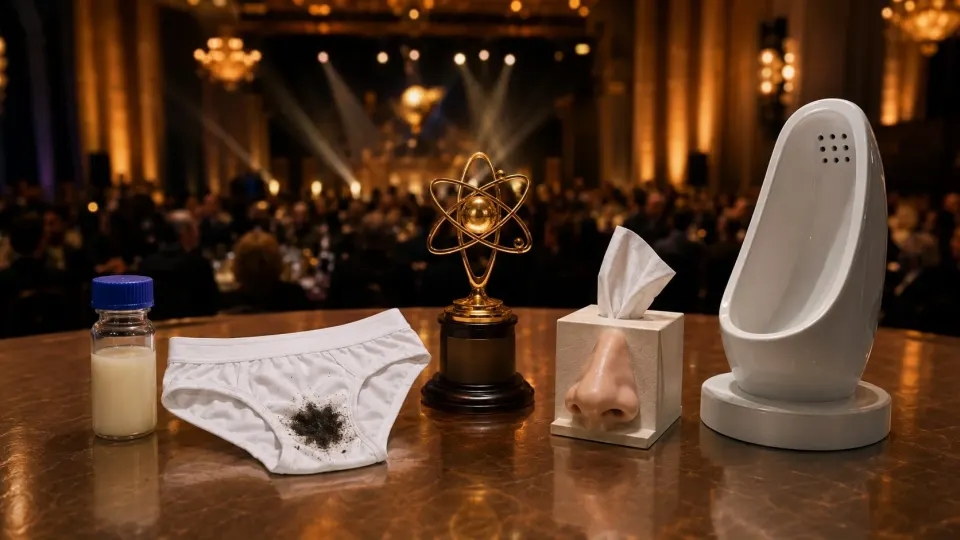
Scientists have spent the year studying cockroach milk, buried underpants, the correct way to blow a nose and how to stop a urinal splashing. Before anybody asks what has happened to civilisation, the answer is: several surprisingly useful things.
The 2026 Ig Nobel prizes honoured ten research teams whose work makes people laugh and then think. The awards are organised by Annals of Improbable Research and celebrate genuine studies with questions unusual enough to make a grant committee reach for a second cup of coffee.
This year’s ceremony took place in Zurich, the first time the event had been hosted outside the United States. Winners received a trophy described as a cross between a mushroom and a human foot, while the audience maintained the traditional supply of paper aeroplanes.
The winners you will immediately tell somebody about
The chemistry prize recognised work on nutrient-rich protein crystals produced by the viviparous cockroach Diploptera punctata. Reports summarised the finding as cockroach milk containing roughly three times the energy of cow’s-milk protein. That does not mean supermarkets are preparing a semi-skimmed insect aisle. Harvesting it at scale would be difficult, and the research was fundamentally about protein structure and nutrition.
The medicine award went posthumously to Japanese researcher Tokuji Unno for a 1970s aerodynamic study of nose-blowing. His work examined pressure and airflow rather than simply advising the public to blow harder until something alarming happens.
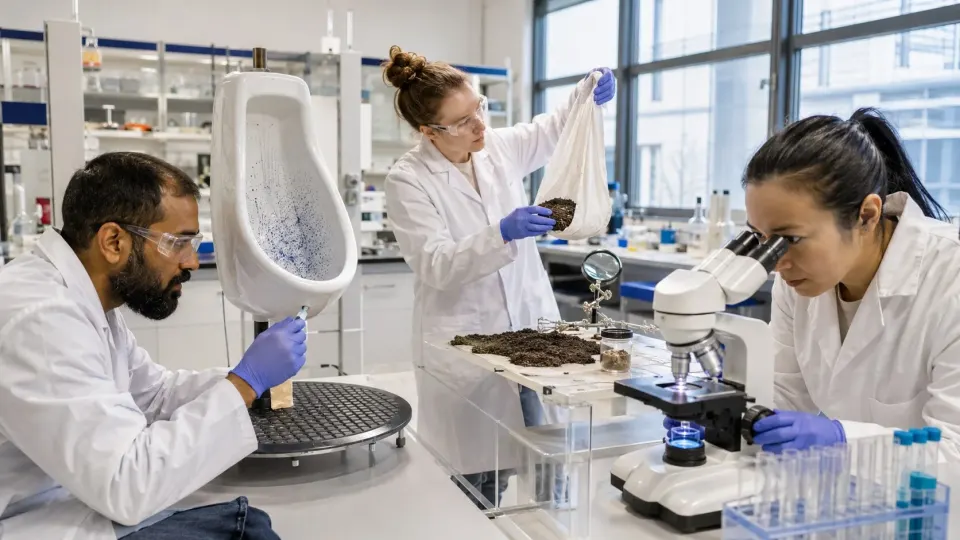
Soil scientists were recognised for an international citizen-science project involving cotton underpants buried in the ground and retrieved later. The degree to which soil organisms had eaten the fabric provided a visible indication of biological activity. It is a soil-health test with the rare advantage that everybody remembers the methodology.
Urinals, mosquitoes and dangerous snakes
The physics prize went to researchers who used fluid dynamics and geometry to design a splash-reducing urinal. This is exactly the sort of problem that sounds trivial until somebody points out how many public toilets exist and how much cleaning, water and discomfort a better design could prevent.
Technology winners repurposed a mosquito’s proboscis — the insect’s needle-like feeding structure — as an extremely fine 3D-printing nozzle. The team called the technique “necroprinting”. It is an ingenious use of biological material and a word guaranteed to make the product demonstration unnecessarily tense.
Biologists were honoured for research into which actions are most likely to prompt venomous snakes to bite. The experiments involved provoking snake defensive behaviour under controlled conditions. The scientific value is clearer guidance about avoiding bites; the occupational conversation begins with “today we need you to step near this angry snake”.
Kissing, social class and smelly teenagers
The biomechanics prize recognised an evolutionary investigation of kissing among apes, Neanderthals and modern humans. The researchers reconstructed how far back the behaviour may extend and concluded that Neanderthals probably kissed.
An economics prize revisited evidence that people who perceived themselves as higher social class were more likely to behave unethically in experiments, including taking sweets intended for children. It is a result designed to make every office sweet jar feel like a live sociology trial.
An olfaction award went to research finding that parents generally rated babies as pleasant-smelling while teenagers performed considerably worse. Parents of teenagers may dispute whether an international research team was strictly necessary.
The peace prize explored the uncomfortable fact that people can prefer friends who are kind to them but formidable — even vicious — toward outsiders. Friendship, it turns out, may contain more strategic calculation than the matching bracelets suggest.
Why silly science is still science
The jokes make the Ig Nobels accessible, but the research questions are not fake. Splash control uses physics. Soil decomposition reflects ecosystems. Nose-blowing involves pressure, anatomy and health. Unusual biological materials can inspire engineering.
Science often advances by examining a small, awkward question properly. Some results become practical tools. Others improve methods or reveal how badly an assumption needed testing. A memorable subject can also bring people into a field they would otherwise ignore.
The OutOut verdict
The 2026 winners have delivered the strongest possible defence of curiosity: if you measure carefully enough, even a pair of pants in a hole can become data.
Not every result will transform daily life. But the next generation of public toilets may splash less, soil testing may become easier to explain and nobody can now claim that science is afraid of the important questions.
Cockroach milk remains optional.